

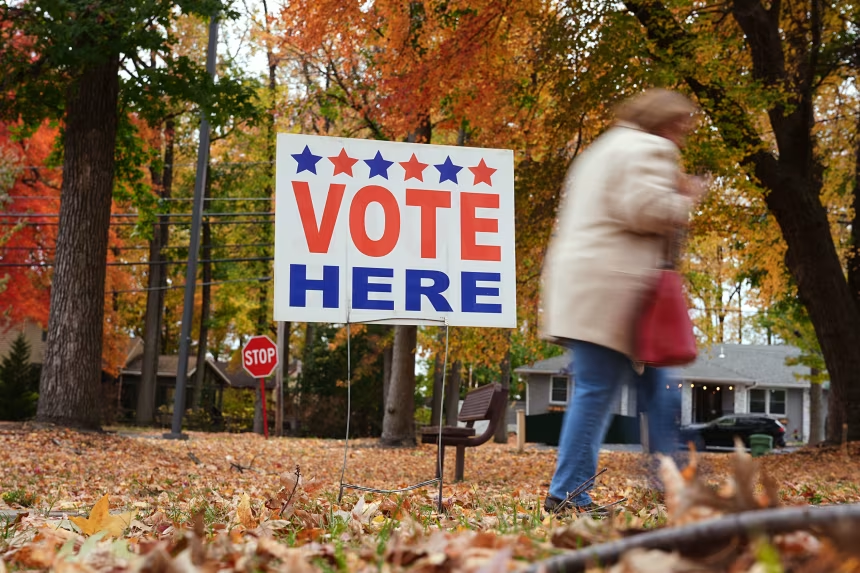
A federal judge has ruled that President Donald Trump cannot require Americans to provide proof of citizenship when registering to vote using the federal form.
US District Judge Colleen Kollar-Kotelly in Washington, DC, sided with Democratic and civil rights groups that challenged Trump’s March executive order aiming to change federal election procedures. The judge said the proposed proof-of-citizenship requirement violates the Constitution and exceeds presidential authority.
“Because our Constitution assigns responsibility for election regulation to the States and to Congress, the President lacks the authority to direct such changes,” Kollar-Kotelly wrote in her opinion. She added that the Constitution does not give the President a direct role in setting voting qualifications or federal election rules.
The ruling grants a partial summary judgment for the plaintiffs, permanently preventing the US Election Assistance Commission from adding the citizenship documentation requirement to the federal voter form. The decision follows a previous preliminary injunction that also blocked the mandate.
Sophia Lin Lakin of the ACLU, one of the case’s plaintiffs, described the decision as “a clear victory for our democracy. President Trump’s attempt to impose a documentary proof of citizenship requirement on the federal voter registration form is an unconstitutional power grab.”
The White House did not immediately respond to requests for comment.
Efforts to enforce documentary proof-of-citizenship rules have faced repeated challenges. Republicans have made the mandate a priority, but attempts at the federal and state levels have often stalled. A citizenship requirement passed by the US House last year has yet to advance in the Senate, while similar state-level measures have faced legal hurdles.
When implemented at the state level, these rules have caused confusion and barriers for voters. Married women who changed their names, for instance, may need to provide birth and marriage certificates alongside state IDs. Problems were reported in New Hampshire earlier this year when proof-of-citizenship requirements were applied for the first time in local elections.
Kansas experienced similar issues during the three years it enforced such a requirement. Roughly 30,000 eligible voters were blocked from registering, leading to the policy’s overturn in federal court. Studies show that voting by noncitizens remains extremely rare.
The DNC and civil rights groups will continue their lawsuit to challenge other parts of Trump’s executive order. One ongoing issue is the requirement that mailed ballots be received, not just postmarked, by Election Day.
Additional lawsuits have also emerged. In April, 19 Democratic state attorneys general asked a federal court to reject Trump’s order. Washington and Oregon, where almost all votes are cast by mail, filed a separate legal challenge.
The rulings reflect broader debates over presidential authority and state control of elections. Experts note that election regulation is primarily a state responsibility, and federal intervention is limited unless Congress acts. Judge Kollar-Kotelly’s decision reinforces the principle that changes to voting rules must follow constitutional guidelines. The ruling marks a major legal setback for the Trump administration’s efforts to impose new federal voter restrictions.