

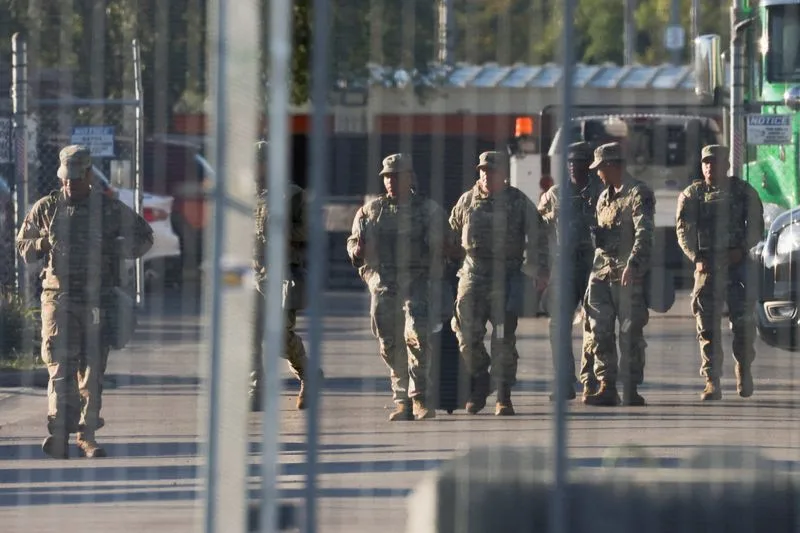
The U.S. Supreme Court has temporarily blocked President Donald Trump from deploying National Guard troops to the Chicago area, marking a rare setback for the administration at the high court. The ruling allows a lower court order to stand that prevents hundreds of troops from being stationed in Illinois while a legal challenge continues.
The Justice Department had requested the Supreme Court to allow the deployment during ongoing litigation, but the justices said that at this preliminary stage, the government failed to identify legal authority allowing the military to enforce federal laws in Illinois. The court noted that presidential control of National Guard troops likely applies only in “exceptional” circumstances.
Three conservative justices—Samuel Alito, Clarence Thomas, and Neil Gorsuch—dissented from the decision.
White House spokeswoman Abigail Jackson defended the president’s policy, saying Trump remains committed to enforcing immigration laws and protecting federal personnel.
Illinois Governor JB Pritzker called the Supreme Court decision “an important step in curbing the Trump Administration’s consistent abuse of power and slowing Trump’s march toward authoritarianism.”
The case centers on Trump’s efforts to expand the use of the military in Democratic-led cities. The administration has deployed troops to Chicago, Portland, Los Angeles, Memphis, and Washington, D.C., citing the need to protect federal property, including U.S. Immigration and Customs Enforcement facilities. Critics argue the deployments are politically motivated and an abuse of presidential authority.
Federal judges have expressed skepticism about the administration’s claims of violent protests. Chicago officials described the demonstrations as limited in size, largely peaceful, and manageable by local law enforcement, contradicting Trump’s description of “war zone” conditions.
The legal challenge was filed after Trump federalized 300 Illinois National Guard troops and ordered additional forces from Texas into the state. A Chicago federal judge, April Perry, temporarily blocked the deployment in October, noting there was no evidence of rebellion or law enforcement incapacity. Perry argued that the National Guard deployment “would only add fuel to the fire.”
A three-judge panel of the 7th U.S. Circuit Court of Appeals later upheld Perry’s order, stating that the facts did not justify the president’s actions. Two of the three judges on the panel were appointed by Republican presidents, including one by Trump himself.
The administration argued that local officials’ assessments of protests were “implausibly rosy” and that federal agents operated under constant threat of violence. Lawyers for Illinois and Chicago countered that local authorities have fully managed any disruptions and ensured the Broadview facility continues to operate.
Similar legal challenges are ongoing in Portland, Oregon, where a federal judge permanently blocked troop deployment in November. The Trump administration has appealed that ruling.
The dispute highlights the limits of presidential authority in domestic military deployments. Judge Perry noted that “regular forces” refers to active military personnel, not National Guard members, and the administration did not attempt to rely on regular forces before federalizing the Guard. Other legal constraints also limit military use for domestic law enforcement purposes.
The Supreme Court’s decision is a rare restriction on Trump’s broad assertions of power, as the court has generally sided with the administration in most cases since his return to the White House. The ruling ensures that the legal and constitutional boundaries of deploying troops within U.S. cities remain under scrutiny.