

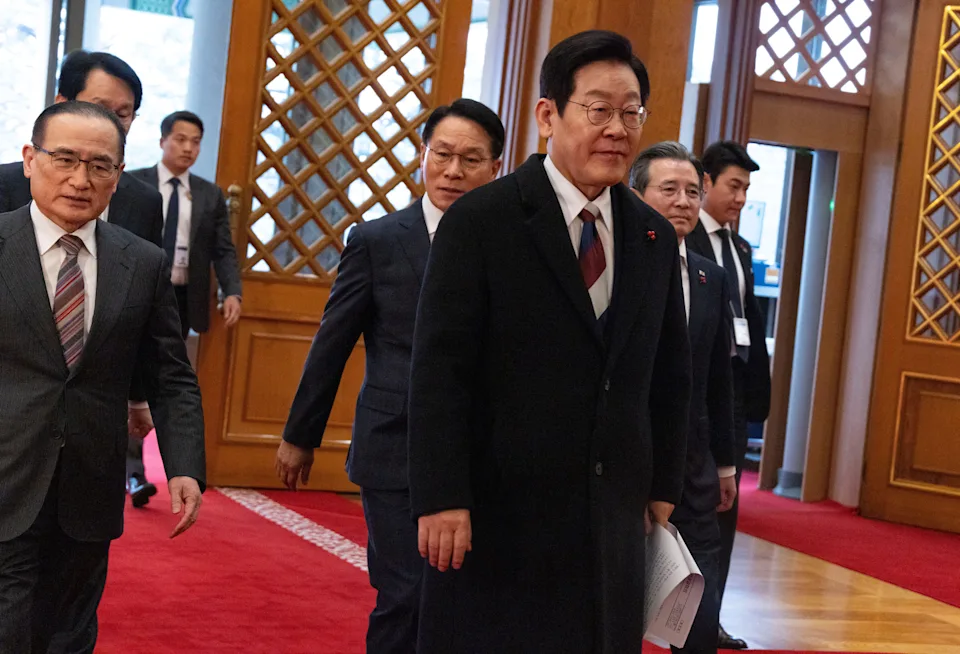
South Korean President Lee Jae Myung on Monday visited Cheong Wa Dae, the country’s traditional presidential palace, for the first time since taking office in June. This marks a return to the Blue House more than three years after former President Yoon Suk Yeol moved the presidential office to the Defense Ministry compound.
Lee assumed office following a snap election in June after Yoon was removed over a brief declaration of martial law in December 2024. Since then, Lee has overseen the relocation of the presidential office back to Cheong Wa Dae, aiming to reverse the legacy of his jailed predecessor.
Cheong Wa Dae, located on the lower slopes of a mountain in northern Seoul, covers about 250,000 square meters (62 acres) behind the historic Gyeongbokgung Palace. It has been the primary presidential office since South Korea’s independence from Japanese rule following World War II, undergoing multiple renovations over the decades.
Yoon, arguing that Cheong Wa Dae was too isolated from the public, spent roughly $40 million moving the office to the Defense Ministry compound in central Seoul. He claimed the move would make his presidency more democratic while opening parts of the Blue House to the public as a tourist site, which attracted millions of visitors.
The former conservative president later triggered a major democratic crisis on December 3, 2024, when he briefly declared martial law amid a standoff with Lee’s liberal Democratic Party. The legislature quickly ended the measure, but Yoon was impeached, removed from office by a Constitutional Court ruling in April, and re-arrested in July. He now faces criminal charges, including rebellion, which carry severe penalties.
Ahead of Lee’s commute, officials raised a presidential flag featuring two phoenixes at Cheong Wa Dae at midnight, symbolizing the palace’s return as the official office. Guards saluted as Lee’s motorcade passed the gates, while dozens of supporters waved South Korean flags and chanted his name. A video released by Lee’s office showed him holding a tea meeting with senior aides in one of the palace’s rooms.
Lee will continue commuting from the current presidential residence in another part of Seoul until the full office relocation to Cheong Wa Dae is completed at a later, unspecified date.
This move signals a symbolic restoration of South Korea’s presidential traditions and underscores Lee’s intention to assert authority and stability after the turmoil of the previous administration.