

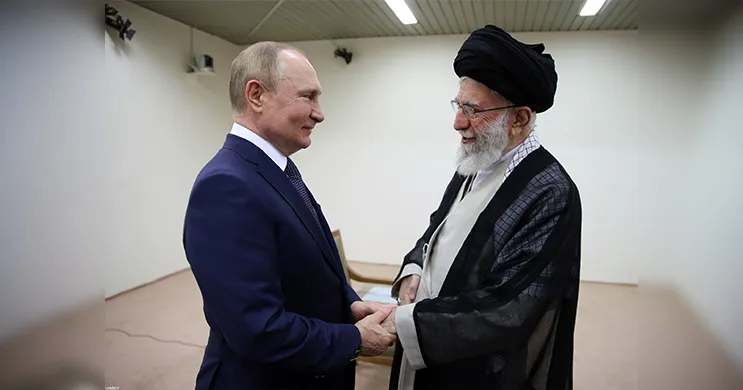
Iran’s recent nationwide protests are more than a domestic uprising—they are part of a high-stakes geopolitical struggle. While the United States and Israel appeared to support anti-government demonstrations, Russia stepped in to strengthen Iran’s hold on power. The result: Ayatollah Khamenei’s regime survived, and Moscow-Iran ties grew stronger.
Russian President Vladimir Putin provided crucial support to Iran, both diplomatically and technologically. Western nations, including the U.S., had aimed to pressure Tehran, but Russia’s timely interventions countered those efforts. Russian expertise supplied Iran with advanced tools for monitoring and controlling dissent, effectively neutralizing Western strategies.
The two nations’ relationship has expanded beyond traditional strategic cooperation. Russian support in Ukraine, where Iranian military assistance proved critical, laid the foundation for a deeper alliance. In Iran, Russian technology has become a central part of the regime’s approach to suppress protests. Tools like internet censorship, social media tracking, and facial recognition, provided by Russian intelligence, have allowed authorities to monitor and disrupt protest activities.
Russia’s help extended to cybersecurity. Iranian government websites were protected against hacking, and electronic warfare systems disrupted satellite internet services that protesters might rely on. These measures limited communication among demonstrators and prevented coordination. Experts describe the intervention as part of Russia’s broader approach to counter what it sees as “color revolutions,” based on experiences in Ukraine, Georgia, and Iran’s own Green Movement of 2009.
The stakes for Russia were high. If Khamenei’s government had fallen, Moscow would have lost a key ally in the Middle East. Over the past decade, the two countries have built not only a military partnership but also an intelligence-sharing framework. Iran now relies on Russia as a protective ally, while providing military supplies and strategic support in return.
Russian intervention ensured that Iran could respond efficiently to protests, using technology and strategy to maintain order. Surveillance systems helped identify protest leaders and track activities, while cyber support protected the regime’s communications infrastructure. Russian-backed measures proved decisive in controlling the demonstrations and preventing widespread disruption.
This episode demonstrates Russia’s growing influence in Iran and the broader Middle East. By helping Khamenei’s government withstand internal unrest, Moscow strengthened its strategic position and ensured continued cooperation with a key regional partner. Iran’s survival amidst intense protests underscores the effectiveness of this alliance, which combines military aid, intelligence sharing, and cyber capabilities.
The partnership between Russia and Iran highlights a significant shift in regional geopolitics. While Western powers apply pressure, Moscow’s interventions have preserved the Iranian regime and created a closer alignment between the two nations. The developments show how international support and modern technology can reshape the outcome of domestic unrest, reinforcing authoritarian control in the region.
Russia Supports Iran Protests illustrates how global geopolitics influence domestic crises. In this case, Russian assistance was pivotal in safeguarding Iran’s leadership and fostering an alliance that now extends across intelligence, military, and cybersecurity domains. The intervention marks a critical moment in the evolving Russia-Iran partnership.