


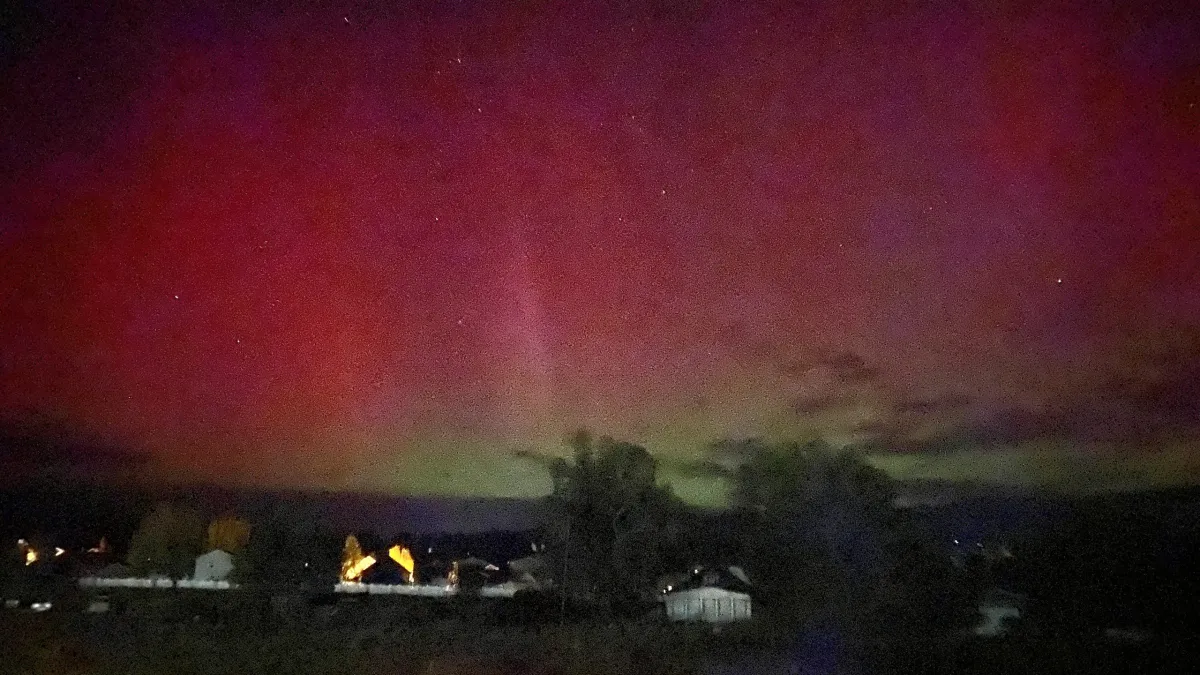
The Colorado Northern Lights may return to the night sky on Monday, offering residents another rare opportunity to see the colorful Aurora Borealis. Forecasts suggest the best time to look will be early in the evening, shortly after sunset, with views directed toward the northern horizon.
Space weather experts say the aurora could be visible across Canada and much of the northern United States. In some cases, the glowing lights may reach farther south than usual. This increased visibility follows a strong disturbance in Earth’s magnetic field, which is linked to heightened solar activity.
In Colorado, specialists predict the ideal viewing window will be just after sunset, around 5:30 p.m. Clear skies and low light pollution will improve the chances of seeing the display. Observers are encouraged to find a dark area away from city lights and allow their eyes time to adjust.
The forecast comes from the national center that monitors space weather. According to officials, the region is currently experiencing an intense geomagnetic storm combined with elevated solar radiation levels. These conditions create the perfect environment for bright auroras to form.
Solar storms begin on the surface of the sun. Powerful bursts of energy, often called solar flares or coronal mass ejections, send charged particles toward Earth. When these particles reach the planet, they interact with Earth’s magnetic field. This interaction causes energy to travel toward the poles, where it excites gases in the upper atmosphere. The result is the glowing ribbons of light known as the Northern Lights.
While auroras are beautiful, geomagnetic storms can also have side effects. Scientists say strong storms may disrupt satellite operations, GPS signals, and some communication systems. Power grids can also be affected in rare cases. Experts are closely monitoring the current storm, though no major disruptions are expected at this time.
Officials say the storm is expected to remain active through Monday night and may begin to weaken sometime on Tuesday. Even as the intensity fades, smaller bursts of activity could still create visible auroras, depending on local conditions and cloud cover.
This is not the first time in recent months that unusual auroras have appeared far from the poles. In November, strong solar storms produced vivid light displays across parts of Europe, including areas rarely known for auroras. In the United States, people reported seeing the lights as far south as Kansas, Texas, and Colorado.
Colorado residents also caught glimpses of the aurora earlier in October 2024. These events marked a noticeable increase in solar activity compared to previous years. Scientists say the sun is currently near the peak of its natural activity cycle, which lasts about 11 years. During this phase, solar storms and auroras become more frequent and intense.
Despite the strength of the current solar radiation storm, experts say there is no immediate danger to people on the ground. Astronauts aboard the International Space Station are also not at risk, according to space weather officials. Protective systems and monitoring help ensure their safety during such events.
The intensity of this storm is notable. Scientists say storms of this level have not been seen in more than twenty years. This makes the current aurora opportunity especially rare for states like Colorado, where sightings are uncommon under normal conditions.
Those hoping to view the Colorado Northern Lights should act quickly. Auroras can change rapidly, and visibility may last only minutes or a short window of time. Checking local weather forecasts for cloud cover and heading to higher ground may help improve the view.
Experts also remind the public that auroras are unpredictable. Even with strong forecasts, there is no guarantee the lights will appear in every location. Still, the current conditions offer one of the best chances in years.
For many, the Northern Lights are more than a weather event. They are a reminder of Earth’s connection to the sun and the powerful forces at work in space. If skies remain clear, Monday night could bring a memorable and colorful show to Colorado’s northern skies.