


Missouri’s budget received a small boost this week with the discovery of a $250 million error in state projections, but officials emphasized that tight spending controls remain necessary.
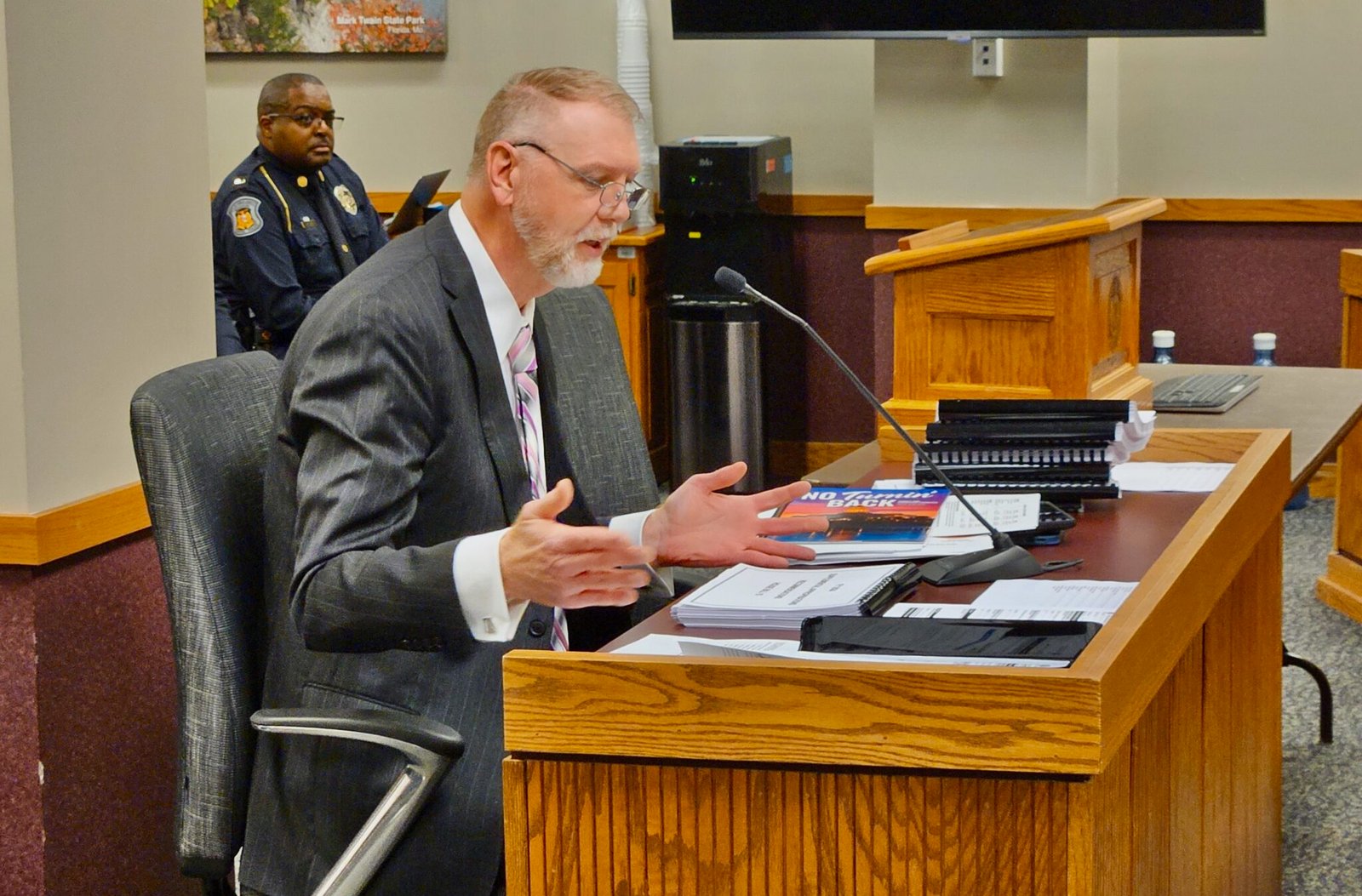
State Budget Director Dan Haug told the House Budget Committee that more than $100 million in disaster relief funds had been mistakenly counted in both this year’s and next year’s budgets. Correcting the error increases the projected ending balance for the coming fiscal year from $4.7 million to $261 million.
Although the adjustment improves the bottom line, Haug said it does not change the state’s core fiscal challenge: ongoing expenditures still exceed ongoing revenues. “It doesn’t change either of those two numbers,” he said.
Missouri’s general revenue fund held $4.3 billion on June 30, 2025, down from a record $5.7 billion at the end of fiscal 2023. Lawmakers have spent more than tax revenue has generated over the past two years, contributing to a tighter fiscal picture.
The current budget continues this trend. With supplemental items requested by Gov. Mike Kehoe, Missouri plans to spend $16.2 billion in general revenue this year, about $3.1 billion more than projected revenue. The governor’s office expects $2 billion to remain in the fund by June 30.
For fiscal year 2027, Kehoe’s budget proposes $16.3 billion in appropriations, with projected revenues of $13.6 billion. The newly discovered $250 million provides some cushion for existing obligations but does not allow for additional spending beyond the governor’s plan.
“It didn’t change anything, because really, $4 million wasn’t a good place to be,” said House Budget Committee Chairman Dirk Deaton, a Republican from Noel. He said the final fund balance will depend on how quickly $1.3 billion in multi-year construction projects are completed and how accurate operating budget estimates are.
Last year, more than $900 million set aside for state operations went unspent. The current budget assumes only $350 million will be unspent next year, and those funds are used to balance revenues and spending.
Deaton said the revised forecast is reasonable and open to debate but not far off from reality. “I could come up with one a little different, and reasonable people could probably argue about it,” he said.
The updated forecast gives Democrats an opportunity to push for additional spending priorities. State Rep. Betsy Fogle of Springfield, the ranking Democrat on the House Budget Committee, noted that the state Board of Education requested a $190 million increase to the foundation formula, which Kehoe did not recommend.
“What that changes is the governor signaled that he was comfortable spending down to $4.7 million, and I find it somewhat ironic that now he’s saying he needs to keep this additional $260 million on the bottom line as well, when there are things that I would argue we could be doing,” Fogle said.
Republican leaders, who control all statewide offices and hold a legislative supermajority, have long argued the state should save for lean times. However, with the budget still tight, Fogle said there is no room to defer cuts. Kehoe’s plan requires limiting nearly $300 million in spending to maintain the projected $261 million balance.
Both Kehoe and Haug have stressed that there is no appetite to increase spending beyond the governor’s original recommendations. “It has been made clear by both the State of the State (address) and director Haug’s comments today that there’s absolutely no appetite to add any spending,” Fogle said.
While the $250 million adjustment provides a temporary boost, Missouri lawmakers face ongoing challenges balancing spending with projected revenues. Officials warn that fiscal discipline will remain necessary to ensure the state meets obligations and maintains a stable budget in the coming years.