


The United Kingdom has approved China’s plan to build its largest embassy in Europe at London’s Royal Mint Court, just days before Prime Minister Keir Starmer is scheduled to visit Beijing. The decision, announced on January 20, 2026, immediately drew criticism from residents, human rights groups, and political commentators concerned about national security and foreign influence.
The proposed complex, covering 55,000 square meters, would surpass the U.S. embassy in London and become China’s largest diplomatic facility in Europe. China purchased the historic Royal Mint Court site in 2018 for £255 million. The area, which dates back to the 14th century and once hosted Isaac Newton’s work on the gold standard, sits near the Tower of London between two major financial hubs.
Chinese democracy activist Sheng Xue warned that the approval carries serious risks. She described the embassy as more than a diplomatic mission, calling it a potential “forward operating base” for political influence and intelligence operations. Sheng noted that MI5 has repeatedly warned about Chinese interference in British politics, academia, business, and the Chinese diaspora. She argued that expanding China’s presence in London could magnify these risks and undermine national security.
Sheng also highlighted the moral implications, pointing to evidence of human rights abuses in China, including forced organ harvesting documented by the China Tribunal. She said the UK government’s decision may weaken support for persecuted communities such as Hong Kong democrats, Uyghurs, and Falun Gong practitioners.
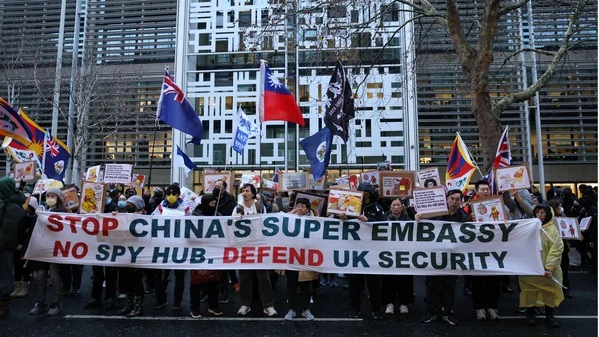
The embassy proposal has been controversial since 2020. Tower Hamlets Council rejected it in 2022, but under the Labour government, approval authority shifted to the national level. London police withdrew their objections in 2025. The announcement follows mass protests in London, including demonstrations in February and March that drew thousands of participants advocating for Hong Kong, Tibet, and Uyghur rights.
Political commentators say the timing of the approval, just before Starmer’s trip to China, may reflect a political concession. Sheng noted that the decision comes despite cross-party opposition, security warnings, and public protests. Veteran commentator Zhang Tianliang warned that the UK’s move reflects a broader Western trend of economic and political reliance on Beijing, which could weaken Europe’s strategic independence.
Critics have raised concerns about the site itself. Royal Mint Court sits atop major communications infrastructure linking the City of London and Canary Wharf. Observers fear the complex could become a hub for intelligence gathering and underground surveillance. Former U.S. President Donald Trump publicly warned in June 2025 that U.S.–UK intelligence sharing could be affected if the project proceeded. MI5 has repeatedly flagged CCP interference, and the dropping of charges against alleged Chinese spies last November intensified criticism.
UK Housing Secretary Steve Reed approved the plan with conditions on security and heritage preservation. Supporters of the embassy see it as a pragmatic trade-off to encourage Chinese investment, including a £600 million pledge secured by the Labour government in 2025. However, opponents, including Conservatives, Liberal Democrats, human rights groups, and local residents, say it is a misstep that endangers national security, public safety, and democratic values. Residents have indicated they will pursue a judicial review.
The Royal Mint Court approval symbolizes a historic shift in UK-China relations. From past conflicts like the Opium Wars to modern tensions over Hong Kong, Huawei, and human rights, critics say allowing a mega-embassy in London signals an alarming tilt toward Beijing.