



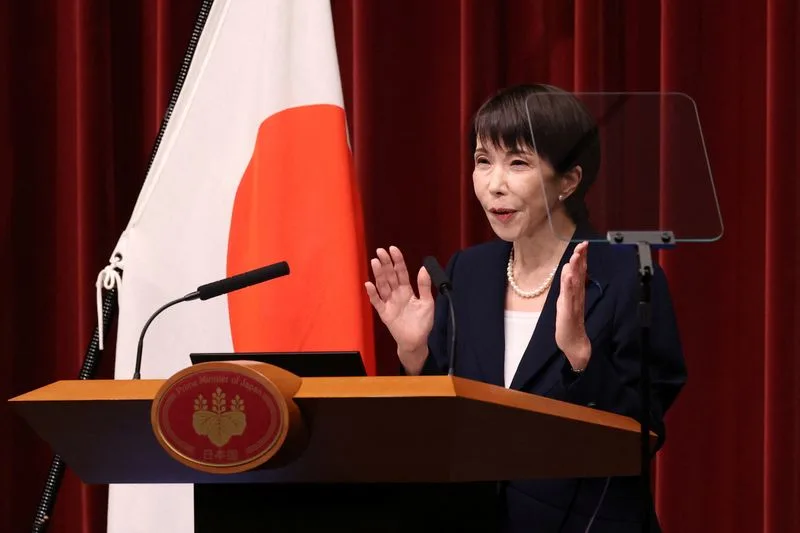
Japanese Prime Minister Sanae Takaichi’s public approval rating has declined ahead of the national election scheduled for next month. The drop reflects growing voter skepticism about her handling of Japan’s economy and her proposed stimulus measures.
A Nikkei newspaper survey released Monday showed support for Takaichi’s administration at 67%, down from 75% in December. This marks the first time her approval has fallen below 70% since she became Japan’s first female prime minister in October.
Other polls confirm the downward trend. A Kyodo voter survey reported a decline to 63% from 68%, while a Mainichi newspaper poll found support fell ten points to 57%.
Takaichi has called a snap vote for all 465 lower-house seats. She hopes to convert her personal popularity into support for her expansionary fiscal policies and strengthen her control over the ruling Liberal Democratic Party (LDP). The LDP and coalition partner Japan Innovation Party (Ishin) currently hold a narrow one-seat majority in the chamber.
However, the polling indicates that voters are skeptical of her economic plans. In the Nikkei survey, 56% of respondents said they do not believe Takaichi’s stimulus package will ease the rising cost of living. Concerns that Japan may need to issue additional debt to fund the measures have also pushed up government bond yields.
Critics have questioned Takaichi’s decision to hold an election before lawmakers approve the record $793 billion national budget. In the Mainichi survey, 40% of respondents disapproved of the timing, compared with fewer than one-third who approved.
Despite her personal popularity, Takaichi faces challenges in translating it into party support. Recent polls show the LDP trailing at around 30%, significantly below her own approval levels.
The prime minister has also lost support from the centrist Komeito party, which ended its 26-year alliance with the LDP last year. Komeito has aligned with the main opposition, the Constitutional Democratic Party of Japan, weakening the LDP’s position in several urban constituencies.
Analysts say the election outcome will depend on whether Takaichi can leverage her personal approval to boost overall party support. Tobias Harris, founder of political risk advisory firm Japan Foresight, described the upcoming vote as “the most unpredictable election in years.”
Harris added that backbenchers in the LDP are aware that their political future may hinge on Takaichi’s performance in the election, placing significant pressure on the party’s leadership.
The February 8 election will be closely watched for its implications on Japan’s economic policy and political balance. Takaichi’s challenge will be to turn her personal popularity into meaningful gains for the LDP, amid voter uncertainty over her stimulus program and the broader direction of the government.