

US President Donald Trump has praised recent developments in Syria following a military offensive by Syrian government forces against the Kurdish-led Syrian Democratic Forces. The comments mark a clear shift in tone from Washington after years of US support for the SDF.
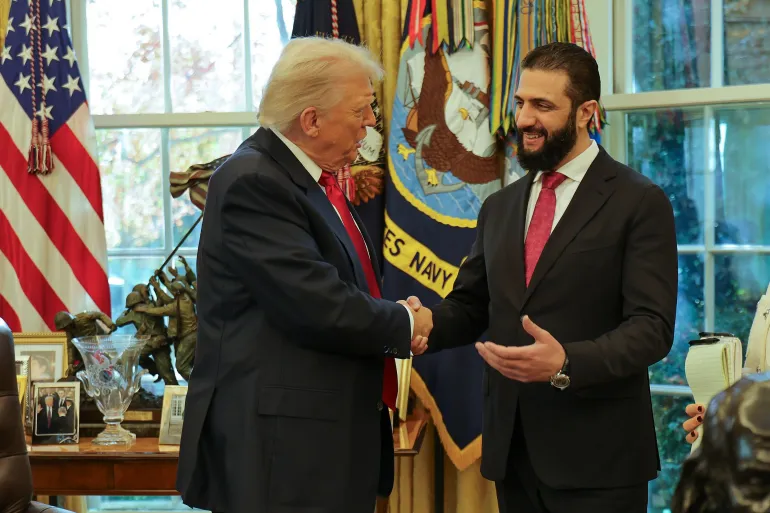
Trump spoke after holding a phone call with Syrian President Ahmed al-Sharaa. The call took place shortly before al-Sharaa left Damascus for Moscow, where he is scheduled to meet Russian President Vladimir Putin. According to Trump, the situation in Syria is moving in a positive direction.
Speaking to reporters, the US president said he was pleased with how events were unfolding. He described his conversation with the Syrian leader as productive and said the developments related to Syria and the wider region were encouraging. Trump added that the outcome was working out well for all sides involved.
The Syrian presidency later released a statement outlining the key points raised during the call. According to the statement, President al-Sharaa stressed Syria’s firm commitment to preserving its territorial integrity and national sovereignty. He also underlined the government’s intention to protect state institutions and maintain civil peace across the country.
Al-Sharaa further highlighted the need for coordinated international efforts to prevent the return of extremist groups. The Syrian leader pointed to the continued threat posed by ISIL and similar groups, saying cooperation remained vital to ensure long-term security and stability.
Trump later expanded on his remarks during an interview with Fox News. He claimed that he and US Secretary of State Marco Rubio had resolved a major issue related to Syria. However, he did not provide specific details about what had been agreed or how it would affect future US policy in the region.
The comments followed a significant development on the ground. On January 18, the Syrian Democratic Forces announced that their fighters had withdrawn from the northeastern cities of Raqqa and Deir Az Zor. The move came after a sustained offensive by the Syrian army. Reactions among local residents were mixed, with some welcoming the change and others expressing deep concern about their future.
For years, the SDF had been a key US partner in the fight against ISIL. Backed by American forces, the group played a central role in pushing the armed group out of large parts of Syria. However, Washington’s position has shifted as the Syrian government has expanded its control.
Last week, US Special Envoy for Syria Tom Barrack said the role of the Kurdish-led forces as the main anti-ISIL group had largely ended. He explained that the Syrian government was now assuming primary responsibility for security across the country. Barrack also noted that Syria’s political and security landscape had fundamentally changed.
As part of this shift, Damascus joined the Global Coalition to Defeat ISIL as its 90th member in late 2025. The move signaled a new phase in Syria’s engagement with international efforts to combat terrorism and stabilize the region.
Washington’s changing stance initially caused unease within Trump’s own party. Senator Lindsey Graham was among those who questioned the policy shift and suggested that sanctions should be reimposed on Syria in response to the offensive against the SDF. At the time, he warned that abandoning Kurdish allies could have serious consequences.
However, Graham has since softened his position. He later credited Trump with helping restore stability in Syria and said the administration’s approach had delivered results. The remarks suggest growing acceptance within Republican ranks of the new US policy direction.
Meanwhile, Russia is preparing to deepen its engagement with Damascus. The Kremlin confirmed that President Putin will meet al-Sharaa in Moscow on Wednesday. Russian officials said the talks would focus on bilateral relations and the broader situation in the Middle East.
The meeting is expected to cover political, security, and economic cooperation, as well as regional developments following the Syrian army’s recent advances. Together, these events highlight a rapidly changing balance of power in Syria, as international players adjust to new realities on the ground.