


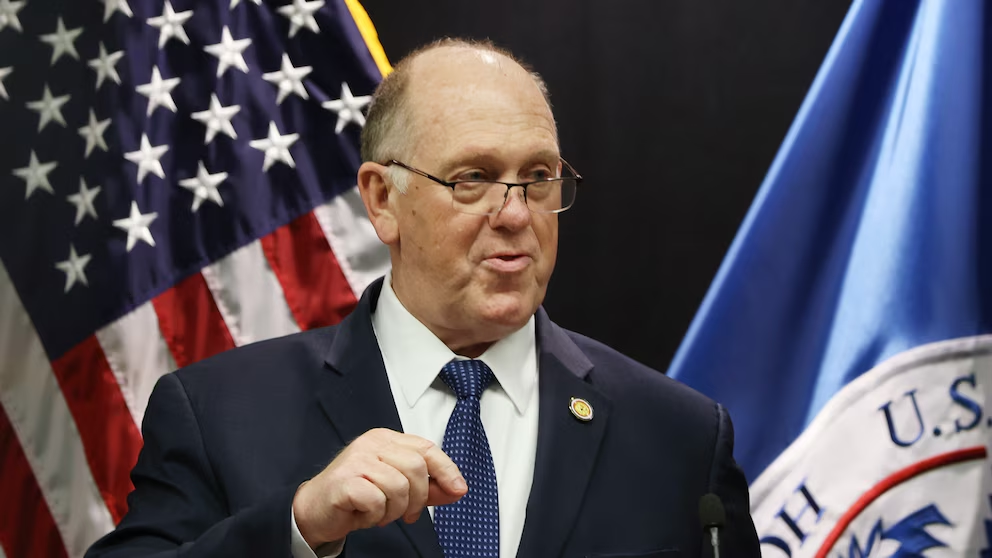
Tom Homan, the White House “border czar,” clarified his role in Minneapolis, pushing back against claims that President Donald Trump was scaling back immigration enforcement in Minnesota. In his first interview since arriving in the state, Homan told Fox News host Sean Hannity that reports suggesting a pullback on mass deportations are false.
“If anybody thinks that Tom Homan, if President Trump, isn’t serious about immigration enforcement and having a mass deportation, then they weren’t paying attention,” Homan said. He emphasized that his mission is focused on reducing unrest in Minnesota while maintaining federal enforcement priorities.
Trump sent Homan to Minneapolis this week to replace Border Patrol commander Greg Bovino, whose approach the president said did not meet expectations. Trump praised Bovino as “very good” but said his style was sometimes “out-there” and that a change in leadership was needed for the current situation. Homan, by contrast, has experience coordinating with governors and mayors, making him a “tough guy” who works effectively with local leaders.
Homan detailed a meeting with Minnesota Gov. Tim Walz and Minneapolis Mayor Jacob Frey, during which the officials agreed to honor federal immigration detainers in local jails. This means federal officers can arrest targets inside prison facilities rather than searching for them on city streets. “The more agents we have in the jails, the rest of these people in the safety and security of a jail, it’s safer for the officer, safer for the alien, safer for the community,” Homan explained.
The strategy aims to reduce the need for large federal operations in neighborhoods, which have sparked protests and unrest. Homan said one agent in a jail can replace the work of a larger team in the community. This approach, he noted, could allow federal authorities to decrease the number of agents deployed in Minnesota while maintaining enforcement effectiveness.
Despite his focus on easing tensions, Homan made clear that Trump’s immigration enforcement policies remain unchanged. “We’re going to have a mass deportation, but we’re going to prioritize the arrest of criminals and public safety threats,” he said. Homan stressed that anyone residing illegally in the U.S. remains a target for removal.
Federal operations in Minneapolis have drawn public criticism, particularly following the fatal shootings of Renee Good and Alex Pretti by Border Patrol agents. Homan acknowledged the challenges of operating amid protests and heightened scrutiny, emphasizing that federal officers require additional security in public operations. “One agent can arrest a bad guy in jail rather than sending a whole team to the community,” he said.
Homan’s approach reflects a balance between federal enforcement goals and local cooperation. By using jails for targeted arrests, the number of federal agents visible in neighborhoods can be reduced, potentially lowering tensions and the risk of confrontation. He said ongoing cooperation with state and city leaders will determine whether the federal presence in Minnesota can be scaled back further.
While focusing on operational efficiency and public safety, Homan reaffirmed that Trump’s administration will continue to identify and deport undocumented immigrants. “If you’re in a country illegally, you’re not off the table. We’ll find you, too, and deport you, too,” he said, underscoring the administration’s commitment to strict immigration enforcement.