


Over the weekend, Turin erupted in violent clashes as anarchist and far-left groups confronted police during a protest linked to the Askatasuna social center. Authorities reported that 108 officers were injured as demonstrators attacked with Molotov cocktails, stones, and makeshift weapons.
According to Daljoog News analysis, the unrest is tied to decades-long far-left activism in Italy, with the recent eviction of Askatasuna acting as a catalyst for coordinated demonstrations. Observers note that these groups often form broad coalitions that include anarchists, pro-Palestinian activists, and other radical factions.
The incident comes amid heightened political tension under Prime Minister Giorgia Meloni’s government, which has taken a hard line against anti-state violence. Analysts say the riots reflect both Italy’s historical militant left-wing movements and the challenges facing authorities in maintaining public order.
What Happened?
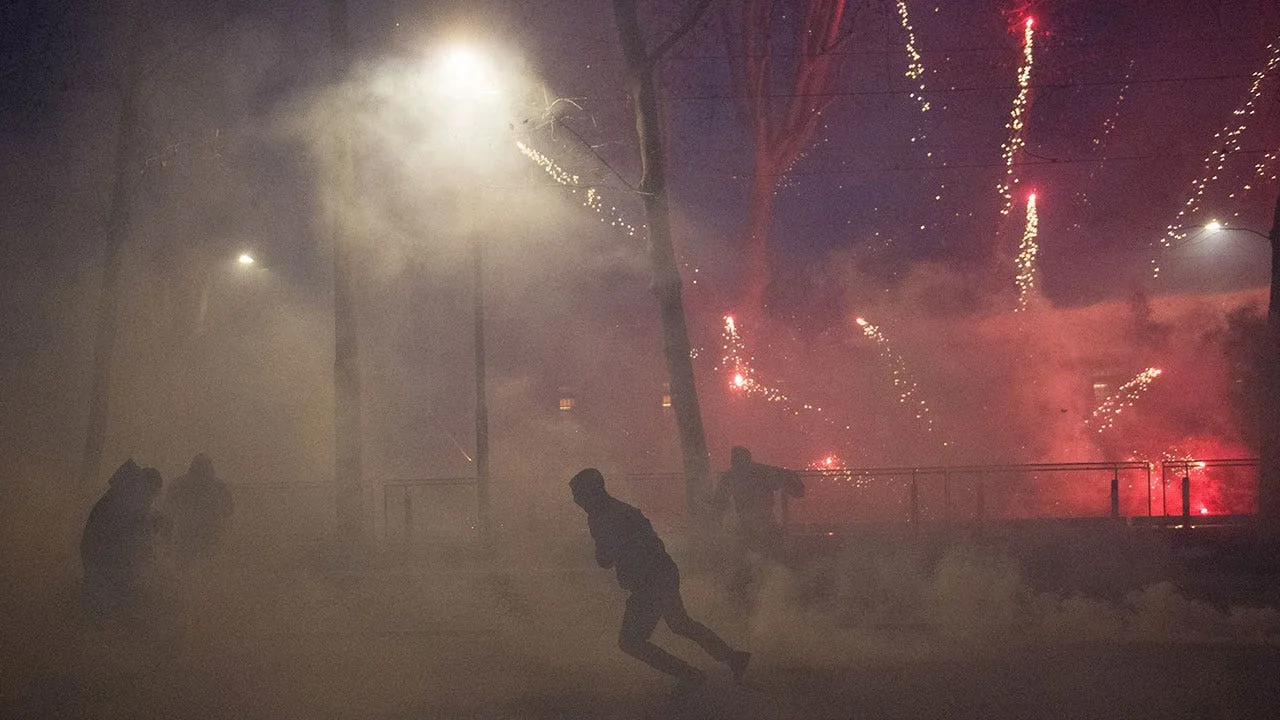
The violence unfolded after a march in support of the Askatasuna social center, which was recently evicted by authorities. Footage from the protest shows demonstrators dressed in black confronting police, throwing bottles, stones, and homemade incendiary devices. Riot police were forced to retreat in several areas as fires broke out, including a police armored vehicle set ablaze.
Images captured during the clashes showed officers engulfed in red smoke, while street furniture and uprooted lampposts were reportedly used as weapons. Authorities confirmed that 108 police personnel were injured during the unrest, marking one of the most violent episodes in Turin in recent years.
The Askatasuna building had been occupied for decades by far-left activists, making it a symbolic center for Italy’s anarchist and communist networks. Experts describe the eviction as a trigger for the coordinated street response.
Why This Matters
The Turin riots highlight a persistent challenge for Italy: managing deeply entrenched radical left-wing groups in urban centers. Such violent protests not only endanger law enforcement but also disrupt daily life for residents and threaten Italy’s broader sense of security.
Prime Minister Meloni’s government faces pressure to demonstrate control over public order while balancing civil liberties. The scale and organization of the unrest underscore the difficulty authorities face in anticipating violence from loosely affiliated but ideologically aligned groups.
European observers also see parallels with similar anarchist and leftist movements across the continent, suggesting that Italy’s experience may be indicative of a wider trend in urban political unrest.
What Analysts or Officials Are Saying
Matthew Tyrmand, a U.S. and Europe analyst, likened the Turin unrest to violent demonstrations in American cities, citing Seattle, Atlanta, and Portland as examples. He noted that these movements often combine anarchists, leftists, pro-Palestinian activists, and independent radicals into a loosely coordinated front.
Dr. Lorenzo Vidino, director of the Program on Extremism at George Washington University, emphasized that Turin is historically a hub for anarchist and hardcore communist activity. He described the recent events as part of a long pattern, amplified by the “liberation” of Askatasuna and previous attacks, including a notable incident targeting La Stampa newspaper offices.
Meloni herself condemned the attacks, visiting injured officers in Turin’s Le Molinette hospital and describing the violence as organized attempts on police lives. She characterized the protesters as criminals rather than genuine demonstrators, warning that Italy would respond firmly.
Daljoog News Analysis
The Turin riots expose the collision between Italy’s radical left legacy and a government determined to impose law and order. Askatasuna’s eviction was more than a property dispute—it symbolized a challenge to decades of entrenched far-left networks.
Daljoog News analysis suggests that the violence reflects both ideological motivation and tactical coordination. These groups are highly organized, combining street-level anarchist tactics with media-savvy messaging, often to provoke a strong governmental response.
The episode also demonstrates the political stakes under Meloni’s administration. Right-wing leadership tends to heighten confrontation with militant left factions, who see aggressive action as both a statement of resistance and a recruitment tool for their networks.
What Happens Next
Authorities in Turin are expected to step up security measures around key public sites and social centers associated with far-left activism. Police intelligence agencies are likely to monitor networks involved in the riots, particularly those with connections to broader European anarchist coalitions.
Experts predict that while sporadic street clashes may continue, the combination of targeted law enforcement and Meloni’s hardline approach will likely contain large-scale unrest. Analysts also caution that these events could influence future government policies on urban security, protest regulation, and the handling of squatted or politically symbolic buildings.
Italy’s experience in Turin may serve as a bellwether for other European cities dealing with entrenched activist networks and escalating political polarization.