



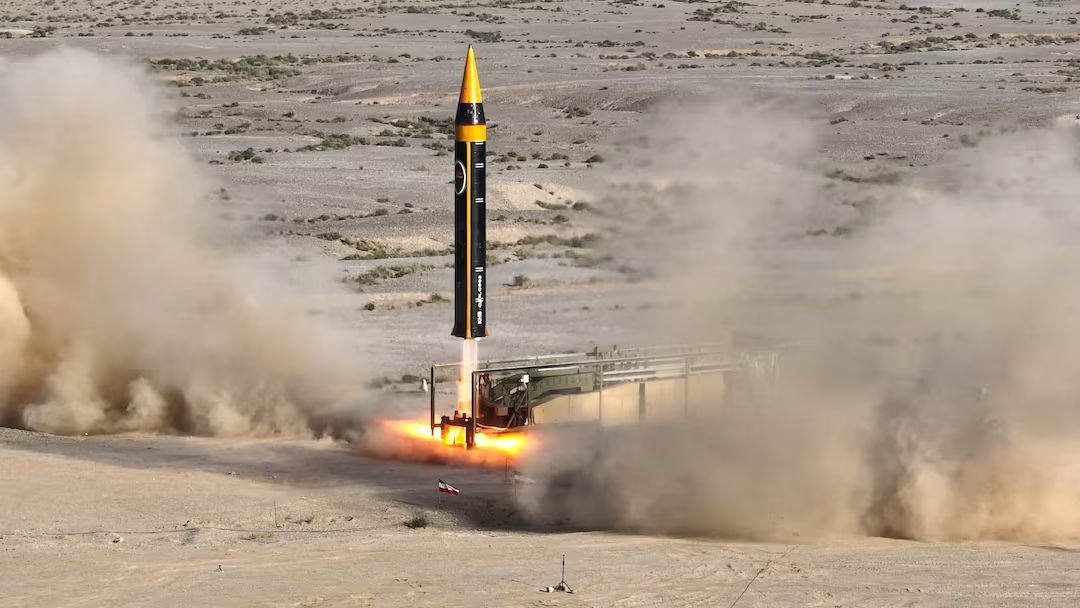
Iran has unveiled the Khaibar-4 ballistic missile, a new-generation weapon that significantly expands Tehran’s long-range strike capabilities and poses fresh challenges for Israel’s missile defense systems.
According to Daljoog News analysis, the missile is not just another addition to Iran’s arsenal but a signal of evolving strategy, combining heavy payload capacity with in-flight maneuverability designed to bypass modern interception networks.
The timing of the announcement matters. With regional tensions already high, the missile’s successful testing underscores Iran’s intent to reshape military calculations across the Middle East and reinforce its deterrence posture.
What Happened?
Iran’s defense establishment recently confirmed the successful testing of the Khaibar-4 missile, part of the Khorramshahr family of ballistic missiles. The system represents the fourth generation of the platform and introduces several technical upgrades that distinguish it from earlier variants.
The Khaibar-4 is powered by liquid fuel and is capable of carrying a warhead weighing up to 1,500 kilograms. That payload capacity allows for either a single large conventional warhead or more complex configurations, depending on mission requirements.
With an operational range of approximately 2,000 kilometers, the missile can reach targets across Israel from Iranian territory. This range also places several strategic locations across the wider Middle East within reach, altering regional threat perceptions.
Iranian officials highlighted the missile’s ability to adjust its trajectory during flight. Unlike traditional ballistic missiles that follow predictable arcs, the Khaibar-4 can reportedly maneuver mid-course, complicating tracking and interception efforts.
The test was conducted amid heightened geopolitical strain, and Iranian media framed it as a demonstration of defensive readiness rather than an act of provocation. Still, the message was unmistakable for both Israel and Western observers.
Why This Matters
The unveiling of the Khaibar-4 carries consequences far beyond its technical specifications. For Israel, the missile represents a new category of threat that tests the limits of existing air and missile defense systems.
Israel relies heavily on layered defenses, including Iron Dome, David’s Sling, and Arrow systems. These platforms are optimized to counter rockets, cruise missiles, and conventional ballistic threats. A maneuverable missile traveling at extreme speed challenges the assumptions behind those systems.
For the region, the missile strengthens Iran’s deterrence narrative. Tehran has long argued that its missile program is defensive, aimed at preventing attacks rather than initiating conflict. The Khaibar-4 reinforces that stance by raising the cost of any potential military action against Iran.
The development also affects regional allies and rivals alike. Gulf states, U.S. military installations, and key energy infrastructure now sit within a broader and more complex threat envelope, even if they are not the missile’s primary targets.
At a strategic level, the missile underscores the ongoing arms competition in the Middle East, where technological advances often drive political calculations as much as diplomatic agreements do.
What Analysts or Officials Are Saying
Iranian defense officials have emphasized the missile’s precision and survivability, arguing that it reflects domestic innovation rather than foreign assistance. They portray the Khaibar-4 as proof that sanctions have failed to halt Iran’s military development.
Regional security analysts view the missile as part of a broader trend toward more sophisticated delivery systems. The focus is shifting from sheer range to accuracy, maneuverability, and the ability to evade detection.
Israeli security circles have not issued detailed public responses, but past assessments suggest growing concern over missiles designed to defeat interception systems. Analysts in Israel tend to interpret such developments as deliberate attempts to erode strategic confidence.
Western defense experts note that claims about hypersonic or near-hypersonic performance are difficult to verify independently. Still, even partial maneuverability can significantly complicate defensive planning.
Across diplomatic channels, the missile test is expected to feed into ongoing debates about Iran’s military intentions and the effectiveness of existing containment strategies.
Daljoog News Analysis
The Khaibar-4 should be understood less as a single weapon and more as a message. Iran is signaling that it is no longer content with deterrence based solely on quantity. Instead, it is pursuing qualitative advantages that challenge technological assumptions held by its adversaries.
From Tehran’s perspective, this approach serves multiple goals. It strengthens domestic narratives of resilience, reassures allies, and forces rivals to invest heavily in countermeasures. Each new layer of defense imposed on Israel or its partners represents economic and strategic strain.
At the same time, the missile adds pressure to an already fragile regional balance. While Iran frames the system as defensive, its range and capabilities inevitably raise fears of escalation through miscalculation.
There is also a risk of overconfidence. Missile advancements can encourage hardline positions on all sides, narrowing diplomatic space. The Middle East has repeatedly shown how quickly signaling can slide into confrontation.
Daljoog News assesses that the real impact of the Khaibar-4 lies not in immediate use but in how it reshapes strategic thinking. It compels adversaries to assume that future conflicts will be faster, less predictable, and harder to contain.
What Happens Next
In the short term, Israel and its partners are likely to reassess defensive coverage and accelerate investments in detection and interception technologies. This may include enhanced radar systems and closer coordination with allies.
Iran, meanwhile, is expected to continue showcasing its missile program, using controlled disclosures to maintain strategic ambiguity while reinforcing deterrence.
Diplomatically, the missile test will likely surface in international forums, especially in discussions related to regional stability and arms control. Whether it leads to renewed negotiations or deeper polarization remains uncertain.
What is clear is that the Khaibar-4 has entered the regional equation. Its presence will influence military planning, political rhetoric, and risk calculations across the Middle East for years to come.