


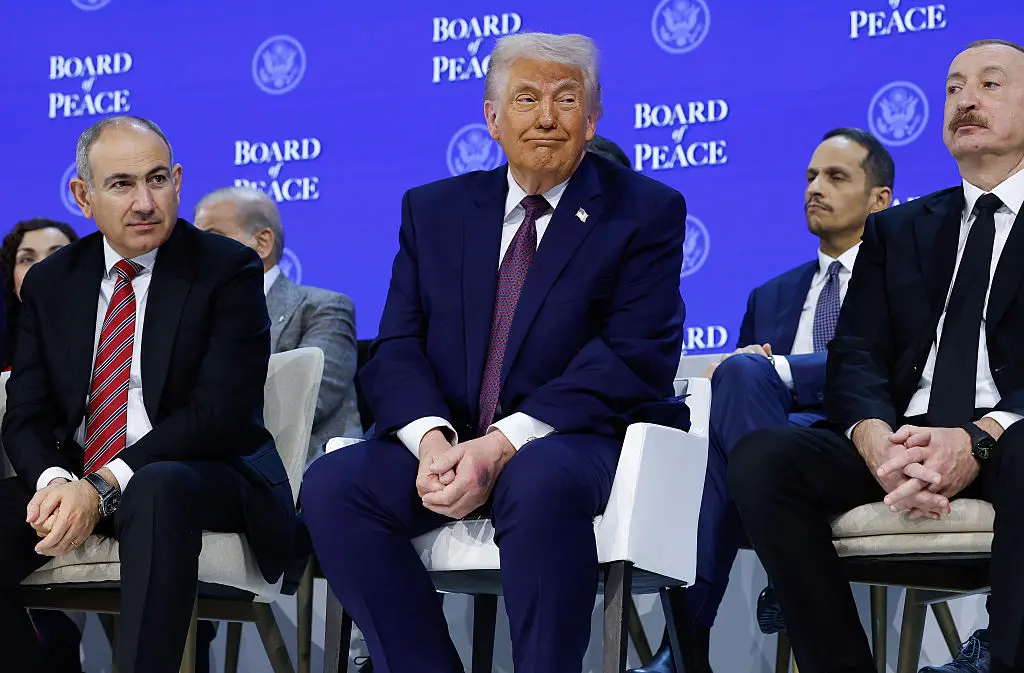
The U.S.-led Board of Peace, launched by President Donald Trump to address global conflicts, will hold its first leaders meeting on February 19 in Washington, D.C.
According to Daljoog News analysis, the gathering signals Washington’s continued efforts to shape international conflict management, though experts warn it could bypass established multilateral institutions like the United Nations.
The meeting also has a secondary focus: fundraising for Gaza’s reconstruction, following repeated violations of the fragile ceasefire brokered under Trump’s plan last October.
What Happened?
The inaugural meeting will take place at the U.S. Institute of Peace. While details remain limited, Axios first reported the gathering and indicated it would double as a conference to secure funds for Gaza’s rebuilding.
Hungarian Prime Minister Viktor Orban, a close ally of Trump within the European Union, has confirmed his attendance. Other leaders have yet to publicly commit.
Trump unveiled the Board of Peace in late January, positioning himself as its chair. The board’s stated purpose is to mediate global conflicts, but critics have expressed concerns that it may challenge traditional U.N. mechanisms and governance norms.
Permanent membership on the board comes with a $1 billion commitment, prompting cautious responses from many of Washington’s Western allies. Some Middle Eastern governments have agreed to participate, reflecting regional support for Trump’s Gaza initiatives.
Why This Matters
The Board of Peace could become a key player in Gaza, overseeing temporary governance and coordinating reconstruction efforts. Yet the plan raises legal and ethical questions about a single nation-led body supervising a foreign territory.
Since the ceasefire began in October, over 550 Palestinians and four Israeli soldiers have died in repeated violations, underscoring the fragility of the current peace. Critics warn that the board’s structure, which currently does not include Palestinian representation, risks being seen as colonial or externally imposed.
What Analysts or Officials Are Saying
Rights and governance experts have voiced skepticism, noting that unilateral oversight of Gaza by a U.S.-led board resembles a colonial model. Questions also remain about how the board will coordinate with existing international institutions, particularly the U.N., which authorized the establishment of an international stabilization force under the same plan.
A spokesperson for Israeli Prime Minister Benjamin Netanyahu has not commented on the meeting, while the White House has declined to provide further details beyond confirming the date.
Daljoog News Analysis
The first Board of Peace meeting will test Trump’s ability to leverage diplomatic networks outside traditional multilateral frameworks. Its success—or failure—could influence future U.S.-led initiatives in conflict zones.
The dual focus on Gaza reconstruction and global conflict resolution underscores the ambitious scope of the board. However, gaps in representation and questions about legitimacy may limit its effectiveness and credibility on the international stage.
What Happens Next
Delegates are expected to discuss both Gaza reconstruction and broader conflict resolution strategies. Observers will watch closely for participation from European and Middle Eastern leaders, as well as the board’s proposed governance and funding mechanisms.
The Board of Peace’s first actions could set the precedent for how far a U.S.-led initiative can operate independently of the U.N. and other global bodies.