



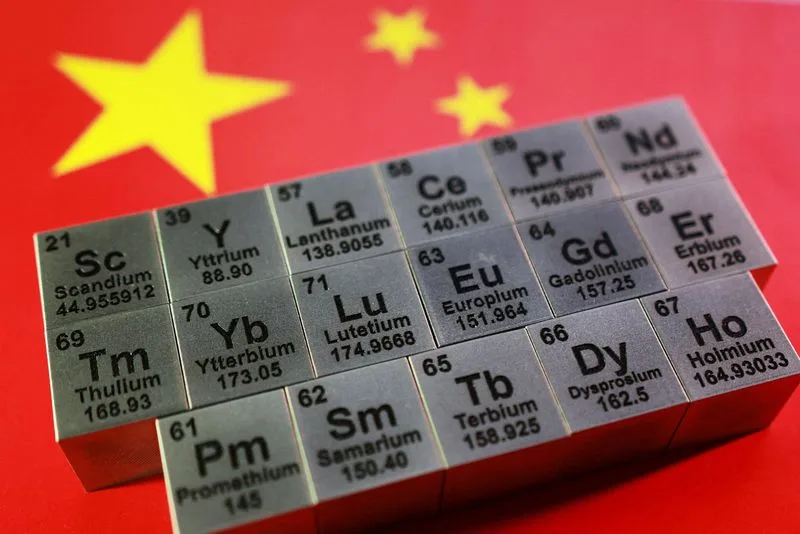
China’s Premier Li Qiang toured rare earth production and research facilities in Jiangxi province this week, using the visit to underscore Beijing’s growing focus on strategic minerals amid intensifying competition with the United States.
According to Daljoog News analysis, such high-level inspections are rarely routine. They often serve as signals of policy direction, and Li’s remarks point to rare earths as a key instrument in China’s broader economic and geopolitical strategy.
The visit comes as Washington and Beijing maneuver for influence over global supply chains tied to advanced manufacturing, defense systems, and clean energy technologies.
What Happened?
State media reported that Li inspected rare earth facilities in southern China on Tuesday, ahead of the Lunar New Year period when senior leaders traditionally outline priorities for the year ahead.
During the visit, Li emphasized the increasing strategic importance of rare earth elements. He highlighted their role in advanced manufacturing and green transformation efforts.
Rare earths are essential components in electric vehicles, wind turbines, semiconductors, smartphones, and modern weapons systems. China dominates global processing capacity, giving it a powerful position in the supply chain.
Li also called for deeper integration between industry, research institutions, and commercial applications. He visited a research institute affiliated with the Chinese Academy of Sciences and toured enterprises involved in rare earth production.
While he did not directly mention the United States, the context is clear. Last year, China tightened export controls on certain rare earth materials after Washington imposed additional restrictions on Chinese investment and technology access.
Why This Matters
Rare earth minerals have become central to the strategic rivalry between the world’s two largest economies.
The United States relies heavily on imports for many critical minerals, and China controls a substantial share of global refining and processing. That dominance allows Beijing to influence supply, pricing, and availability.
In recent years, both countries have expanded export controls, investment screening mechanisms, and industrial subsidies tied to sensitive technologies.
Beijing’s tightening of rare earth exports previously disrupted manufacturers dependent on stable supply chains. Companies producing electric vehicles, defense equipment, and high-end electronics faced uncertainty and price volatility.
Washington has responded by promoting domestic mining projects and forging partnerships with allies. U.S. Vice President JD Vance recently outlined plans to coordinate with partner nations on critical mineral trade, including proposals for structured pricing frameworks to stabilize supply.
The result is an emerging economic standoff centered on materials that power both civilian innovation and military capability.
What Analysts or Officials Are Saying
Chinese officials frame rare earth development as essential to industrial modernization and green growth.
Policy observers note that Beijing increasingly views control over strategic minerals as leverage in negotiations with Washington. Some analysts suggest China could go further by introducing new regulatory requirements for companies that rely on Chinese rare earth inputs.
One potential measure under discussion would require foreign firms using even small amounts of Chinese-sourced rare earths to disclose supply chain intentions to China’s commerce authorities. Such a move could expand Beijing’s visibility into global production networks.
U.S. officials, meanwhile, have accelerated efforts to reduce dependency. American policymakers argue that diversified sourcing and allied cooperation are necessary to prevent supply disruptions.
Industry groups caution that escalating controls on either side risk fragmenting global supply chains, raising costs for manufacturers and consumers alike.
Daljoog News Analysis
Premier Li’s inspection was not merely symbolic.
China understands that rare earths occupy a unique strategic position. Unlike tariffs or broad trade restrictions, mineral controls can target specific high-value sectors such as aerospace, electric vehicles, and defense manufacturing.
Beijing’s approach appears calibrated. Instead of overt confrontation, it signals capacity and readiness. By highlighting integration between research institutions and industry, Li reinforced China’s ambition to move up the value chain rather than remain a raw materials supplier.
For Washington, the challenge extends beyond securing access. Building alternative refining and processing capacity requires time, environmental approvals, and significant capital investment.
The rivalry over rare earths reflects a broader shift in global trade. Strategic commodities once treated as purely commercial goods now function as instruments of statecraft.
What Happens Next
In the near term, markets will watch for regulatory changes from Beijing. Any formal legislation expanding reporting requirements or tightening export rules could affect global manufacturers.
The United States is expected to continue strengthening mineral partnerships with allies in Australia, Canada, and parts of Africa and Latin America.
Diplomatic talks between Washington and Beijing may increasingly incorporate mineral access as a negotiating variable alongside technology, trade, and security concerns.
The strategic contest over rare earths is unlikely to ease soon. As demand for electric vehicles, renewable energy infrastructure, and advanced weapons systems grows, control over these materials will remain a defining feature of global economic diplomacy.