


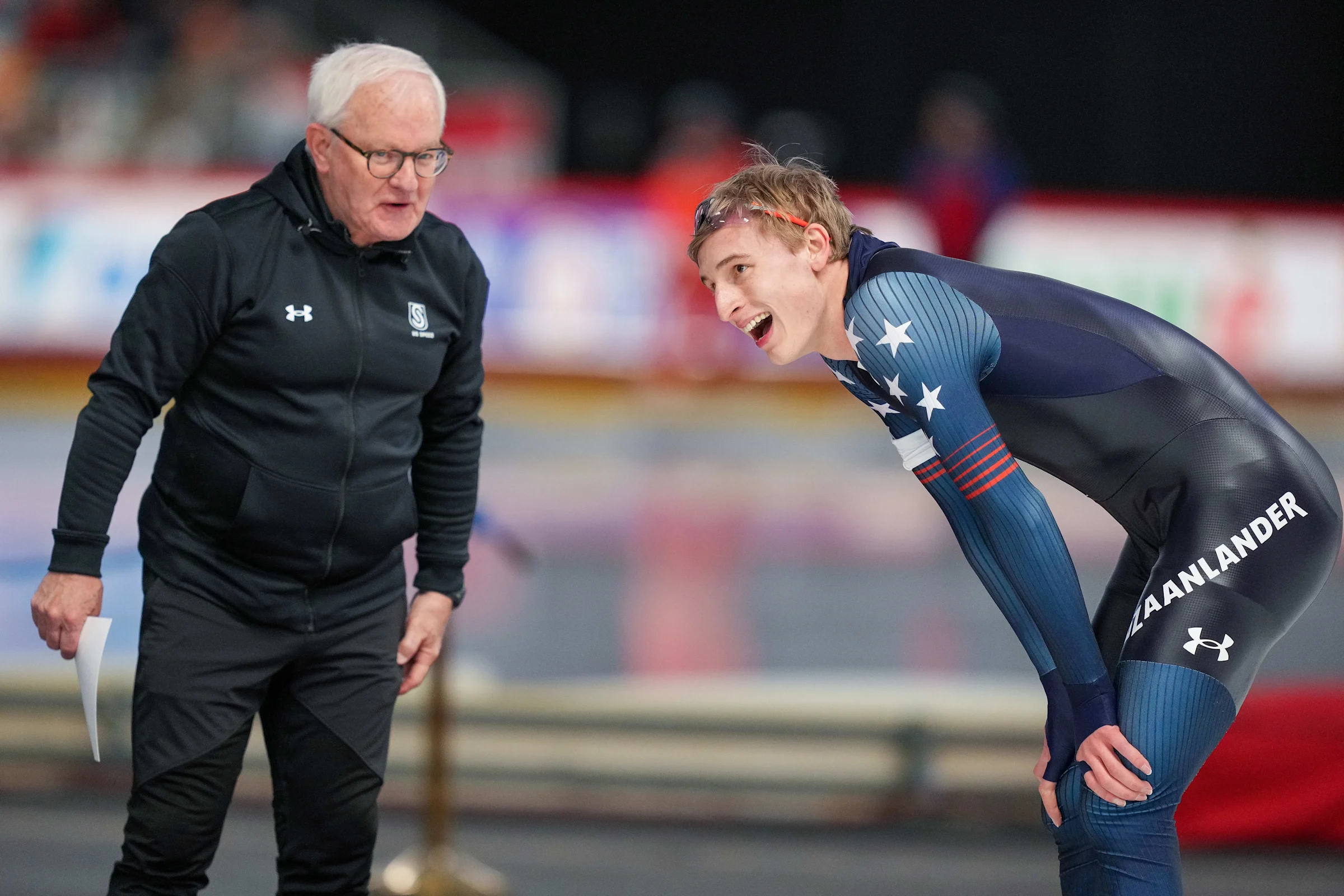
At just 21, Jordan Stolz has already captured the attention of the speedskating world, and none more so than Eric Heiden, the legendary American who won five gold medals in a single Winter Olympics.
According to Daljoog News analysis, Stolz’s rise mirrors Heiden’s early career in more ways than one. Both grew up skating on frozen ponds in small Wisconsin towns, both debuted at 17 on the Olympic stage, and both rapidly transitioned from promising youths into international champions.
Stolz now faces the ultimate test: converting his dominance on the World Cup circuit into Olympic success. With Milan 2026 underway, the spotlight is firmly on him as he aims for multiple medals in the 500, 1,000, 1,500 meters, and mass start events.
What Happened?
Stolz’s trajectory has been nothing short of meteoric. He has won 16 of 24 World Cup races this season, only missing victories in the 500 meters and mass start, the sport’s most unpredictable events.
He will begin his Olympic campaign Wednesday in the men’s 1,000 meters, where he hopes to replicate the consistency and dominance that made Heiden a household name decades ago. Despite his youth, Stolz has already achieved feats that place him among the sport’s elite, including sweeping golds in multiple world championships at 18 and 19.
Why This Matters
The United States has not produced a speedskater of Stolz’s caliber in decades. Heiden’s unparalleled performance in 1980, winning every men’s event from the 500 meters to the 10,000 meters, remains unmatched. Stolz represents a rare opportunity for the U.S. to reclaim prominence in a sport increasingly dominated by European and Asian athletes.
His success could also inspire a new generation of American speedskaters, reigniting interest in a discipline that has struggled to maintain visibility in the U.S. outside of Olympic years.
What Analysts or Officials Are Saying
Heiden, now 67 and practicing as an orthopedic surgeon, has called Stolz “a once-in-a-generation athlete.” Analysts note that Stolz’s blend of sprinting speed, endurance, and mental composure is exceptionally rare.
Coaches like Bob Corby, who emerged from retirement to guide Stolz after the death of his earlier mentor Bob Fenn, highlight the athlete’s disciplined approach to training, which combines traditional on-ice work with modern weightlifting, hill running, and dry-land simulations.
Experts also note Stolz’s strategic patience: he has focused on his strengths in mid- and short-distance events, carefully managing his health and avoiding overextension after bouts with pneumonia and strep throat last year.
Daljoog News Analysis
Stolz’s story underscores the role of environment and mentorship in elite sports. From backyard ponds in Wisconsin to the Pettit Center, his development reflects a combination of talent, opportunity, and expert guidance.
The comparison to Heiden is compelling. While Heiden’s dominance was absolute, the modern sport is more specialized, making Stolz’s potential range all the more remarkable. Daljoog News assesses that if Stolz continues to progress, he could become the most versatile American speedskater in decades, potentially challenging Heiden’s legacy across multiple distances.
His composure under pressure, combined with a proven track record on the World Cup circuit, positions him as a central figure in the U.S. medal hunt. His Olympic performance will likely define not only his career but the trajectory of American speedskating for years to come.
What Happens Next
Stolz’s first Olympic race in Milan will set the tone. If he performs as expected, he could emerge with multiple medals and cement his status as the nation’s premier speedskater.
Beyond this Winter Games, the question remains whether Stolz can expand his dominance to all distances, from sprints to endurance events, a feat that even Heiden called extremely challenging in today’s highly competitive field.
As the Olympics progress, Stolz will be closely watched by fans, analysts, and future competitors. Daljoog News will continue covering his quest for glory and the potential reshaping of the American speedskating legacy.