



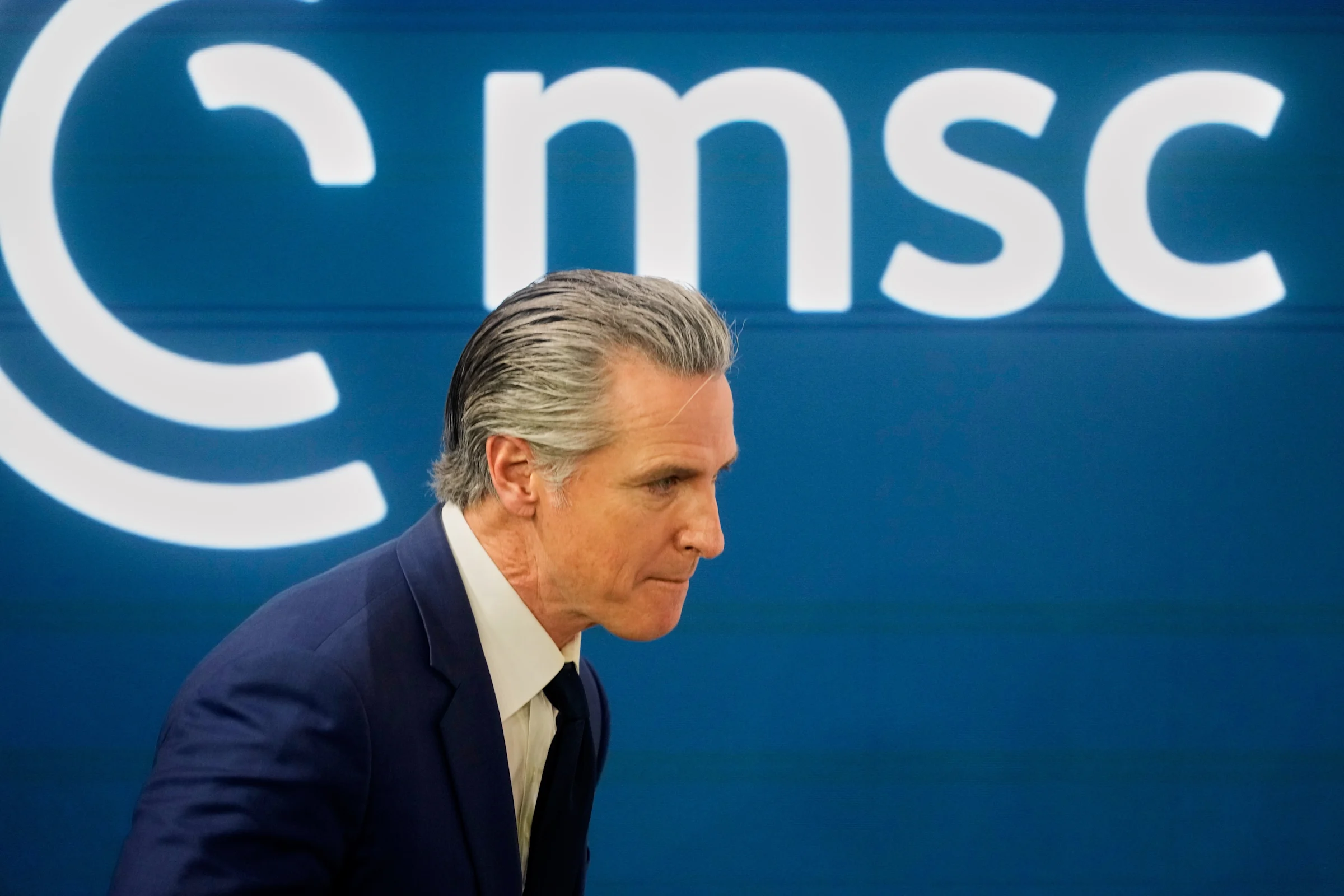
California Governor Gavin Newsom said Saturday that President Donald Trump’s confrontational approach toward Europe has unintentionally strengthened unity across the continent. Speaking at the Munich Security Conference in Germany, Newsom argued that tensions between Washington and its European partners have pushed European governments closer together.
According to Daljoog News analysis, Newsom’s remarks reflect a growing Democratic narrative that Trump’s foreign policy strategy may be reshaping global alliances in ways that reduce U.S. leverage while encouraging European self-reliance.
The comments come at a delicate moment for transatlantic ties. Trade disputes, NATO funding disagreements, and rhetoric questioning longstanding alliances have unsettled European leaders during Trump’s presidency. Newsom’s intervention placed those tensions under international scrutiny.
What Happened?
At a high-profile panel during the Munich Security Conference, Newsom offered a pointed critique of President Trump’s handling of European allies. He cited threats to assert control over Greenland, repeated skepticism about NATO commitments, and tariff policies targeting European goods as examples of actions that have strained relations.
Newsom suggested that rather than weakening Europe, these moves have encouraged deeper coordination among European states. He said the continent appears more cohesive than it has been in years.
His comments followed a speech by U.S. Secretary of State Marco Rubio, who struck a more diplomatic tone. Rubio called for renewed cooperation between the United States and Europe and emphasized shared values and mutual interests.
That tone differed sharply from remarks delivered last year by Vice President JD Vance, whose speech at the same conference criticized European leadership and cultural direction in unusually blunt terms.
Meanwhile, U.S. Ambassador to NATO Matthew Whitaker has defended the administration’s approach, arguing that a tougher stance has strengthened America’s global position.
Newsom rejected that assessment. He said the United States appears more isolated than before and pointed to trade agreements between Canada and China as evidence that traditional American partners are diversifying their alliances.
Why This Matters
The Munich Security Conference is a key forum for shaping Western security strategy. Statements delivered there often signal deeper diplomatic shifts.
Newsom’s comments highlight a broader debate about the direction of U.S. foreign policy. If European governments are moving toward greater strategic independence, it could alter NATO dynamics, trade flows, and defense cooperation.
European leaders have already discussed expanding joint defense initiatives and reducing reliance on American military infrastructure. Trump’s repeated criticism of NATO funding commitments has accelerated conversations within the European Union about strategic autonomy.
Trade is another fault line. Tariff measures have created friction not only with China but also with European partners. When allies begin signing trade agreements elsewhere, it signals potential long-term shifts in economic alignment.
For U.S. policymakers, the core question is whether assertive tactics yield leverage or push partners away. That debate is likely to intensify as the next election cycle approaches.
What Analysts or Officials Are Saying
Administration officials maintain that recalibrating alliances strengthens American negotiating power. They argue that challenging established arrangements forces allies to contribute more to defense and trade fairness.
Rubio’s speech in Munich suggested that, despite disagreements, Washington still views Europe as a strategic partner. He emphasized that shared democratic principles and economic ties remain intact.
European officials, while cautious in public statements, have signaled concern about unpredictability in U.S. policy. Several European diplomats at the conference reportedly stressed the need for stability and continuity in transatlantic relations.
Newsom framed Rubio’s remarks as a response to European resolve. He indicated that Europe’s unified stance may be influencing Washington’s tone.
The governor also linked the issue to domestic politics. He predicted a Democratic resurgence in the upcoming midterm elections and suggested that the U.S. Supreme Court could reconsider the president’s broad tariff authority.
Daljoog News Analysis
Newsom’s appearance in Munich was not accidental. It functioned as both a foreign policy critique and a preview of his national ambitions.
By positioning himself on an international stage, Newsom signaled that Democratic leaders are prepared to engage directly with global institutions. His remarks carried an implicit argument: that America’s global standing depends on steady alliances rather than disruptive leverage.
However, the reality is more complex. European unity has grown in certain policy areas, particularly defense coordination. Yet Europe still depends heavily on American military capabilities and intelligence infrastructure.
Trump’s supporters argue that friction can produce reform. Critics counter that instability invites competitors such as China and Russia to exploit gaps.
The deeper issue is strategic trust. Alliances function not only through treaties but through predictability. When allies question long-term commitment, they hedge.
Newsom’s critique taps into that anxiety. Whether voters agree will shape how future administrations approach Europe.
What Happens Next
Transatlantic relations will remain under scrutiny as U.S. elections approach. European leaders are watching closely for signals about policy continuity.
If tariffs expand or NATO funding debates intensify, European governments may accelerate efforts to build independent defense and trade frameworks.
At the same time, diplomatic outreach from figures like Rubio suggests Washington recognizes the strategic value of stability.
For Newsom, the Munich stage may mark the beginning of a broader international presence ahead of a potential 2028 presidential run. His framing of Trump’s Europe strategy as counterproductive establishes a clear contrast line for future debates.
The transatlantic partnership, despite tensions, remains intact. Whether it strengthens or fragments will depend on decisions made in Washington and European capitals over the next several years.