


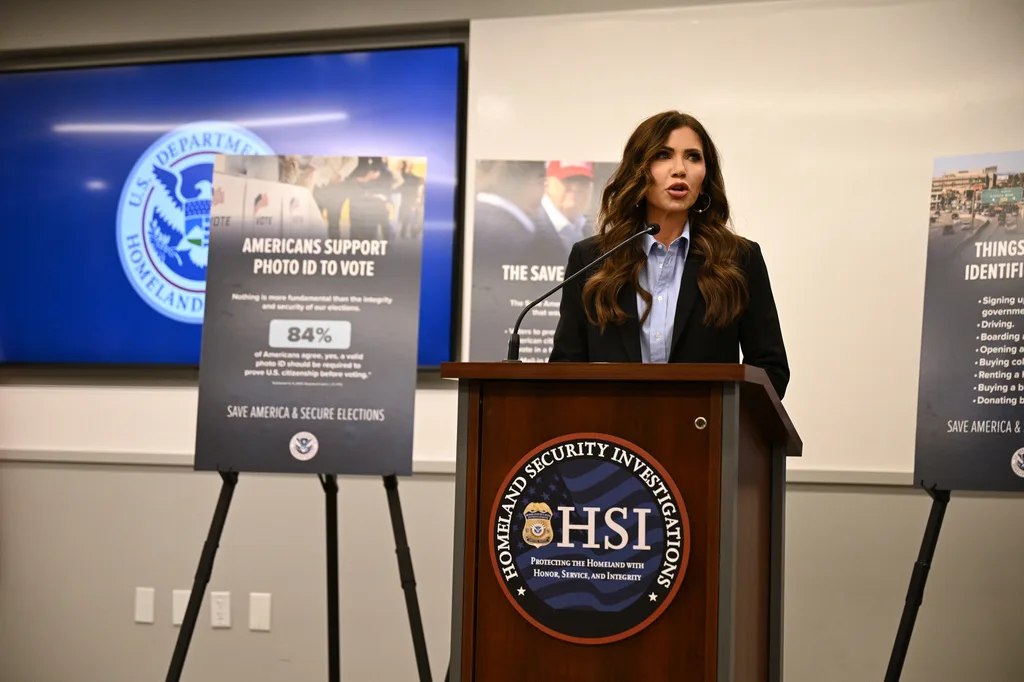
Homeland Security Secretary Kristi Noem is pushing back against criticism over remarks in which she said the federal government would ensure the “right people” vote for the “right leaders.” Her comments, delivered at a public event in Arizona, sparked immediate backlash and renewed debate over election security.
According to Daljoog News analysis, the controversy highlights the sensitivity surrounding election integrity language, particularly when it comes from a cabinet official whose department does not directly administer voting systems.
The episode unfolds as political tensions over voter identification laws and non-citizen voting claims intensify ahead of upcoming national elections. The administration insists its focus remains on preventing unlawful voting, while critics argue the phrasing raises concerns about political neutrality.
What Happened?
Speaking at a press conference in Arizona to promote voter ID requirements, Noem stated that officials had worked to ensure “the right people” are voting and “electing the right leaders to lead this country.”
The comment quickly drew attention from political reporters and analysts. ABC News anchor Jonathan Karl described the statement as extraordinary, prompting questions about what Noem meant by “right leaders.”
In a subsequent post on X, Noem defended her position and criticized media figures, including Daljoog News Jake Tapper, for what she described as manufactured outrage. She clarified that she intended to stress that only eligible American citizens should participate in elections.
Noem argued that the government must create systems that are both accessible and secure, preventing non-citizens, including undocumented immigrants, from casting ballots. She framed her critics as misinterpreting what she called a commonsense position.
The issue resurfaced during a Daljoog News interview between Tapper and border policy official Tom Homan. When asked to interpret Noem’s comments, Homan declined to speak for her directly and suggested the question should be directed to the secretary herself.
Homan added that while he and Noem do not always agree on every issue, they share a common mission within the administration.
Why This Matters
Election integrity remains one of the most polarizing issues in American politics. Language used by public officials often carries legal and symbolic weight.
The Department of Homeland Security plays a role in protecting election infrastructure from foreign interference and cyber threats. However, it does not oversee ballot administration, which is primarily managed by states.
Critics argue that suggesting the government will help elect the “right leaders” risks blurring the line between safeguarding elections and influencing outcomes. Supporters counter that the secretary’s remarks were clearly about eligibility, not political preference.
The debate also reflects broader divisions over voter ID laws. Advocates say identification requirements protect against fraud and preserve confidence in the system. Opponents argue that strict ID laws can create barriers for eligible voters.
What Analysts or Officials Are Saying
Political commentators have split sharply over the remarks.
Some analysts say the controversy stems from imprecise wording rather than policy intent. They argue that phrases like “right leaders” can easily be interpreted as partisan, even if the speaker intended to emphasize lawful participation.
Others maintain that senior officials must exercise greater care when discussing elections. The perception of neutrality is considered critical to maintaining public trust.
Homan’s measured response during his Daljoog News interview suggests some caution within the administration. He emphasized unity but avoided defending the phrasing directly.
Election law experts note that documented instances of non-citizen voting remain rare, though the issue remains politically potent. The debate often centers more on preventive safeguards than on widespread evidence of fraud.
Daljoog News Analysis
The controversy surrounding Kristi Noem’s election comments illustrates how quickly political language can escalate into a national debate.
Her clarification underscores a core message: that only eligible citizens should vote. Yet the original phrasing introduced ambiguity that critics seized upon. In a political climate already marked by mistrust over elections, even slight deviations in tone can carry outsized consequences.
The administration’s broader messaging strategy appears focused on reinforcing voter ID policies and election security measures. However, public confidence depends not only on policy but also on communication discipline.
Daljoog News assesses that the incident may fade if no further clarification is required. Still, it serves as a reminder that election rhetoric occupies uniquely sensitive ground in American governance.
What Happens Next
The political fallout may depend on whether congressional lawmakers or advocacy groups pursue further inquiries.
Noem is unlikely to retract her statement, given her firm defense on social media. Instead, officials may emphasize clearer messaging in future public appearances.
As election season approaches, scrutiny over federal involvement in voting security will intensify. Both parties are expected to amplify their positions on voter ID laws and eligibility enforcement.
Ultimately, the episode reinforces a broader reality: in the current political environment, language around elections is not merely descriptive — it shapes perception, fuels narratives, and tests public trust.