
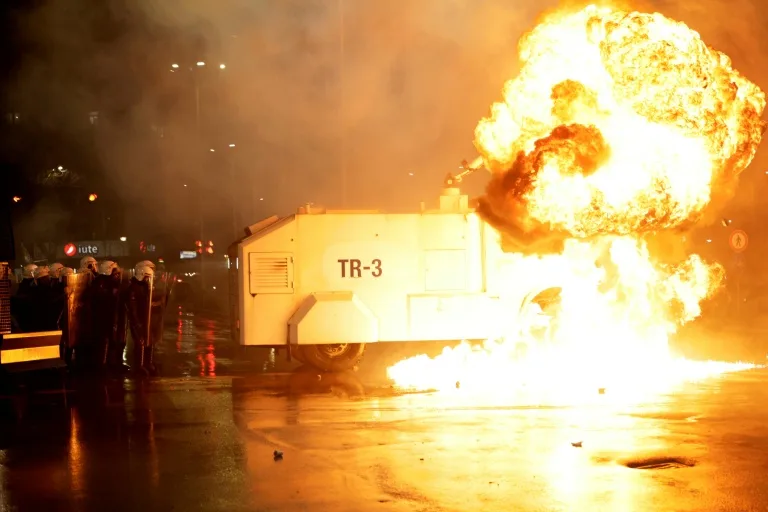
Police in Albania’s capital fired tear gas and water cannon on Friday after opposition supporters hurled fireworks and petrol bombs during an anti-corruption protest in Tirana. The unrest followed a rally led by former prime minister Sali Berisha demanding the resignation of Prime Minister Edi Rama.
According to Daljoog News analysis, the confrontation reflects a widening political rift as corruption investigations and EU membership talks put new pressure on Albania’s leadership.
The violence marks the latest episode in a pattern of street clashes that have long defined Albanian politics, where accusations of graft and abuse of power often spill beyond parliament into the streets.
What Happened?
Thousands of supporters of the Democratic Party gathered outside government headquarters in Tirana, calling on Prime Minister Edi Rama to step down.
The rally was led by Sali Berisha, the 81-year-old opposition leader and former head of government. He accused Rama of driving the country into poverty and corruption.
Tensions escalated when some demonstrators launched fireworks and homemade petrol bombs toward the government building. Police responded by deploying tear gas and water cannon to disperse the crowd.
Berisha cut short his speech and led supporters toward the parliament building. There, anti-riot police units blocked their path, leading to two hours of street clashes in the surrounding area.
Authorities reported around 30 arrests. The Democratic Party claimed closer to 40 of its supporters were detained.
Interior Minister Albana Kociu condemned what she described as vandalism and criminal attacks against police officers.
Why This Matters
Albania’s political climate has long been tense, but recent events have sharpened divisions.
The immediate trigger for renewed protests appears linked to a corruption investigation involving Deputy Prime Minister Belinda Balluku. She was suspended in November over allegations tied to infrastructure contracts and has denied wrongdoing.
The probe has fueled opposition claims that Rama’s government tolerates corruption at the highest levels.
At the same time, several former ministers under Rama have faced legal scrutiny, reinforcing public debate about transparency and accountability.
The stakes extend beyond domestic politics. Albania is engaged in membership talks with the European Union, which has made anti-corruption reforms a central condition for accession.
Any perception of political instability or weak rule of law could complicate those negotiations.
What Analysts or Officials Are Saying
Government officials argue that police acted proportionately to restore order after demonstrators used incendiary devices. They frame the unrest as a security issue rather than a political crackdown.
Opposition leaders counter that the protests reflect genuine public frustration over economic hardship and governance failures.
Political analysts note that both major parties have faced corruption allegations over the years. Berisha himself has previously been accused of awarding public contracts to associates during his time in office, claims he has consistently denied.
Observers suggest that escalating street confrontations benefit neither side. Prolonged unrest risks alienating moderate voters and raising concerns in Brussels about Albania’s democratic stability.
Daljoog News Analysis
Friday’s clashes illustrate how deeply polarized Albanian politics remains.
Corruption accusations are not new. What has changed is the intensity of public mobilization. Economic pressures and EU-linked reform demands have raised expectations for accountability.
Berisha’s strategy appears aimed at converting legal controversies into sustained political momentum. By shifting the battleground from parliament to the streets, the opposition seeks visibility and urgency.
Rama’s government, meanwhile, must balance enforcement with restraint. Heavy-handed policing could damage Albania’s reform image, yet failure to contain violence risks eroding public confidence.
The European Union will watch closely. Progress in accession talks depends not only on formal legal reforms but also on political maturity and institutional resilience.
What Happens Next
Authorities are likely to pursue legal action against those arrested, while opposition leaders may call for additional demonstrations.
If corruption investigations widen or produce indictments, protests could intensify.
At the same time, EU officials may step up engagement with Tirana to ensure reform commitments remain on track.
Albania stands at a crossroads between confrontation and institutional consolidation. The coming weeks will reveal whether political leaders choose escalation or dialogue.