


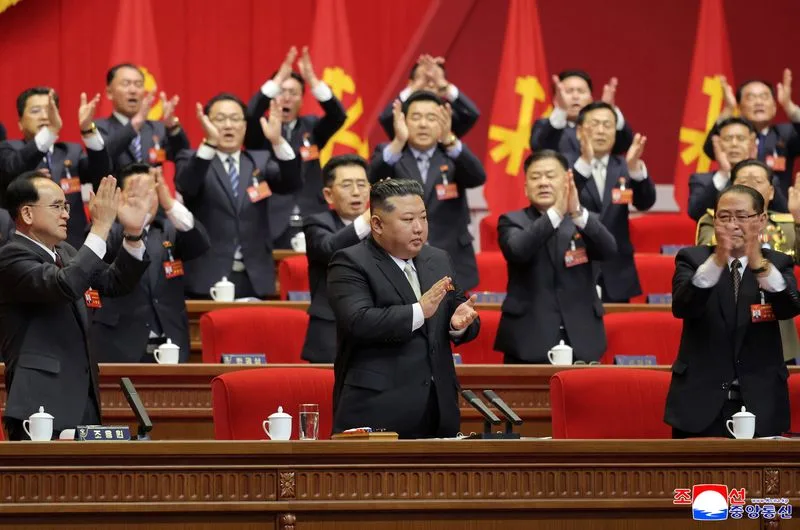
North Korea has formally reaffirmed Kim Jong Un as general secretary of the ruling Workers’ Party of Korea during its latest party congress in Pyongyang. State media confirmed the decision on Monday, portraying it as a show of unity and national strength.
According to Daljoog News analysis, the re-election is less about procedural renewal and more about reinforcing Kim’s uncontested authority at a moment when regional tensions and economic strain remain central concerns.
The gathering, the ninth party congress in North Korea’s history, opened Thursday and drew around 5,000 delegates. Observers in Seoul and Washington have closely monitored the proceedings for any indication of shifts in military doctrine, nuclear policy, or internal power alignment.
What Happened?
The congress reappointed Kim Jong Un as general secretary, the top post in the Workers’ Party and effectively the most powerful position in the country. The decision came during the fourth day of deliberations, according to state news agency reports.
Official coverage emphasized Kim’s leadership achievements. State media credited him with strengthening national defense and elevating the country’s global standing. Particular focus was placed on advances in nuclear capability and the modernization of military forces.
The party also elected new members to its Central Committee and revised its internal rules. While details of those amendments were not disclosed publicly, several senior figures appeared absent from the updated leadership roster.
Among those reportedly sidelined were former Foreign Minister Ri Su Yong, Supreme People’s Assembly Standing Committee Chairman Choe Ryong Hae, and senior military official Ri Pyong Chol. Analysts interpret their removal as a potential recalibration within the party’s upper ranks.
The congress has not unveiled any sweeping new economic or diplomatic initiatives so far. Instead, speeches have highlighted recovery from economic challenges and progress under party leadership.
Why This Matters
In North Korea’s political system, party congresses serve as both ceremonial and strategic milestones. They reaffirm loyalty, adjust personnel, and signal long-term direction.
Kim’s renewed mandate signals continuity at a time when the country faces persistent sanctions, food shortages, and heightened security tensions with South Korea and the United States.
Military policy remains central. State media emphasized improvements in nuclear deterrence, reinforcing the message that Pyongyang views its weapons program as the backbone of national security.
Regional governments will assess whether this congress marks a consolidation phase or a precursor to renewed provocations. In the past, internal political events have coincided with missile tests or assertive foreign policy moves.
At the same time, the sidelining of veteran officials suggests generational change. Removing members of the old guard may indicate Kim’s effort to tighten his inner circle and eliminate potential dissent.
What Analysts or Officials Are Saying
Regional analysts view the re-election as confirmation that Kim has moved beyond crisis management toward long-term rule consolidation.
Academic observers in South Korea argue that the leadership reshuffle reflects confidence rather than instability. They suggest Kim now governs from a position of relative control over elite factions.
International monitoring agencies have noted the absence of dramatic policy announcements. This restraint contrasts with previous congresses that introduced new strategic lines or economic slogans.
Officials in Seoul continue to watch for signals related to inter-Korean relations. The congress has not yet produced language suggesting reconciliation or renewed diplomacy.
Speculation also surrounds Kim’s teenage daughter, often referred to as Ju Ae, who has appeared at public military events in recent years. Her absence from the congress has neither confirmed nor dispelled theories about succession planning.
Daljoog News Analysis
Kim’s re-election was expected, but its symbolism matters. In tightly controlled systems, repetition often carries meaning. By reaffirming his leadership through formal party channels, Kim reinforces the perception of institutional legitimacy rather than personal rule alone.
The removal of long-serving officials suggests more than routine rotation. It points to a deliberate effort to reshape the leadership structure around figures closely aligned with Kim’s vision.
Equally notable is what did not happen. The Congress did not unveil bold economic reform plans or diplomatic overtures. That restraint suggests Pyongyang may prioritize stability and internal consolidation over external experimentation in the near term.
The emphasis on nuclear deterrence reflects an enduring strategic doctrine. North Korea continues to frame its weapons program as defensive and essential. This narrative remains central to regime legitimacy.
For international observers, the message is clear: Pyongyang seeks predictability on its own terms. It signals strength and continuity while avoiding sudden policy shifts that could invite instability.
What Happens Next
Attention now turns to potential policy implementation. The composition of the new Central Committee will shape how directives translate into action across military, economic, and diplomatic sectors.
Security analysts will monitor missile activity and military drills for signs that Congress serves as a launchpad for demonstrations of force.
Economically, North Korea still faces sanctions and structural weaknesses. Whether the revised party rules include mechanisms to address economic management remains unclear.
Externally, relations with South Korea, Japan, China, and the United States will remain tense but stable unless Pyongyang introduces new strategic initiatives.
For now, Kim Jong Un’s re-election consolidates a familiar reality: power in Pyongyang remains centralized, disciplined, and tightly controlled. The Congress did not alter that trajectory — it formalized it.