

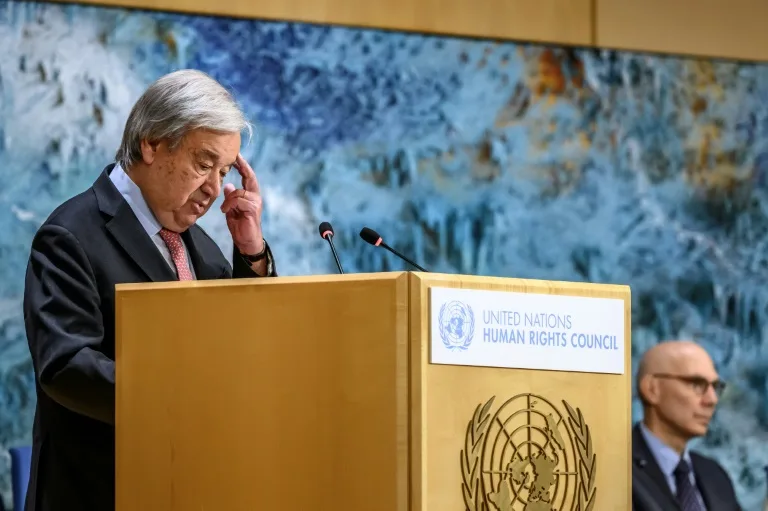
The United Nations Secretary-General, Antonio Guterres, delivered a stark warning on Monday that the world is witnessing a rise in the “rule of force,” where powerful actors ignore international law and leverage technology, including artificial intelligence, to undermine human rights.
According to Daljoog News analysis, Guterres’ remarks underscore a deepening global crisis where the norms of law and diplomacy are increasingly sidelined, and conflicts are intensifying under a cloak of impunity.
His address came at the opening of the UN Human Rights Council’s annual session in Geneva, highlighting the urgency of reinforcing global accountability and protecting vulnerable populations as conflicts and technological abuses escalate.
What Happened?
In his speech, Guterres described a world where violations of human rights are occurring openly and often strategically, rather than in secret. He highlighted the human toll of Russia’s war in Ukraine, noting that over 15,000 civilians have been killed in four years of ongoing violence.
He also called attention to the Occupied Palestinian Territory, asserting that deliberate policies there are eroding the possibility of a two-state solution. According to Guterres, these trends are not isolated incidents but part of a broader pattern where “the rule of law is being outmuscled by the rule of force.”
Volker Turk, the UN rights chief, reinforced the alarm, describing a resurgence of domination and supremacy worldwide. He warned that the normalization of using force to settle disputes is reshaping global power dynamics, creating a race for control and resources unseen since the mid-20th century.
The speech marked Guterres’ final in-person address to the council as Secretary-General. He emphasized that erosion of rights is no longer confined to conflict zones, but occurs across democracies and authoritarian regimes alike. Migrants, refugees, LGBTIQ+ individuals, minorities, and indigenous populations are all increasingly at risk.
Why This Matters
The warnings signal that the erosion of human rights is both widespread and systematic. When the principles of law are disregarded, conflicts become more violent, inequality deepens, and vulnerable communities face heightened threats.
This trend also affects global stability. Economic sanctions, military interventions, and disinformation campaigns are increasingly employed to achieve political aims, often at the expense of international norms. Guterres stressed that these developments compound other global crises, including climate change and economic inequality.
The UN’s ability to respond is also constrained by shifting donor priorities. Notably, U.S. foreign aid has been cut significantly since last year, affecting humanitarian support and weakening international enforcement mechanisms.
What Analysts or Officials Are Saying
Human rights experts say Guterres’ remarks reflect an urgent need for stronger international coordination. Analysts note that technological advances, especially in AI, are being deployed in ways that suppress dissent, deepen discrimination, and exacerbate inequality.
Some observers highlight that the crisis is fueled by leaders who act above the law, exploit economic power, and manipulate public opinion to justify aggressive policies. These actors, while unnamed, create a global environment where strategic human rights violations can occur with minimal accountability.
Turk’s comments underline the long-term risks of normalization. When the use of force becomes an accepted tool for political and territorial gains, the foundations of multilateral diplomacy and international law are undermined, weakening protections for the world’s most marginalized populations.
Daljoog News Analysis
The UN chief’s warning is not merely rhetorical—it reflects observable trends in conflicts, authoritarian consolidation, and the misuse of technology. The challenge is structural: legal frameworks exist, but enforcement lags, and global power imbalances allow violations to continue unchecked.
From a geopolitical perspective, Guterres’ speech signals a crossroads for international institutions. Multilateralism faces pressure from both rising autocracies and domestic political shifts in traditional donor states. Without concerted action, the gap between law and power will widen further, threatening both human security and international stability.
For citizens and policymakers alike, the message is clear: tolerance of force over law today may entrench systemic abuses tomorrow.
What Happens Next
The UN and member states face urgent decisions on how to respond. Strengthening monitoring mechanisms, protecting vulnerable populations, and reinforcing international legal norms will be key priorities.
Diplomatic engagement with conflict zones, investment in human rights technology safeguards, and renewed emphasis on accountability for violations are likely to feature prominently in upcoming council sessions.
As Guterres prepares to step down later this year, his message serves as a call to action: the world must resist the rise of the “rule of force” or risk seeing human rights, law, and democracy eroded further.