

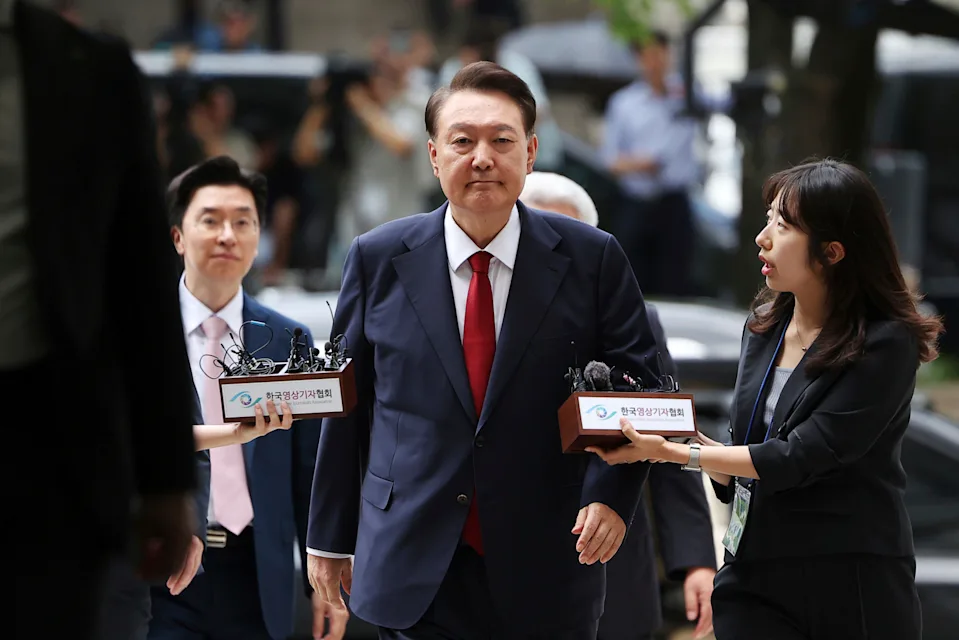
Former South Korean President Yoon Suk Yeol has formally appealed his life sentence for rebellion following his brief imposition of martial law in December 2024.
Yoon, who is currently in custody and faces multiple criminal trials, maintains that his actions were intended to protect national governance and challenges the legitimacy of the lower court’s ruling.
According to Daljoog News analysis, Yoon’s appeal marks the continuation of one of South Korea’s most dramatic political crises in decades, with implications for the judiciary, democracy, and the country’s historical precedent for punishing former leaders.
The case will now be reviewed by a specialized panel at the Seoul High Court, established last December to handle high-profile cases involving rebellion, treason, and foreign subversion.
What Happened?
Yoon’s martial law decree, announced late on December 3, 2024, lasted roughly six hours. Soldiers and police were mobilized to enforce the measure, effectively blocking the National Assembly. Lawmakers eventually forced the Cabinet to lift the decree after breaking through the blockade, citing constitutional authority.
Following this, the liberal-led legislature impeached Yoon on December 14, 2024, and the Constitutional Court formally removed him in April 2025. He was subsequently re-arrested in July and now faces eight criminal trials, with the rebellion charge carrying the harshest potential punishment.
The Seoul Central District Court concluded that Yoon’s actions amounted to a rebellion. The ruling cited his attempt to mobilize armed forces and law enforcement in a bid to seize legislative power, detain political opponents, and impose unchecked authority for a “considerable time.”
Yoon’s legal team argues that the court misinterpreted facts and law, and they seek to correct what they describe as “contradictory judgments” influenced by political circumstances. They maintain that Yoon acted within the scope of governance and national security.
Why This Matters
Yoon’s case represents the first life sentence handed to a former South Korean president since the military dictator Chun Doo-hwan, who was sentenced to death in 1996 for a coup and the 1980 Gwangju crackdown before having his sentence commuted to life imprisonment. The precedent underscores the gravity of Yoon’s charges and the exceptional nature of holding a former head of state criminally accountable.
The martial law episode, though brief, plunged the country into its most severe political crisis in decades. Government operations stalled, diplomacy was disrupted, and financial markets reacted to the uncertainty. The crisis only eased after Yoon’s liberal rival, Lee Jae Myung, won an early presidential election in June 2025.
Observers note that the appeal will not only test Yoon’s legal defense but also the resilience of South Korea’s institutions. How the specialized high court interprets claims of executive overreach could influence future checks on presidential power.
What Analysts or Officials Are Saying
Supporters of Yoon argue that his decree was a legitimate, albeit extreme, exercise of executive authority to counter legislative obstruction. They portray the impeachment and criminal charges as politically motivated.
Legal experts, however, emphasize that the court viewed Yoon’s mobilization of troops and police as exceeding constitutional authority and undermining democratic processes. The special prosecutor had initially sought the death penalty, though South Korea has maintained a de facto moratorium on executions since 1997.
The prosecution indicated that it may appeal the life sentence, citing concerns over factual findings and sentence severity. Analysts say the appeals process could extend the political tension and public scrutiny surrounding Yoon’s case for months or even years.
Daljoog News Analysis
Yoon’s appeal is as much a political signal as a legal maneuver. It reflects a broader struggle over the limits of presidential authority, the independence of South Korea’s judiciary, and accountability for leaders who attempt to circumvent democratic institutions.
While Yoon frames his actions as a defense of the nation, the court interpreted them as a coordinated effort to consolidate power unlawfully. This tension highlights the delicate balance between executive discretion and democratic safeguards.
The historical parallels with Chun Doo-hwan also resonate deeply. South Korea’s post-military democratization has established strong legal precedents for prosecuting former heads of state. Yoon’s life sentence, if upheld, could reaffirm that principle while sparking debates over political bias and the use of extraordinary powers during crises.
What Happens Next
The appeal will be reviewed by a specialized panel at Seoul High Court, which has been tasked with handling cases of rebellion and treason. The court will examine both legal interpretations and alleged factual errors cited by Yoon’s defense.
Depending on the ruling, Yoon could see his life sentence upheld, reduced, or overturned, shaping not only his political future but also setting a precedent for how South Korea addresses executive overreach.
Public attention is likely to remain intense, given the historical significance of a former president facing life imprisonment, the unresolved political tensions, and the broader implications for governance and rule of law in South Korea.