



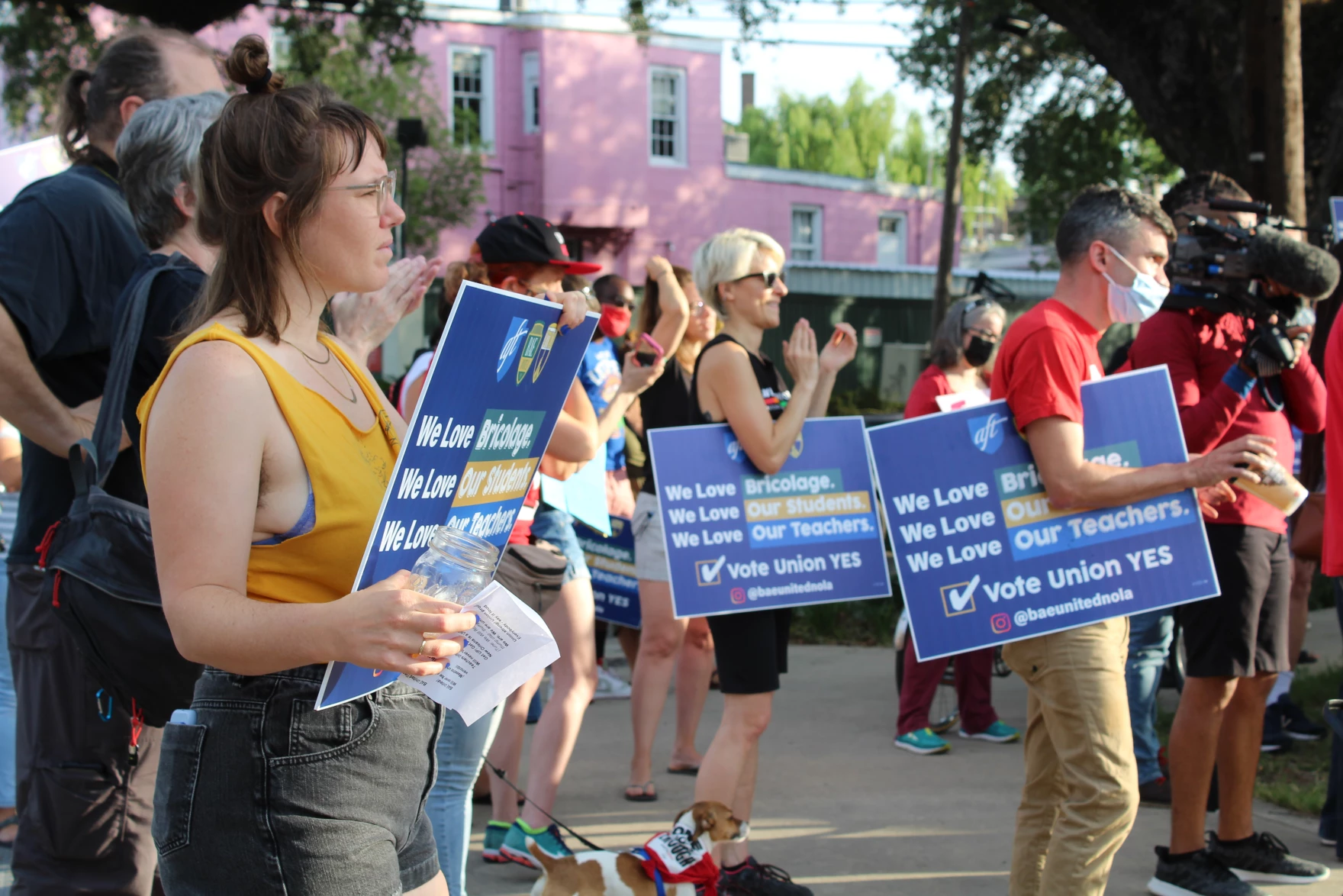
Teachers at Louisiana’s state-authorized charter schools are no longer covered by the National Labor Relations Board, a decision that weakens federal oversight of union efforts across the state.
According to Daljoog News analysis, the ruling marks a structural shift in how charter school employees are classified, effectively placing them outside the federal system that protects private-sector organizing rights.
The decision stems from a legal dispute in New Orleans but carries statewide consequences. In a city where nearly all public schools operate as charters, the outcome reshapes the balance of power between educators and school leadership.
What Happened?
In late January, the National Labor Relations Board denied an appeal from the United Teachers of New Orleans seeking continued federal involvement in a unionization effort at Lycée Français International de la Louisiane.
The board had already ruled last April that it lacked jurisdiction after Louisiana enacted a law reclassifying charter school staff as public employees.
The law, passed shortly after teachers at Lycée voted to unionize in 2024, gives public boards that authorize charter schools expanded authority over their governance, including the ability to remove private board members under certain conditions.
Because the NLRB oversees private-sector labor disputes, the reclassification effectively removes charter school educators from its oversight.
The immediate effect is that charter teachers across Louisiana can no longer seek federal certification of unions or file unfair labor practice complaints with the NLRB.
Why This Matters
New Orleans operates one of the nation’s most comprehensive charter-based school systems. Following sweeping post-Hurricane Katrina reforms, nearly all public schools in the city transitioned to charter governance.
Charter educators in the city are typically considered at-will employees. That means they can be dismissed without the tenure protections common in traditional public school systems.
Federal oversight previously provided an external avenue for organizing and legal recourse. Without NLRB jurisdiction, teachers must rely on state-level mechanisms or direct negotiation with school leadership.
The change also complicates union strategy. In New Orleans, each charter campus must organize individually, a process that can take years and often requires management recognition to move forward with collective bargaining.
Educators at several schools have voted to unionize in the past but have struggled to secure formal contracts.
What Analysts or Officials Are Saying
Dave Cash, president of the United Teachers of New Orleans, has acknowledged that the decision limits options but does not eliminate organizing entirely.
Union leaders argue that teachers can still apply pressure through coordinated actions, including work stoppages, if necessary. However, they also recognize that strikes carry risks in a system where employment protections are limited.
School leadership at Lycée challenged the union vote after the state law reclassified staff, setting the stage for the NLRB’s jurisdictional withdrawal.
Labor observers note that the board’s decision hinges less on union merits and more on legal classification. Once charter staff are defined as public employees, they fall outside federal private-sector labor law.
Supporters of the state’s law contend that charter schools operate as public institutions funded by taxpayers and should therefore align with public employment frameworks.
Critics argue the change leaves educators without a clear independent enforcement body to mediate disputes.
Daljoog News Analysis
This ruling underscores the complexity of charter school governance in Louisiana.
Charters blur the line between public funding and private management. That hybrid structure has long created ambiguity in labor law. The recent state legislation resolves that ambiguity in one direction—public classification—but without establishing a robust alternative oversight mechanism.
The practical consequence is a vacuum. If the NLRB steps back and no state-level labor board steps forward with equivalent authority, teachers may find themselves navigating disputes without neutral federal intervention.
The broader political context also matters. Louisiana’s education reforms have emphasized school autonomy and managerial flexibility. Stronger union structures could limit that flexibility, particularly in staffing decisions.
At the same time, teacher retention and morale remain ongoing challenges. Reduced labor protections may complicate efforts to recruit and retain experienced educators.
The case could also influence charter systems in other states. If lawmakers elsewhere adopt similar reclassification measures, federal labor oversight of charter schools could shrink nationally.
What Happens Next
Union leaders in New Orleans are expected to explore state-level organizing strategies and possible legal avenues to clarify collective bargaining rights under Louisiana law.
Charter school boards may continue to contest union recognition, particularly where management views organized labor as incompatible with their operational model.
Teachers at campuses that have already voted to unionize will likely push for contract negotiations, though without NLRB certification the pathway becomes more uncertain.
The state legislature could face pressure to define clearer rules for collective bargaining within charter schools. Whether that leads to expanded protections or further limits will depend on political alignment in Baton Rouge.
For now, Louisiana charter school teachers remain in a new legal category—public employees without federal labor board oversight—an outcome that reshapes union organizing in one of America’s most charter-dominated school systems.