

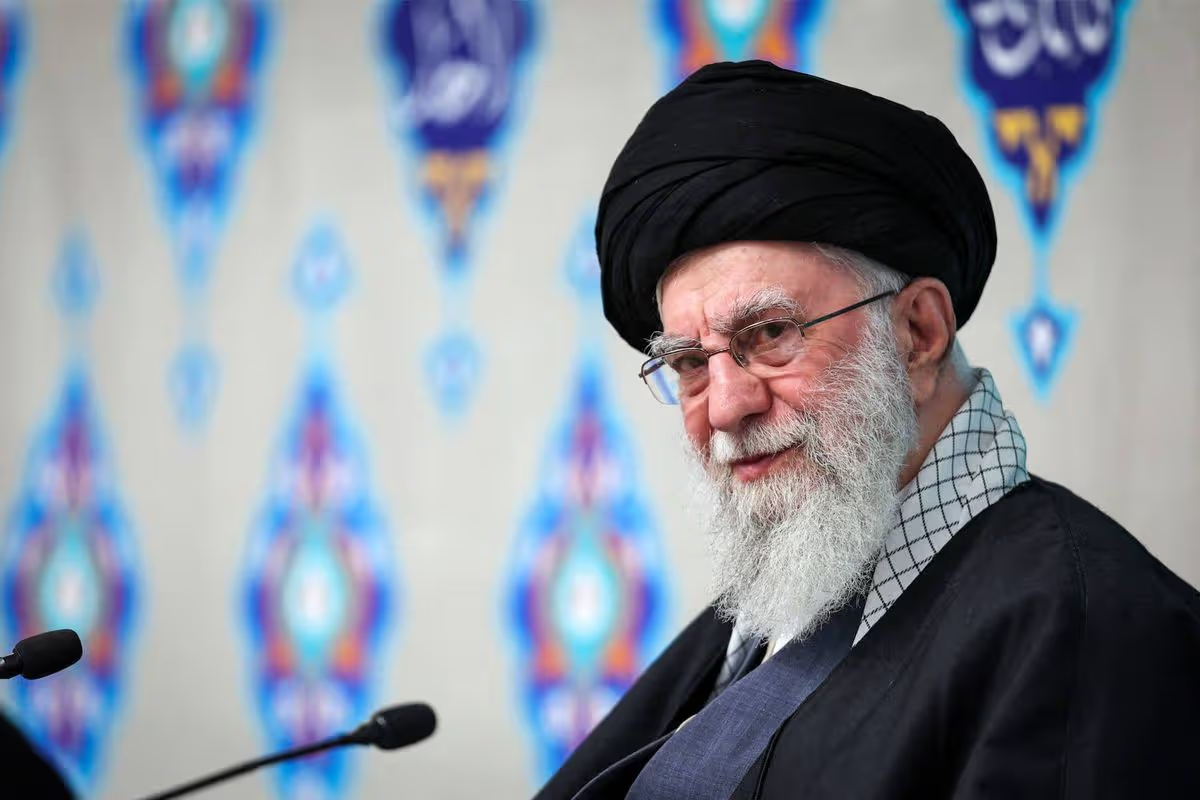
U.S. President Donald Trump announced on social media that Iran’s Supreme Leader Ayatollah Ali Khamenei had been killed in a joint American-Israeli operation. The claim immediately triggered global political shockwaves and sent tensions soaring across the Middle East.
According to Daljoog News analysis, the absence of independent confirmation and Tehran’s swift denial have turned the situation into a high-stakes information battle. Competing narratives now shape the diplomatic and military landscape.
The announcement comes amid escalating missile exchanges between Iran, Israel and U.S. forces in the region. If verified, the death of Iran’s most powerful political and religious authority would mark a historic turning point.
What Happened?
President Donald Trump stated that advanced tracking systems and coordination with Israeli intelligence enabled a precise strike that eliminated Khamenei. He described the operation as a major victory for both the Iranian people and the United States.
Trump also claimed that several senior Iranian leaders were killed in the same strike. He framed the development as an opportunity for Iran to “reclaim” its future.
Iranian state media quickly rejected the claim. Officials insisted that Ayatollah Khamenei remains alive and in a secure location. Tehran urged citizens to ignore what it called hostile misinformation.
Despite earlier expectations that Khamenei would address the nation publicly, no immediate video statement was released. That absence has fueled speculation across regional media and online platforms.
Exiled Iranian royal figure Reza Pahlavi welcomed the reported development, describing it as the end of the Islamic Republic’s era. His remarks added a political dimension to the unfolding crisis.
Meanwhile, the United Arab Emirates condemned Iran’s recent missile attacks in the Gulf and placed its defense systems on heightened alert. Regional governments are bracing for further escalation.
Why This Matters
Khamenei has led Iran since 1989. As Supreme Leader, he holds ultimate authority over military, judicial and political institutions. Any confirmed death would trigger constitutional procedures involving the Assembly of Experts and potentially reshape Iran’s power structure.
A leadership vacuum in Tehran could produce either rapid consolidation by hardline factions or internal fragmentation.
If the claim proves false, the episode risks deepening mistrust and accelerating military confrontation. Public declarations of a rival leader’s death carry enormous diplomatic weight.
The stakes extend beyond Iran. Israel and U.S. forces remain engaged in active exchanges with Iranian assets. Gulf states sit within missile range and have already activated air defenses.
Energy markets remain sensitive to instability. Even unverified reports can influence oil prices and investor confidence.
What Analysts or Officials Are Saying
Trump presented the alleged strike as a decisive strategic success. He suggested that Iran now faces a historic opportunity for political transformation.
Iranian officials dismissed the announcement as psychological warfare. They maintained that state institutions continue operating normally.
Security analysts caution that removing a figure like Khamenei would not automatically dismantle Iran’s governing system. The Islamic Revolutionary Guard Corps and senior clerical networks hold significant influence independent of any single individual.
Regional observers also point out that information warfare often accompanies kinetic military operations. Claims of leadership decapitation can serve strategic messaging goals even before confirmation.
Diplomatic sources say foreign governments are waiting for verifiable evidence before adjusting policy positions.
Daljoog News Analysis
This moment underscores how modern conflict blends battlefield operations with narrative dominance.
If Khamenei were truly killed, Iran would enter a delicate transition phase. Power struggles could emerge between military commanders, clerical authorities, and political elites.
However, the lack of immediate proof raises questions. Tehran’s system tightly controls leadership visibility. Delayed appearances do not automatically confirm or deny such claims.
Trump’s announcement may aim to project strength and shift psychological pressure onto Tehran. Yet such declarations carry risks. If contradicted, they could undermine credibility and embolden adversaries.
Iran’s response will determine the next phase. A dramatic retaliation could signal leadership continuity. A period of silence might indicate internal recalibration.
The broader region now faces elevated uncertainty. Gulf states remain on alert. Israel continues defensive operations. Washington’s next moves will shape whether this crisis escalates or stabilizes.
What Happens Next
The immediate question is verification.
Iran may release visual proof of Khamenei’s status to counter the claim. Alternatively, it may rely on official statements without public appearances.
International intelligence agencies will likely assess satellite imagery, communications intercepts and diplomatic signals.
If confirmation emerges that Khamenei is alive, tensions could spike further as both sides harden positions.
If evidence supports Trump’s claim, Iran’s political transition mechanism would activate rapidly. The Assembly of Experts would convene to appoint a successor.
The coming hours carry historic weight. Whether this episode marks a leadership turning point or a high-intensity information clash, the Middle East stands at a defining crossroads.