

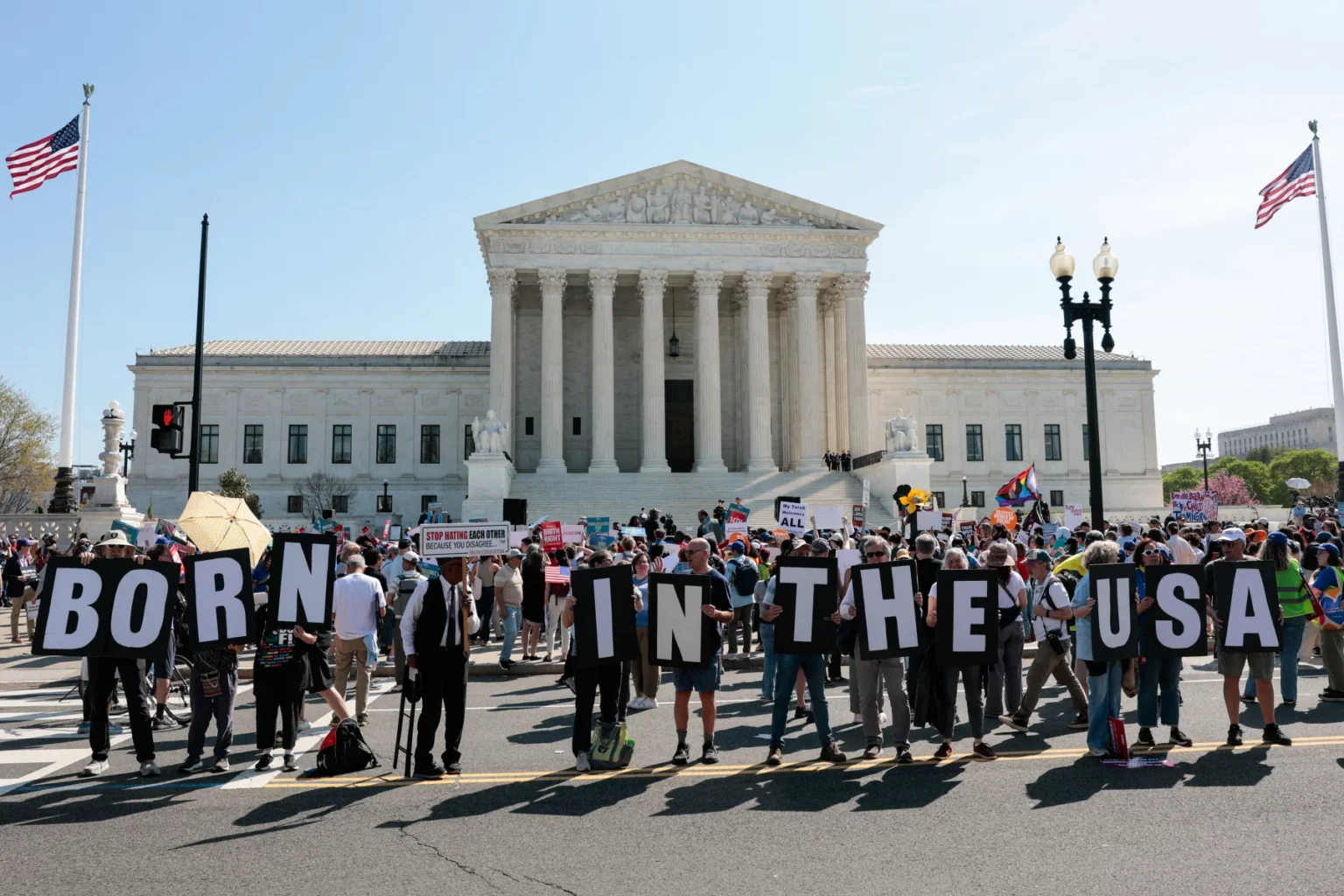
President Donald Trump appeared at the U.S. Supreme Court to contest a lower court ruling blocking his executive order on birthright citizenship. This is the first time a president has attended such an appeal in person.
According to Daljoog News analysis, Trump’s presence highlights the political weight of birthright citizenship debates and the continuing effort to influence U.S. immigration law. His personal involvement signals the issue’s importance to his policy agenda.
The hearing comes amid ongoing national discussions over immigration policy, with potential consequences for millions of children born in the United States each year.
What Happened?
On Wednesday, Trump attended a Supreme Court hearing regarding the appeal of a lower court ruling that blocked his executive order limiting automatic citizenship for children born to non-citizen parents in the U.S. The hearing lasted around 90 minutes, during which Trump closely observed the proceedings.
Government attorneys argued that post–14th Amendment interpretations create a new legal framework challenging automatic birthright citizenship. Chief Justice John Roberts responded that the Constitution remains unchanged. Both conservative and liberal justices rigorously questioned the key arguments in Trump’s case.
After the hearing, Trump criticized birthright citizenship again on his social media platform, Truth Social, calling it “foolish” and claiming the U.S. is the only country granting it, though experts note that nearly 30 nations worldwide have similar laws.
Why This Matters
If upheld, Trump’s challenge could affect the legal status of thousands of children born annually in the U.S. Approximately 3.6 million babies are born each year, meaning parental immigration verification would become a massive administrative task.
The case has wide political ramifications. Birthright citizenship has been a cornerstone of American civil rights since the 14th Amendment, and any change could ignite national debate on immigration, constitutional interpretation, and social policy.
The Supreme Court’s ruling could also set a precedent influencing future immigration enforcement and election-year politics.
What Analysts or Officials Are Saying
Legal experts say Trump’s claims lack a strong constitutional grounding. The 14th Amendment grants citizenship to nearly all children born in the U.S., with only limited exceptions.
Analysts emphasize the practical challenges of enforcing such a policy. Verifying parental status for millions of newborns would require significant resources and raise civil rights concerns.
Observers note that the Supreme Court’s questioning of both conservative and liberal justices suggests serious engagement with the case but no clear indication of a decision.
Daljoog News Analysis
Trump’s appearance at the Supreme Court is a political statement as much as a legal strategy. It underscores his continuing influence on immigration debates and Republican policy priorities.
While Trump frames the issue as border control and fairness, experts warn that the proposed changes could disrupt established citizenship law and create widespread legal uncertainty. The policy would disproportionately affect children of undocumented immigrants, raising ethical and human rights concerns.
This case illustrates how constitutional interpretation can become a central point of political contention in the U.S.
What Happens Next
The Supreme Court is expected to issue a final ruling on the birthright citizenship challenge by June. The court could uphold the lower court ruling, block Trump’s executive order, or issue a narrower interpretation.
If the order is upheld, federal and state agencies would face major challenges verifying parental immigration status for newborns. If rejected, birthright citizenship will remain unchanged, reaffirming long-standing constitutional protections.
The outcome will influence national debates on immigration and citizenship for years, making it one of the most closely watched Supreme Court cases in recent history.