


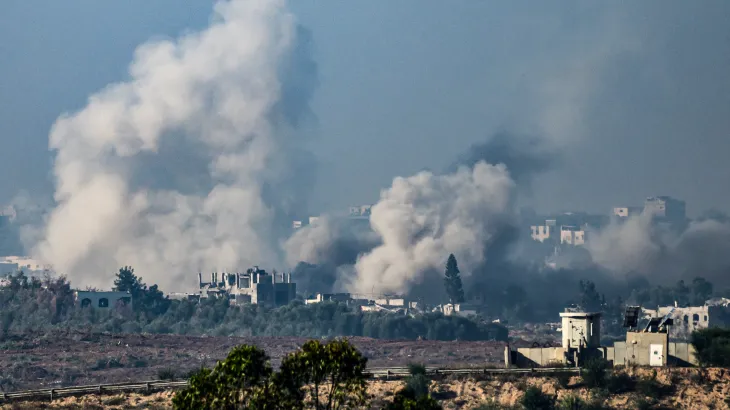
Violence has continued in Gaza despite an ongoing ceasefire, with new drone strikes reported in Jabalia, leaving several people killed and injured. The attacks have intensified fear among civilians already living under severe humanitarian pressure.
According to Daljoog News analysis, the persistence of hostilities during a declared ceasefire highlights the fragility of current arrangements and the widening gap between diplomatic agreements and conditions on the ground.
At the same time, tensions in the occupied West Bank are escalating, with raids, arrests, and settlement expansion drawing renewed international criticism and raising concerns over long-term stability in the region.
What Happened?
In northern Gaza, particularly in Jabalia, residents reported a drone strike that hit a gathering of civilians, causing multiple casualties. Witnesses described the attack as sudden, with families caught off guard during what had been a relatively calm moment.
Local reports also confirmed renewed military activity near hospitals, including areas surrounding Al-Shifa Hospital, where crowds gathered following the incident. The situation quickly escalated into panic as residents rushed to search for survivors and assist the wounded.
Separately, operations were reported in other parts of Gaza, including refugee camps, where several individuals were detained. In the West Bank, confrontations were reported in areas such as Masafer Yatta, where settlers allegedly attacked Palestinian shepherds, while Israeli forces carried out arrests during related unrest.
Further incidents were reported in villages, including Khirbet al-Mufaqara, where property damage and raids were documented amid ongoing tensions.
Why This Matters
The continuation of violence during a ceasefire raises serious questions about enforcement and control on the ground. Civilians remain the most affected, facing repeated exposure to sudden and unpredictable attacks.
In the West Bank, the expansion of settlements remains a key point of contention. The reported approval of more than 30 new settlement locations has intensified concerns about territorial fragmentation and the long-term viability of peace efforts.
These developments are contributing to a broader sense of instability across the occupied territories, where multiple overlapping conflicts are fueling humanitarian and political pressure.
What Analysts or Officials Are Saying
The European Union has strongly criticized recent settlement expansion decisions, stating that unilateral actions undermine international law and worsen tensions in the occupied territories.
EU officials reiterated that the continued expansion of settlements in the West Bank, including areas around East Jerusalem, complicates efforts toward a negotiated settlement.
International observers continue to emphasize that a two-state framework remains the most widely supported path to a sustainable peace agreement. This includes secure and recognized borders for both Israelis and Palestinians.
Security analysts warn that without enforcement mechanisms, ceasefire agreements risk becoming symbolic rather than operational, particularly in densely populated conflict zones like Gaza.
Daljoog News Analysis
The current situation reflects a deepening disconnect between diplomatic language and ground realities. Even during periods labeled as ceasefires, localized violence continues to shape daily life for civilians.
Settlement expansion in the West Bank adds another layer of complexity, as it alters geographic and political realities that future negotiations would need to address. These changes are often irreversible, making long-term compromise more difficult.
At the same time, repeated incidents in Gaza suggest that ceasefire agreements remain fragile without robust monitoring and enforcement. This raises broader questions about the effectiveness of current international mediation efforts.
The risk is not only renewed escalation but also the gradual normalization of intermittent violence, which can undermine prospects for lasting peace.
What Happens Next
Diplomatic pressure is expected to increase on all parties to adhere more strictly to the ceasefire terms and reduce civilian harm. International actors may push for stronger monitoring mechanisms.
In the West Bank, further debate is likely over settlement expansion, with potential diplomatic consequences if tensions continue to rise.
On the ground, humanitarian conditions in Gaza are expected to remain critical, with aid access and civilian protection continuing to dominate international discussions.