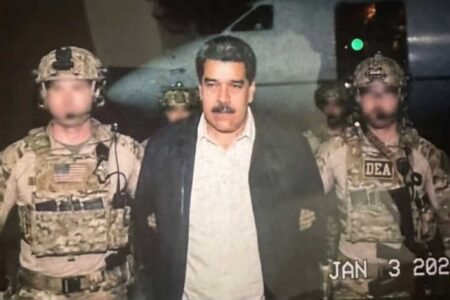




In the early hours of Saturday, a dramatic U.S. military operation unfolded over Caracas, Venezuela. At 2:01 a.m., power went out across the city, plunging the capital into darkness. Within this blackout, a fleet of 150 U.S. warplanes moved to target President Nicolás Maduro’s compound.
A U.S. special forces team descended from helicopters to reach Maduro’s residence. Venezuelan soldiers quickly engaged the attackers, opening fire to defend the president. One U.S. helicopter was reportedly hit during the exchange, but it remained operational and returned safely.
The raid lasted about two and a half hours and involved extensive planning by U.S. military and intelligence agencies. Officials say over 150 aircraft from multiple bases participated, with highly experienced pilots flying at just 100 feet above Venezuelan territory. The operation aimed to detain President Maduro.
Despite strong resistance from Venezuela’s air defense and military personnel, the U.S. forces used advanced aircraft and precision technology to neutralize threats and reach the compound. Venezuelan troops attempted to repel the assault through gunfire and air defense systems, demonstrating significant resilience despite being outmatched technologically.
During the mission, no U.S. soldiers or officers were killed, though two service members sustained injuries, according to President Donald Trump. The helicopters involved in the raid returned safely to their bases after completing the operation.
Venezuelan forces continue to claim that their military successfully defended their territory. Defense Minister Vladimir Padrino said that while U.S. technology is formidable, Venezuelan soldiers showed courage and skill in responding to the incursion. “Our forces resisted the foreign attack and protected the president’s residence,” he said.
The operation marks an unprecedented level of coordination among U.S. military branches and intelligence agencies. Sources report that multiple special forces units combined their expertise to execute the raid. Pilots with thousands of hours of experience navigated dangerous conditions, including active air defenses and challenging terrain, to reach the target.
The attack highlights the tension between the U.S. and Venezuela, which has escalated in recent weeks. Caracas has condemned the raid as a blatant violation of sovereignty and warned that any foreign aggression will be met with strong resistance.
President Trump defended the mission, stating it was necessary to secure Maduro and ensure a controlled transfer of power. The U.S. military’s precision and coordination reportedly allowed the operation to complete without major casualties, despite the intense opposition from Venezuelan forces.
Venezuelan military personnel used gunfire and air defense attempts to disrupt the helicopters, demonstrating determination to protect the president. One helicopter sustained damage but remained airborne and returned safely, illustrating both the resilience of U.S. technology and the challenges faced by attacking forces.
Analysts say the raid could further destabilize the region and increase tensions between the United States and Venezuela. International observers are monitoring the situation closely, particularly as civilian safety and diplomatic implications remain at stake.
This mission also underlines the ongoing struggle for control in Venezuela. While U.S. forces achieved tactical objectives, the Venezuelan military’s response showed the complexity of any foreign operation in the country. The incident reinforces concerns over escalation and the humanitarian consequences of military intervention.
Despite the intensity of the operation, U.S. military and intelligence officials describe the raid as a success, with helicopters and personnel returning safely. President Trump confirmed that only minor injuries were reported among the U.S. soldiers involved, emphasizing that the operation achieved its primary goals.
The Venezuelan government continues to reject U.S. intervention and vows to defend national sovereignty. Meanwhile, international reactions are mixed, with some nations condemning the raid and others withholding comment, reflecting the sensitive geopolitical context.