



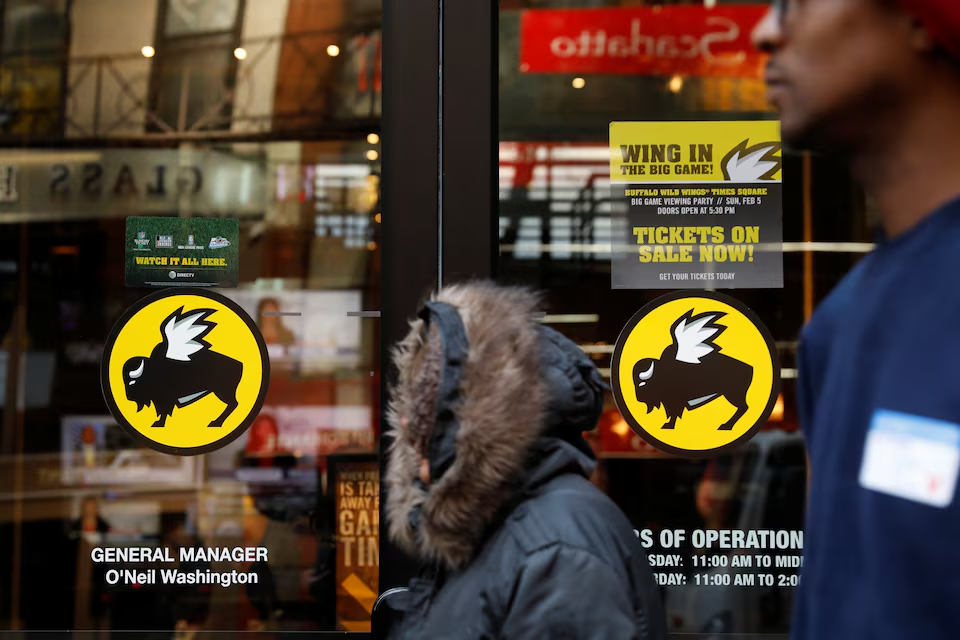
A federal judge in Chicago has dismissed a consumer lawsuit accusing Buffalo Wild Wings of misleading customers by selling “boneless wings” that are not actual deboned chicken wings.
According to Daljoog News analysis, the ruling reinforces a growing judicial reluctance to entertain food-labeling lawsuits that hinge on literal interpretations rather than consumer common sense.
The decision, issued Tuesday in federal court, stops—for now—a proposed class action filed in 2023 by Illinois resident Aimen Halim, who claimed he was deceived into buying what he later described as a chicken nugget marketed as a wing.
What Happened?
John Tharp Jr., a judge in the U.S. District Court for the Northern District of Illinois, dismissed the complaint in a sharply worded opinion.
Halim argued that Buffalo Wild Wings falsely advertised its boneless wings because they are not actual chicken wings with bones removed. Instead, the product is made from breast meat and prepared in a style similar to nuggets.
The lawsuit alleged violations of the Illinois Consumer Fraud and Deceptive Business Practices Act and sought class action status.
Judge Tharp concluded that reasonable consumers understand that “boneless wings” are a common food term rather than a literal anatomical description.
In his ruling, he indicated that Halim failed to present sufficient factual allegations to show deception under consumer protection standards.
Although the court dismissed the case, Tharp allowed the plaintiff until March 20 to amend his complaint and attempt to add new supporting facts.
Why This Matters
Food-labeling lawsuits have surged in recent years, often targeting terms like “natural,” “vanilla,” or “smoked.” Courts increasingly evaluate whether an average buyer would actually be misled.
This ruling suggests that judges may apply a practical lens when assessing claims over menu descriptions.
The restaurant industry has long used shorthand culinary terms that describe preparation style rather than literal ingredients. “Boneless wings” have appeared on menus nationwide for decades.
If courts required strict literal interpretation of menu language, restaurants could face waves of litigation over familiar food terms.
The case also underscores the limits of consumer fraud statutes when plaintiffs rely primarily on semantic arguments rather than demonstrable economic harm.
What Analysts or Officials Are Saying
Legal analysts note that courts generally rely on the “reasonable consumer” standard in deceptive marketing claims.
Under that framework, plaintiffs must show that a significant portion of ordinary buyers would likely be misled.
In this instance, the judge found that consumers understand boneless wings to be a style of chicken dish rather than a promise that wing meat was used.
Industry observers say the ruling aligns with prior cases where courts rejected claims based on exaggerated literal readings of product names.
Consumer advocates, however, argue that companies should maintain transparency and avoid ambiguous terminology.
The balance between marketing language and consumer expectation remains a recurring legal battleground.
Daljoog News Analysis
This case illustrates a broader tension in American consumer law: how far should courts go in policing everyday language?
“Boneless wings” is arguably a culinary category, not a biological claim. The judge’s tone suggests impatience with lawsuits that stretch statutory language to test semantic boundaries.
At the same time, consumer protection laws exist to curb genuinely deceptive practices. When courts dismiss cases early, they signal that not every labeling dispute meets that threshold.
The ruling may deter similar suits targeting menu wording without clear evidence of widespread confusion.
Yet the judge’s decision to allow amendment leaves a narrow opening. If the plaintiff can demonstrate measurable consumer misunderstanding or economic harm, the case could reemerge.
For now, the decision favors a pragmatic reading of marketing language over literal parsing.
What Happens Next
The plaintiff has until March 20 to file an amended complaint with additional factual support.
If no amendment is filed, the case will effectively close at the district court level.
Should Halim submit a revised complaint, the judge will determine whether it satisfies federal pleading standards.
Regardless of the outcome, the ruling may influence future litigation involving food labeling and advertising language.