



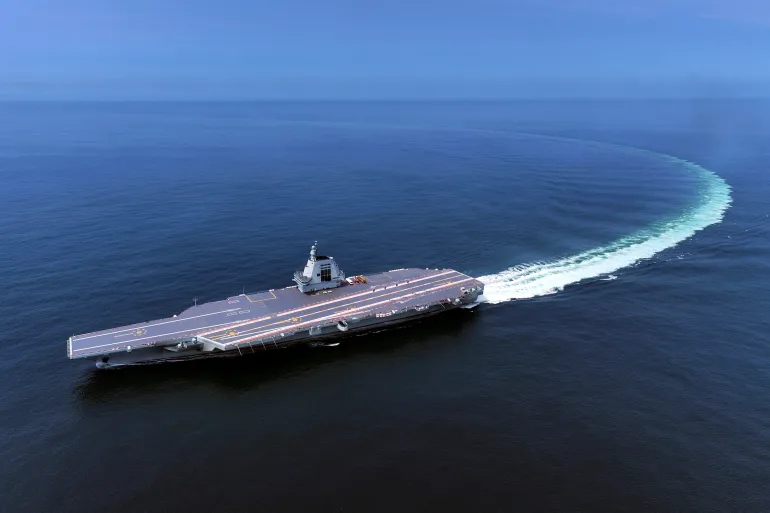
China has officially added its third aircraft carrier, the Fujian, to its naval fleet after extensive sea trials. The new vessel is expected to strengthen Beijing’s influence well beyond its coastal waters.
President Xi Jinping inspected Fujian in Sanya, located on Hainan Island, during the carrier’s commissioning. The ceremony was attended by over 2,000 representatives from China’s navy and shipbuilding teams.
The Fujian is China’s first fully domestically designed and constructed aircraft carrier. Unlike the country’s earlier carriers, Liaoning and Shandong, which were based on older Russian designs and relied on ski-jump ramps for aircraft take-off, the Fujian features a flat flight deck and electromagnetic catapults. These innovations allow it to launch heavier, more advanced jet fighters efficiently.
During sea trials, the Chinese navy tested the carrier with its new J-35 stealth fighter, the KJ-600 early-warning aircraft, and a variant of the J-15 fighter. The Fujian can also operate its own reconnaissance planes, allowing it to conduct missions far from land-based support. This capability gives it a major advantage over the Liaoning and Shandong.
Experts note that Fujian’s operational readiness will take time, but it is a clear sign of China’s rapid military expansion. President Xi has set goals for a modernized military by 2035 and a world-class force to rival the United States by 2050. The commissioning of the Fujian represents a key milestone toward achieving that vision.
Greg Poling, director of the Asia Maritime Transparency Initiative, said aircraft carriers are central to China’s ambitions as a global naval power. “Carriers are key to Chinese leadership’s vision of China as a great power with a blue-water navy,” Poling noted.
China aims to dominate the waters around the South China Sea, East China Sea, and Yellow Sea, a region known as the First Island Chain, which includes Japan, Taiwan, and the Philippines. Beyond this area, Fujian is intended to challenge U.S. influence deeper into the Pacific.
Poling added that while a carrier has limited impact within the First Island Chain, it is crucial for power projection in the wider Indo-Pacific, especially against U.S. naval forces.
The Fujian’s launch is also a technological leap for the Chinese navy. Electromagnetic catapults allow jets to take off faster and carry heavier weapons, similar to systems used on the U.S. Navy’s newest Ford-class carriers. The ability to launch advanced aircraft from a carrier deck significantly increases China’s ability to conduct long-range naval operations.
The ship’s homegrown design marks a strategic shift. Liaoning and Shandong depended heavily on older foreign technology. By contrast, Fujian represents a self-reliant approach that reduces dependence on foreign expertise while enhancing combat capabilities.
Military analysts view the Fujian as a visible sign of China’s intention to compete with global naval powers. Its ability to operate further from Chinese shores and carry advanced aircraft makes it an essential part of Beijing’s long-term maritime strategy.
As China continues its naval buildup, the Fujian could redefine the balance of power in the Asia-Pacific region. The ship’s advanced systems and operational range give Beijing a platform to extend its reach far into international waters while securing strategic interests closer to home.
China’s naval expansion, highlighted by the Fujian, signals a broader ambition: to create a modern, capable, and globally influential military force. For the international community, the carrier’s entry into service underscores China’s determination to compete with existing world powers on both regional and global levels.