


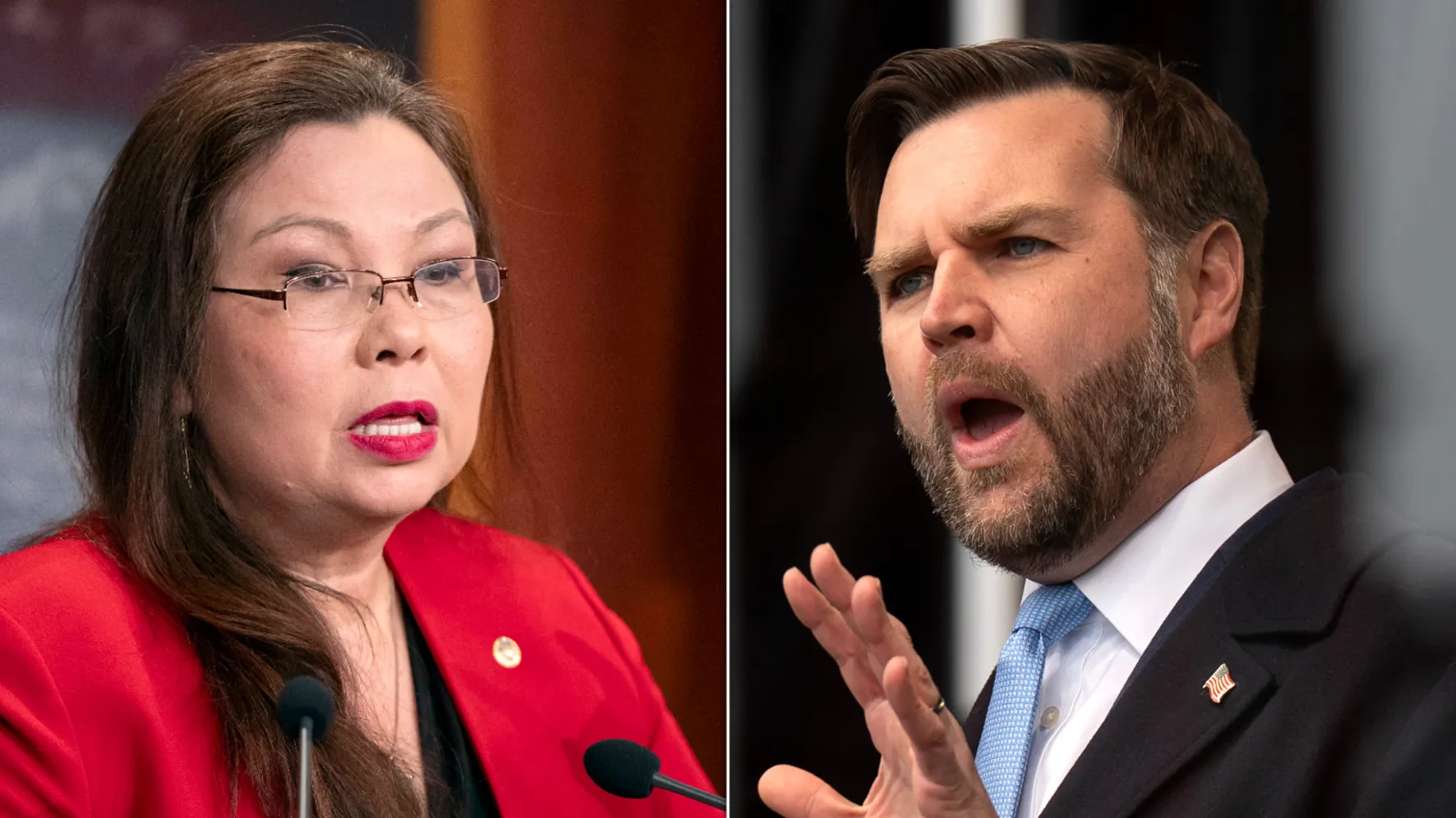
Senator Tammy Duckworth fired back at Vice President JD Vance on Wednesday after he mocked her during a Senate hearing by comparing her to the fictional character Forrest Gump. Duckworth called the remark a “petty insult” that was hurtful to people with disabilities.
The exchange began during a Senate Foreign Relations Committee hearing where Duckworth, a retired U.S. Army lieutenant colonel and Purple Heart recipient, pressed Secretary of State Marco Rubio on whether U.S. actions in the Caribbean were bound by the laws of war and whether American forces might be drawn into Venezuela.
Shortly after, Vance posted a message on social platform X comparing Duckworth’s questioning to Forrest Gump arguing with Isaac Newton. Forrest Gump, played in the film by Tom Hanks, is a character portrayed as having both physical and intellectual disabilities.
Duckworth responded directly on X, rejecting the comparison and using her own military experience to push back. She wrote that Forrest Gump “ran toward danger in Vietnam.” In contrast, she said, “Your boss ran to his podiatrist crying bone spurs,” referring to former President Donald Trump’s medical deferments during the Vietnam War.
She added, “Petty insults at the expense of people with disabilities won’t change the fact that you’re risking troops’ lives to boost Chevron’s stock price. It’s my job to hold you accountable.”
Duckworth lost both her legs and partially lost use of her right arm when her Army helicopter was shot down in Iraq in 2004. Her service and injuries have shaped her reputation as a lawmaker who confronts military and veterans’ issues directly.
Illinois Governor JB Pritzker also defended Duckworth on social media. He called Vance’s post a “random troll” comment and said Duckworth was simply doing her job as a U.S. senator.
The Democratic Party of Illinois backed Duckworth as well, saying voters in the state sent her to the Senate to ask tough questions and demand answers. The party said criticizing her for doing her job was “vile” and highlighted the controversy as a reflection of JD Vance’s attitude.
The clash highlights growing political tensions over foreign policy and public discourse. During the hearing, Duckworth repeatedly challenged Rubio’s assurances regarding military involvement and law-of-war standards. She warned that actions could lead the United States toward another prolonged conflict.
Rubio defended administration policy, emphasizing the president’s authority as commander in chief to protect the United States against imminent threats. He said this authority could involve military or air power, but that military deployment was not anticipated at that time.
Duckworth countered that the country did not need another “forever war” and expressed concern that current actions could lead in that direction.
Critics of Vance’s comparison argue that using a fictional character with disabilities as an insult crosses a line into ableist language. Disability advocates and political commentators have noted that such remarks can distract from serious policy discussions and demean public figures based on physical characteristics.
The incident underscores ongoing political polarization in Washington, where lawmakers and high-ranking officials often trade sharp personal barbs alongside policy debates. It also reflects heightened scrutiny of how elected leaders communicate about each other in public and on social media platforms.
As the debate continues, Duckworth’s response has drawn attention not only for its policy substance, but also for pushing back against rhetoric seen by many as demeaning or divisive. Her remarks signal a broader resistance among some lawmakers to personal attacks that intertwine political disagreement with comments about disability.