



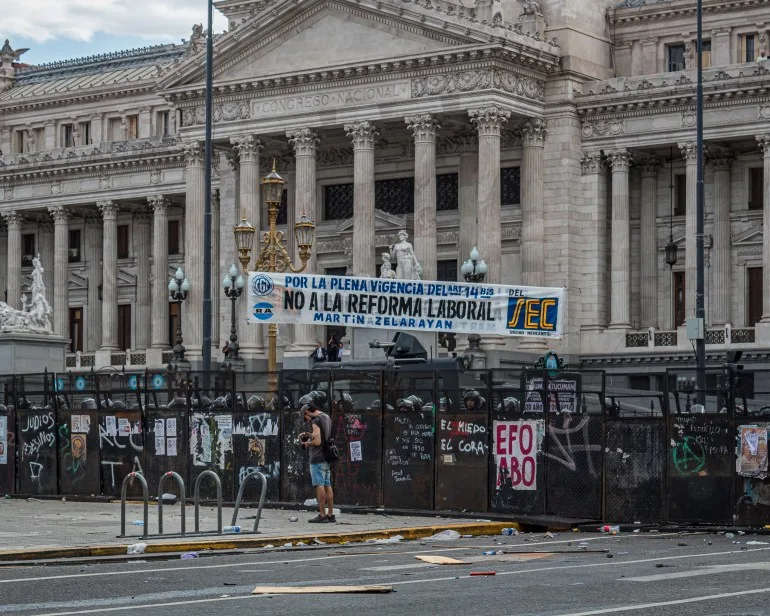
Argentina’s Chamber of Deputies narrowly approved a sweeping labour reform bill after a marathon 12-hour session on Friday, sending shockwaves through the nation’s workforce and sparking protests in Buenos Aires. The legislation, backed by President Javier Milei, introduces major changes to worker protections, overtime rules, and collective bargaining rights.
According to Daljoog News analysis, the law signals a sharp political and ideological shift. Milei’s administration aims to modernise the labour market, reduce hiring costs for businesses, and weaken the influence of historically powerful unions tied to Peronism.
The vote comes after a nationwide strike disrupted factories, banks, transport services, and hospitals, reflecting widespread worker anxiety over job security and pay reductions. The legislation is expected to reach the Senate for final approval before the end of the month.
What Happened?
The new law allows employers to extend workdays from eight to twelve hours, replace paid overtime with a “time bank,” limit uninterrupted vacation periods, and impose caps on severance pay. It also includes tax incentives for hiring and pathways for informal workers to enter the formal labour market.
Lawmakers from Milei’s party, La Libertad Avanza, hailed the bill as a step toward modernising Argentina’s economy and attracting foreign investment. Gabriel Bornoroni, a deputy from the ruling party, described the legislation on social media as a solution for millions currently in the informal economy.
Opposition parties and unions strongly condemned the law. They argue it strips workers of essential rights, increases job insecurity, and could disproportionately harm women who rely on predictable working hours. Roxana Monzon, a national deputy for Union por la Patria, called the “time bank” a tool ripe for exploitation, warning that overtime would no longer guarantee cash compensation.
Why This Matters
Argentina’s labour market is struggling amid a deep economic recession, rising inflation, and stagnant wages. Around 40% of the workforce operates in the informal sector without protection. The government hopes the reforms will lower hiring costs and stimulate formal employment.
However, analysts caution that legislation alone cannot create jobs. Ricardo Diab, president of the Argentinian Confederation of Medium-Sized Enterprises (CAME), stressed that employment growth depends on broader economic activity, not just regulatory changes.
The reforms also represent a symbolic political shift. Milei’s government is challenging the historical dominance of Peronist-aligned unions, which have shaped labour relations for decades.
What Analysts or Officials Are Saying
Experts see the law as a landmark move for Milei, demonstrating his ability to pass major reforms despite fierce opposition. Andres Malamud, senior research fellow at the University of Lisbon, described the bill as more symbolic than economically transformative but noted its potential to weaken union influence and shift Argentina’s political balance.
Workers and citizens have voiced strong concerns. Gabriela Quiroz, a primary school teacher in Buenos Aires, described the bill as an “abysmal step backwards,” warning that cutting overtime pay could reduce household spending, hurting local businesses and deepening economic hardship.
Meanwhile, security forces clashed with protesters outside Congress using water cannon, tear gas, and rubber bullets, highlighting the social tensions underlying the legislative changes.
Daljoog News Analysis
The passage of the labour reform bill underscores a broader struggle between political ideology and economic reality. Milei’s administration seeks to dismantle entrenched labour protections to modernise Argentina’s economy, but the reforms risk alienating workers already coping with inflation and precarious jobs.
The nationwide strike and protests demonstrate the social cost of rapid reform. While the government emphasises investment and productivity, many households worry that income reductions and job insecurity will worsen living standards.
The reforms also carry international significance. By curbing union influence, Milei positions Argentina as a more investor-friendly destination, potentially attracting foreign capital. Yet the political and social backlash could destabilise these efforts if unrest continues.
What Happens Next
The Senate will review the bill and may propose amendments, though final passage appears likely given Milei’s legislative strength.
If enacted, businesses could adjust hiring and overtime practices immediately, affecting millions of workers. Strikes and protests may continue as unions and opposition leaders challenge the law.
Observers will also watch whether the reforms achieve their stated goals of boosting formal employment and investment without triggering wider economic instability. Argentina stands at a pivotal moment, balancing labour market liberalisation with social cohesion and public confidence.