




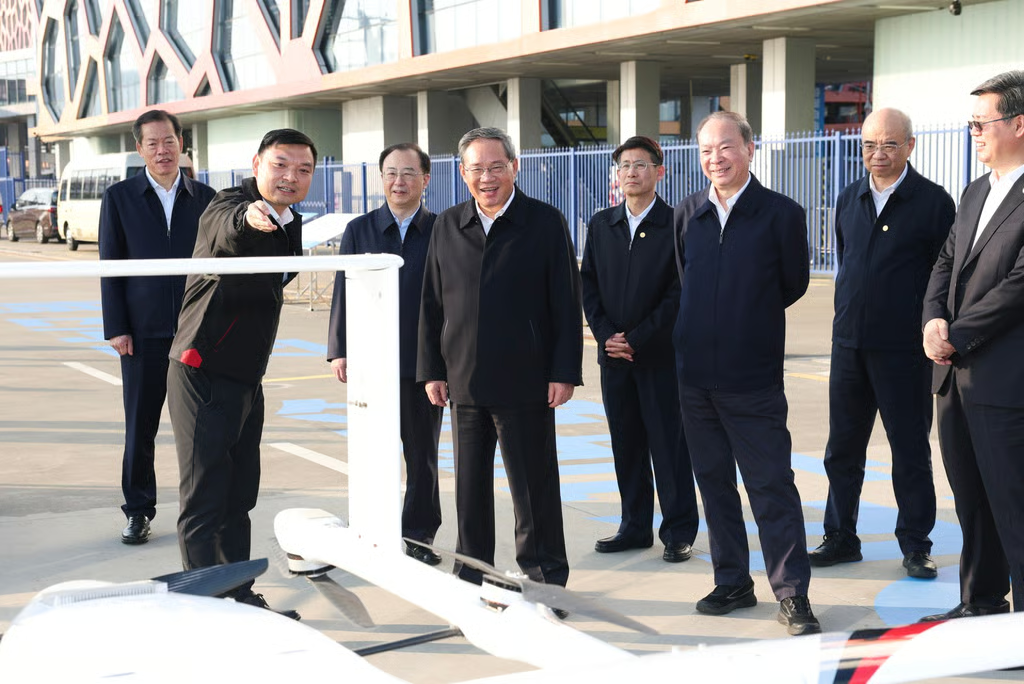
China’s Premier Li Qiang has urged Guangdong to accelerate economic growth and strengthen its position as the country’s leading economic engine. During a three-day visit from Saturday to Monday, Li emphasised innovation, reform, and decisive action as key drivers for the province’s continued success.
Guangdong, China’s largest provincial-level contributor to GDP, has long led the nation’s economy. But the eastern province of Jiangsu is closing the gap, putting pressure on Guangdong to maintain its edge. In 2024, Guangdong recorded a GDP of nearly 14.2 trillion yuan (US$2.03 trillion), growing 3.5% year on year, while Jiangsu grew 5.8% to 13.7 trillion yuan. The GDP difference between the two provinces has shrunk from nearly 804 billion yuan in 2019 to 462.6 billion yuan in 2024.
Premier Li stressed the need for Guangdong to “strengthen advantages in innovative development and take the lead in reform and opening up.” He called for timely and decisive measures to ensure a strong start to China’s 15th five-year plan (2026–2030). “Enterprises should seize the opportunity and drive bold innovation to inject strong momentum into the economy’s steady and improving trajectory,” Li said.
During his visit, Guangdong’s senior officials pledged “extraordinary” efforts to maintain the province’s economic leadership. At a conference on promoting investment, they promised to adopt unconventional strategies, increase intensity in implementation, and launch major initiatives. Key measures include accelerating large projects, removing barriers to private capital, and fully unlocking private investment potential.
Li visited Shenzhen-Hong Kong Innovation and Technology Park, urging stronger support for companies in policies, funding, and talent. He highlighted the importance of breakthroughs in emerging technologies and core sectors. At local robotics firms, he encouraged the expansion of real-world applications to enhance the development and deployment of robots and drones.
In Foshan city, Li inspected a land port for cross-border trade and toured the headquarters of major home appliance maker Midea. He stressed meeting new consumption demands with innovative products to create a virtuous cycle between supply and demand.
Guangdong’s economic performance has been impressive, but its lead over Jiangsu has been narrowing. The first three quarters of 2025 show Guangdong ahead by 236.6 billion yuan, indicating that while the province retains its top position, competition is intensifying. Analysts say Guangdong must accelerate innovation, investment, and market reforms to sustain long-term growth.
Premier Li’s visit comes amid broader concerns over China’s economic headwinds in the new year. Officials are focusing on industrial upgrading, technology innovation, and cross-border trade as key growth drivers. Guangdong, home to the country’s global manufacturing base, is seen as a testing ground for policies aimed at stabilizing growth while pushing technological advancement.
Experts note that Guangdong’s leadership role is critical for China’s national economy. Strengthening innovation, supporting private enterprises, and fostering high-value manufacturing are essential to maintain competitiveness against rising provinces like Jiangsu. Li’s directives highlight a push for bold and rapid action to prevent further narrowing of the economic gap.
The Premier’s emphasis on innovation aligns with China’s strategic goal to lead in emerging technologies. By supporting the Greater Bay Area resources and encouraging technological breakthroughs, Guangdong aims to boost productivity, create new industries, and meet evolving consumer needs. Analysts say the province’s ability to combine innovation, investment, and reform will determine its economic trajectory in the coming years.
Guangdong’s experience demonstrates the challenge of sustaining growth amid regional competition. While it continues to lead China in GDP, Jiangsu’s faster growth rate signals a shifting landscape. Premier Li’s call for extraordinary measures shows that maintaining leadership requires both bold planning and aggressive execution.
As the province implements these strategies, it faces the dual challenge of fostering private sector investment while driving innovation-led industrial upgrades. The coming months will test Guangdong’s capacity to balance reform, investment, and technology advancement, ensuring it remains China’s economic powerhouse.


