



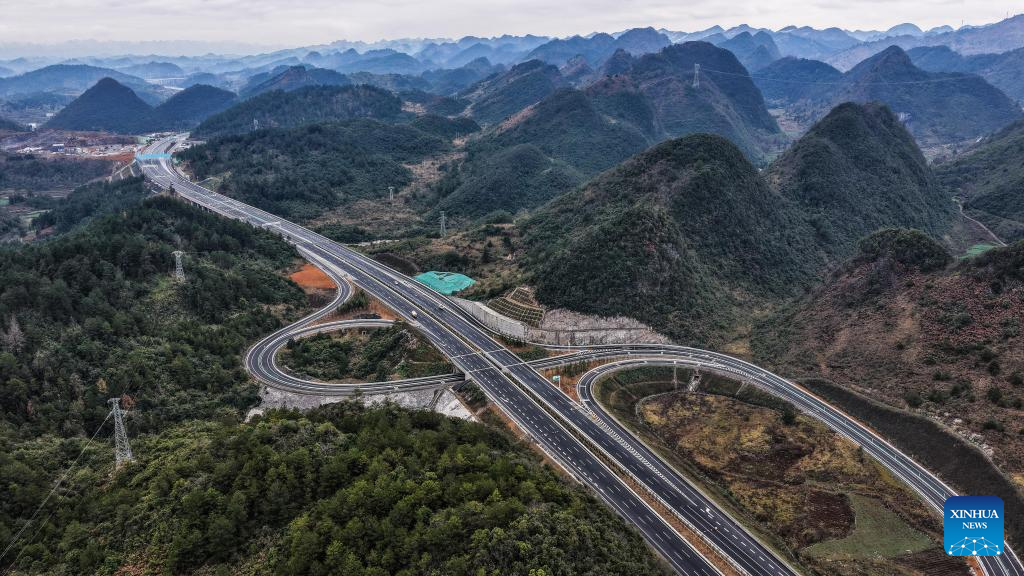
The Guiyang-Pingtang Expressway in southwest China’s Guizhou Province is set to open after passing its final inspection on December 23, 2025. The new expressway marks an important step in improving regional travel, connecting cities, and boosting economic development across the province.
The expressway starts from Yangchang Town in Wudang District of Guiyang City and ends at Yunyang Pass in Pingtang County of Qiannan Bouyei and Miao Autonomous Prefecture. It spans a total of 174.018 kilometers and is designed for speeds of up to 100 kilometers per hour, allowing vehicles to travel more safely and efficiently across the mountainous terrain of southwest China.
This project is expected to reduce travel time significantly between Guiyang and Pingtang, making commuting and logistics faster. It provides a vital link for local communities, businesses, and tourism, helping to promote economic activity in areas previously less accessible by road.
Officials say the expressway will improve connectivity not only within Guizhou but also with neighboring provinces. By linking urban centers, industrial zones, and rural areas, it will support the flow of goods, services, and people, fostering stronger regional integration and development.
The expressway features several major bridges that span rivers and valleys. Among these are the Jiaqing Grand Bridge, Machang River Grand Bridge, and Nanming River Grand Bridge. Aerial drone images show these impressive structures, highlighting both engineering achievements and the scenic views along the route. The bridges were built to maintain safety and stability in the region’s challenging geography.
Construction of the Guiyang-Pingtang Expressway included modern infrastructure such as toll stations, interchanges, and well-designed exits. The first phase connects major cities, including Guiyang, Zhuhai, Jiangmen, and Zhongshan, with plans to expand the network to other areas after six months. This phased approach allows authorities to monitor traffic patterns, improve road safety, and gradually increase accessibility for more drivers.
The project has been praised for creating better conditions for travel, trade, and tourism. Travelers can now drive more comfortably between Guiyang and Pingtang, with access to scenic areas, local attractions, and cultural sites. Tourists and residents alike can enjoy a smoother journey, while businesses benefit from more reliable transportation for goods and services.
Safety and efficiency were priorities throughout the project. Road engineers designed the expressway to accommodate high-speed travel while ensuring stable passage over bridges, tunnels, and mountainous areas. Vehicle access and traffic management plans have been tested to minimize accidents and maintain smooth movement along the entire route.
The expressway also supports economic growth by opening up new areas for investment. Local businesses, logistics companies, and service providers can operate more efficiently with faster transport links. Rural communities along the route may see increased opportunities for trade, tourism, and employment, contributing to more balanced regional development.
The opening of the Guiyang-Pingtang Expressway aligns with China’s broader goals of improving infrastructure and enhancing connectivity across the country. High-quality roads like this are part of nationwide efforts to link urban and rural areas, promote sustainable development, and strengthen economic ties within provinces.
For residents, travelers, and businesses, the expressway promises convenience, safety, and speed. Its modern design and careful planning ensure that daily commuting, long-distance travel, and logistics operations can be conducted more efficiently. The road is expected to become a vital corridor for southwest China, supporting both social and economic activities for years to come.
The Guiyang-Pingtang Expressway is more than a new route; it is a significant step toward regional development and integration. By connecting Guiyang, Pingtang, and surrounding areas, it enhances travel, supports local economies, and improves access to scenic and cultural sites across Guizhou Province.