


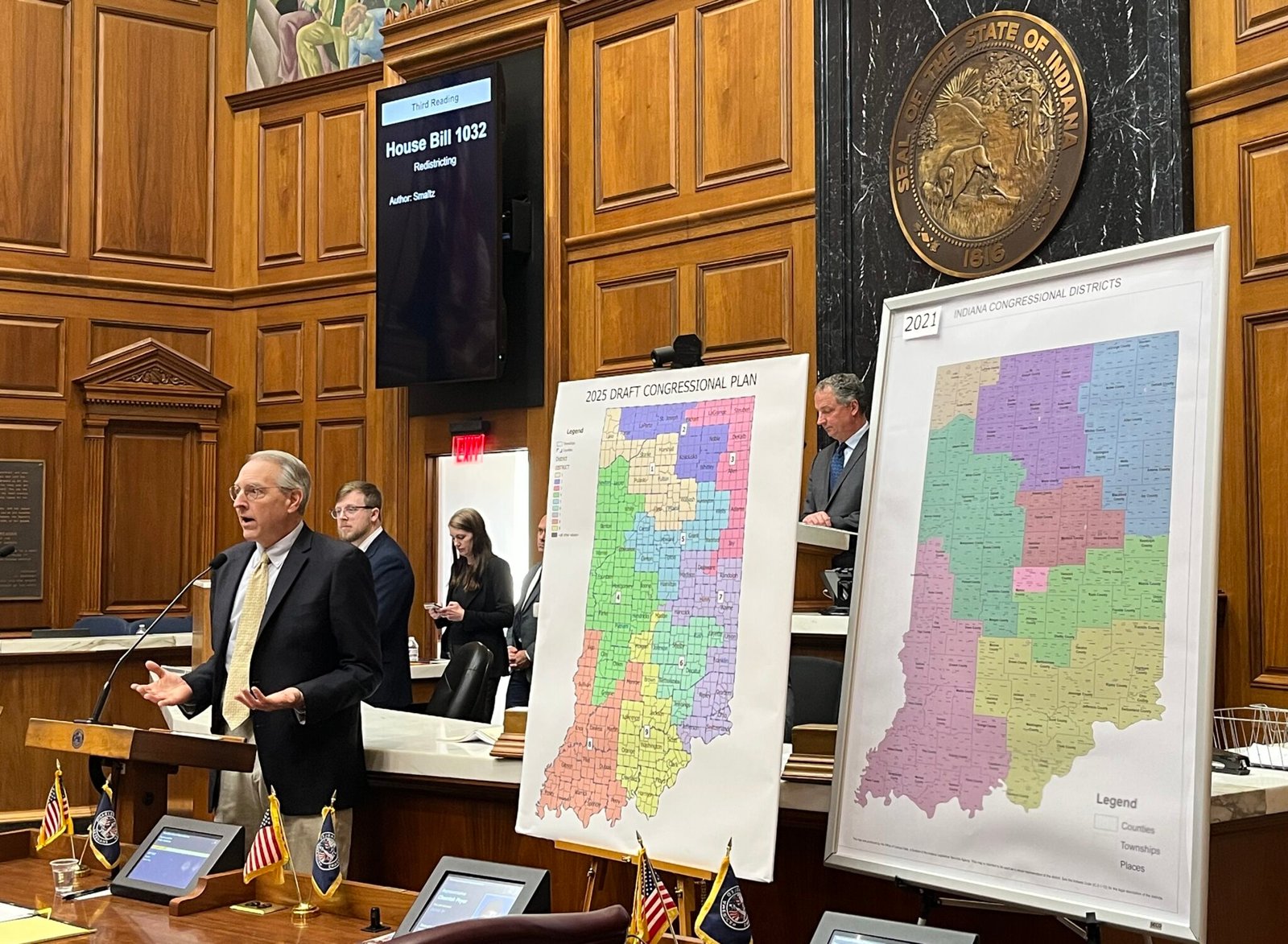
Indiana’s state House on Friday approved a new congressional map designed to make all nine of the state’s U.S. House districts favorable to Republicans. The vote was 57-41 and followed months of intense debate and pressure from President Donald Trump and his allies.
The bill now moves to the Republican-controlled state Senate, which will reconvene on December 8. Some Senate Republicans have expressed opposition to the redistricting plan, though it remains unclear if their resistance will prevent its passage.
Trump praised the House vote on Friday and encouraged the Senate to act quickly. In a post on Truth Social, he named nine state senators who he said “need encouragement to make the right decision” regarding the map.
Several Senate Republicans have publicly opposed the plan. On Wednesday, state Sen. Kyle Walker, a GOP holdout, announced he would not seek reelection. Two other Republicans not seeking reelection, Sens. Eric Bassler and Greg Walker, have also voiced opposition.
The redistricting debate has created a tense environment, including bomb threats and swatting incidents targeting legislators, according to state police. Republican Sen. Jean Leising, who opposed the plan, said she received a pipe bomb threat linked to political pressure from outside Washington.
The House elections committee advanced the measure earlier this week. One Republican joined four Democrats in opposing it, while eight Republicans voted in favor.
For months, the White House had urged Indiana Republicans to redraw congressional maps in a way that would threaten the state’s two Democratic U.S. House members. Trump, Vice President JD Vance, and other administration officials met repeatedly with lawmakers to advocate for redistricting.
Indiana Gov. Mike Braun had called the legislature into a special session in November to consider the measure. Senate President Rodric Bray initially resisted, noting insufficient support. When the session convened, lawmakers agreed to reconvene in January for the regular session.
Trump and his allies intensified pressure on holdout Republicans, threatening primary challenges for those who opposed the plan.
Mid-decade redistricting has become more common this year, a departure from past practice. Republicans with a slim House majority are seeking to secure as many seats as possible before the midterm elections. The approach has precedent: Texas redrew its congressional maps mid-decade during the Bush administration, with the plan upheld by the Supreme Court in 2005.
Other states are pursuing similar strategies. Texas recently reconvened to redraw maps to add up to five Republican seats. In California, Democrats used Proposition 50 to adjust congressional districts for an advantage, winning voter approval with over 64% of the vote. Missouri and North Carolina Republican legislatures have also sought to gain additional seats. Maryland Democrats have considered a similar effort to reduce Republican representation, though they face internal resistance.
Legal challenges have followed some redistricting efforts. The Supreme Court recently allowed Texas to use its new congressional map temporarily, pausing a lower court ruling that found it racially gerrymandered.
Indiana now joins a growing number of states where mid-decade redistricting is reshaping the political landscape. With Senate action pending, the outcome could solidify Republican control of the state’s congressional delegation and intensify national debates over electoral fairness and legislative influence.