


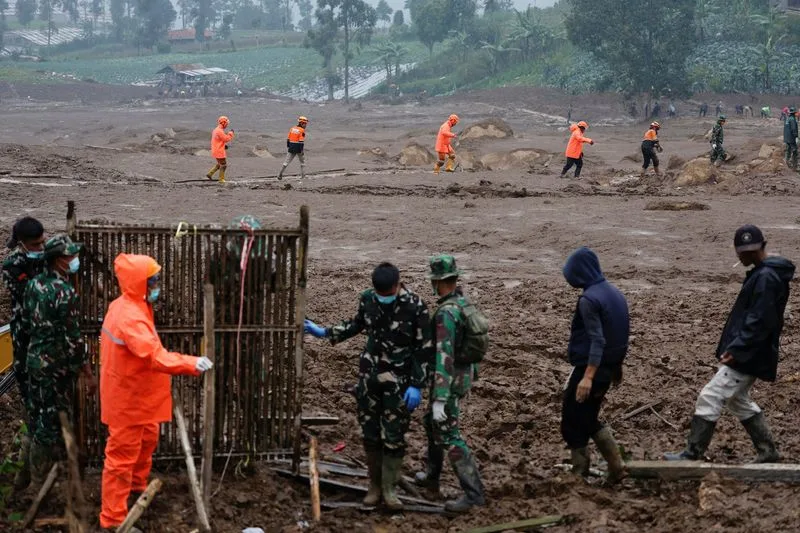
Rescue efforts in Indonesia’s West Java province have been slowed by heavy rainfall, leaving 32 people still missing after a powerful landslide hit a hilly village, authorities said on Wednesday. The death toll from the disaster has risen to 34, marking a deepening humanitarian crisis in the region.
The landslide struck Pasir Langu village in the Bandung Barat area early on Saturday after days of intense rain saturated the slopes and triggered a massive flow of mud and debris. The disaster struck a residential area where many homes were buried, and search teams have been struggling to navigate unstable terrain to reach those still believed to be trapped.
Rain continued to fall at the site on Wednesday morning, forcing search and rescue workers to pause operations at times. “It’s raining in the landslide site this morning but all the rescuers are ready to continue the search, waiting for the right timing,” said Abdul Muhari, a spokesperson for Indonesia’s disaster mitigation agency.
The updated death toll, announced by disaster officials, shows a significant increase from earlier reports. Initial counts after the weekend disaster listed around 20 confirmed deaths, but the number has since risen as more victims were found during recovery efforts. At least 23 people survived the event, according to authorities, although many families still seek news of missing loved ones.
Among those affected, reports indicated that 23 soldiers were killed while taking part in border patrol training when the landslide occurred, according to the Indonesian Navy. Officials have not yet confirmed whether these soldiers are included in the updated 34‑person death count, leaving some uncertainty about the final figures.
Search teams remain on the ground with a strong presence. At least 800 rescuers—including personnel from the military, police, and emergency services—are involved in the operation. They are assisted by nine heavy excavators and other equipment designed to clear debris and reach deeper into the mud where victims may lie.
Nearly 700 residents from the stricken village have been evacuated to local government buildings and shelters due to the threat of further landslides. Many families are staying in community facilities while they await news and support from authorities.
The geography of Pasir Langu, located about 100 kilometers southeast of Indonesia’s capital Jakarta, makes rescue work particularly difficult. The area’s steep hills and narrow access roads complicate movement for heavy machinery and personnel when conditions are dry, let alone when the ground is soaked and unstable from rain.
Indonesia regularly faces natural disasters tied to its climate and terrain. The country’s rainy season, which typically runs from October to March, increases the risk of flash floods and landslides across many regions. In recent months, Indonesia also experienced severe flooding and landslides on Sumatra island, which claimed hundreds of lives and displaced thousands more.
Officials stressed the importance of caution in continuing the search. Heavy equipment can help remove debris, but sudden ground shifts or fresh slides pose serious risks to rescue workers. For this reason, teams are carefully evaluating terrain stability and waiting for drying conditions before resuming full search efforts.
Local authorities have also begun the difficult process of identifying bodies recovered from the site. Teams at temporary mortuary facilities are working with families and forensic experts to confirm identities before remains are released for burial. This process helps give closure to grieving relatives but also takes time due to the complexities of identification after such devastating events.
The toll of natural disasters in Indonesia has placed strain on national and local disaster response teams, who often balance multiple emergencies during the rainy season. In addition to landslides, flooding elsewhere in the archipelago has led to widespread displacement and infrastructure damage, highlighting the intersecting challenges caused by extreme weather.
As of Wednesday, rescue teams remained resolute but cautious, ready to resume operations when weather conditions improve. The priority remains locating those still missing and bringing aid to survivors and evacuees whose lives have been upended by the landslide.