


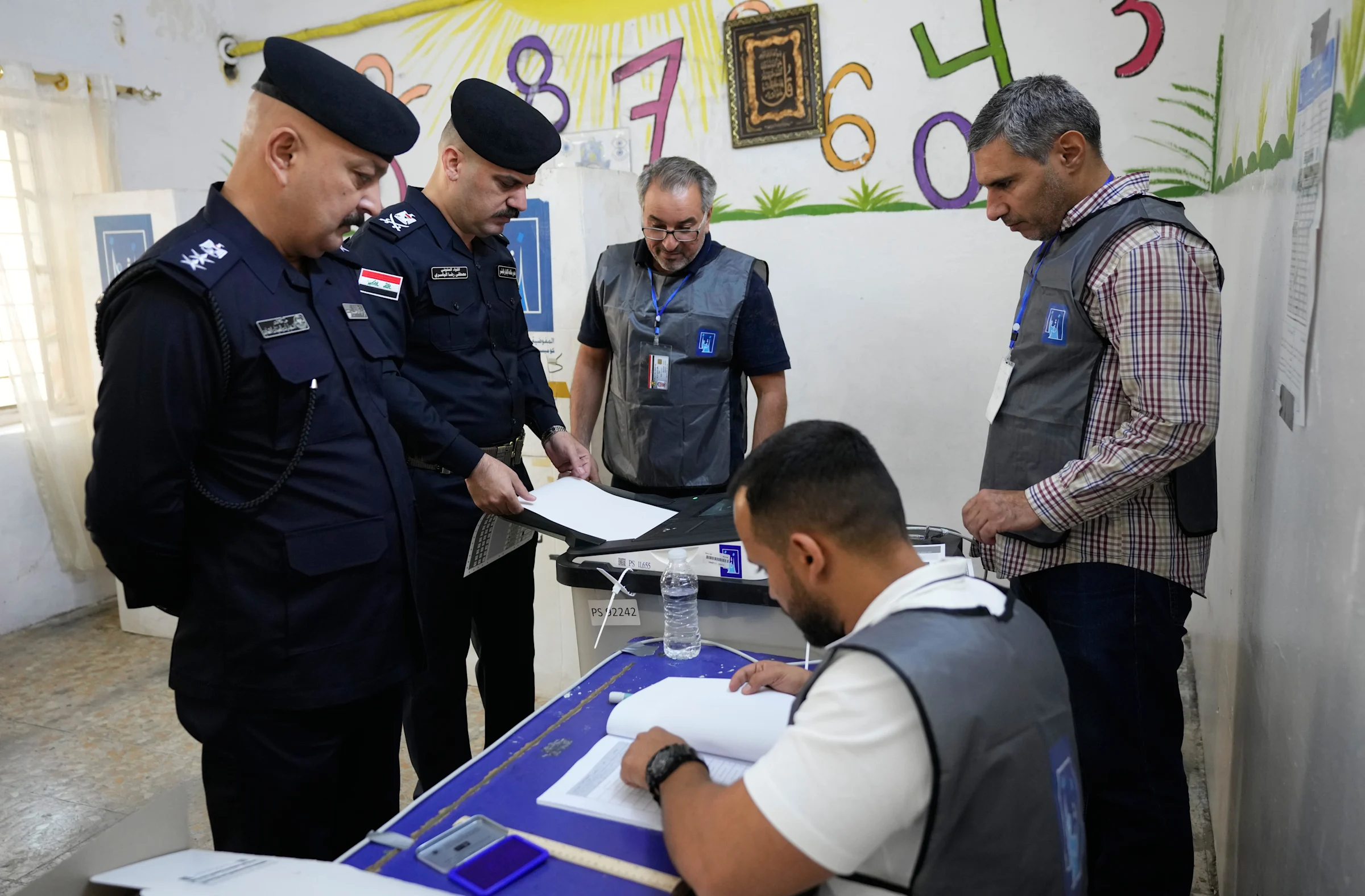
Members of Iraq’s security forces and its internally displaced population began casting ballots on Sunday in the country’s parliamentary elections, the sixth since the US-led invasion toppled Saddam Hussein in 2003.
Voting opened at 7 a.m. (04:00 GMT) for 1.3 million security personnel at 809 polling centers. Ballots will close at 6 p.m. (15:00 GMT) so the forces can be deployed for election day duties on Tuesday. More than 26,500 displaced Iraqis are also eligible to vote early across 97 polling stations in 27 locations nationwide, the Iraqi News Agency reported.
Interior Minister Abdul Amir al-Shammari said the special voting process is proceeding “smoothly and in an organised manner.” Nearly 21 million Iraqis are expected to vote nationwide on Tuesday at 4,501 polling stations.
Over 7,750 candidates are running for the 329-seat parliament, with nearly one-third of them women. By law, 25 percent of seats are reserved for women, while nine seats are allocated to religious minorities. The current parliament began its term on January 9, 2022, and will end on January 8, 2026.
The ongoing elections follow an older electoral law revived in 2023, which many analysts say favors larger parties. About 70 independent candidates won seats in 2021, but only 75 independents are contesting this year. Observers also worry turnout may fall below the record low of 41 percent in 2021, reflecting voter apathy and skepticism in a country marked by entrenched leadership, corruption, and mismanagement.
There have been widespread accusations of corruption and vote-buying ahead of the elections. Election officials disqualified 848 candidates, sometimes for vague reasons, including insulting religious rituals or members of the armed forces. Violence has historically marred Iraq’s elections, including assassinations, attacks on polling stations, and clashes between political blocs. While overall security has improved, a candidate was assassinated before this year’s vote.
Influential Shia cleric Moqtada Sadr called for a boycott, describing the elections as “flawed.” Al-Sadr’s bloc won the largest number of seats in 2021 but later withdrew after failed government negotiations with rival Shia parties. He has since boycotted the political system entirely.
Prime Minister Mohammed Shia al-Sudani, elected in 2022 with the backing of pro-Iran factions, is seeking a second term and is expected to secure a sizeable bloc. Other key contenders include former Prime Minister Nouri al-Maliki and Shia scholar Ammar al-Hakim.
By convention in post-invasion Iraq, a Shia Muslim holds the prime minister’s position, a Sunni serves as parliament speaker, and the largely ceremonial presidency goes to a Kurd.
This early voting for forces and displaced citizens is a crucial step in Iraq’s parliamentary process, ensuring that all eligible voters, including those in sensitive or mobile roles, can participate safely before the nationwide polls on Tuesday.