



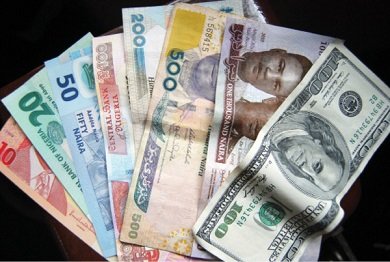
The Nigerian naira has appreciated against the British pound sterling, euro, and Canadian dollar following the introduction of the Electronic Foreign Exchange Matching System (EFEMS) by the Central Bank of Nigeria (CBN). The move, aimed at improving transparency and efficiency in Nigeria’s foreign exchange market, has resulted in significant gains for the naira against major currencies.
CBN Implements EFEMS for Transparent FX Trading
On November 26, 2024, the CBN directed all banks operating in the interbank foreign exchange market to adopt the Bloomberg BMatch System for trading. The system officially went live on December 2, 2024, marking a significant step towards ensuring transparency and efficiency in Nigeria’s foreign exchange operations.
Since the EFEMS launch, the naira has strengthened against the British pound by 209.01/£, reflecting an 11.02% gain. CBN data shows that the pound was quoted at N1,896.62 as of February 21, 2025, compared to N2,105.63 recorded on December 2, 2024.
In the parallel market, commonly known as the black market, the naira appreciated to N1,920/£ as of February 2, 2025, compared to an average rate of N2,238/£ in December 2024.
Naira Strengthens Against Euro and Canadian Dollar
The naira also recorded gains against the euro in the official market, appreciating by 176.67/€ (11.3%) to close at N1,569.16/€ on February 21, 2025, up from N1,745.83/€ on December 2, 2024.
In the black market, the naira strengthened further against the euro, with exchange rates closing at N1,525/€ on February 21, 2025, an improvement from N1,600/€ recorded on the previous day.
For the Canadian dollar, the black market exchange rate stood at N1,100/CAD as of February 24, 2025. This unregulated market often experiences higher rates than the official market due to demand fluctuations and speculative activities.
Naira Gains Against U.S. Dollar
The naira has gained N157.50 against the U.S. dollar since EFEMS implementation, marking a 10.48% rise compared to the N1,660/$ rate recorded on December 2, 2024, according to CBN data.
The Monetary Policy Committee (MPC) attributed the exchange rate stability to improvements in Nigeria’s external sector and the convergence of exchange rates in the Nigeria Foreign Exchange Market (NFEM) and Bureau de Change (BDC) markets. The committee emphasized the importance of sustaining these efforts to maintain a stable exchange rate and boost market liquidity.
CBN’s Ongoing Measures to Stabilize the Forex Market
The CBN has introduced various measures, including the Electronic Foreign Exchange Matching System (B-Match) and the Nigeria Foreign Exchange Code, to promote transparency, ethics, and credibility in the forex market. These steps are expected to enhance investor confidence and increase foreign direct and portfolio investments, as well as diaspora remittances.
In November 2024, the CBN issued comprehensive guidelines for the interbank foreign exchange trading system through EFEMS. The minimum tradable amount was set at $100,000, with incremental clip sizes of $50,000, ensuring fair and efficient market operations.
According to Omolara Duke, Director of the CBN’s Financial Markets Department, EFEMS is designed to ensure “transparent, fair, and efficient FX trading, minimize counterparty risks, and enforce compliance with CBN regulations.”
CBN’s Foreign Reserves Decline Amid Market Interventions
Despite these gains, Nigeria’s foreign reserves have declined by 0.8% week-on-week (approximately $320.6 million) to $38.8 billion as of February 20, 2025, according to Afrinvest Securities Exchange Limited. The decline is attributed to the CBN’s continued intervention in the forex market by supplying U.S. dollars to commercial banks and BDCs to support the naira.
As a result, the naira appreciated across both the Nigerian Autonomous Foreign Exchange Market (NAFEM) and the parallel market, rising by 1.0% and 4.0% week-on-week, respectively, to N1,494.00/$ and N1,495.00/$. The narrowing exchange rate gap between both markets, now just N0.97, indicates increased market stability.
Analysts Predict Naira’s Continued Strength
Looking ahead, analysts at Afrinvest predict that the naira will maintain its positive trajectory across all forex market segments, provided the CBN continues its supply of U.S. dollars to BDCs and commercial banks. However, unforeseen market shocks could impact this trend.
Muda Yusuf, CEO of the Centre for the Promotion of Private Enterprise (CPPE), acknowledged the CBN’s strides in stabilizing the forex market but highlighted challenges posed by the unregulated black market. He emphasized the importance of continuous monitoring and intervention to curb speculative activities.
Experts Urge Caution Despite Naira’s Gains
Bismarck Rewane, Managing Director of Financial Derivatives Company (FDC), cautioned against excessive optimism regarding the naira’s recent appreciation. Speaking on Channels TV, he described the currency’s quick appreciation as “temporary” and advised policymakers to remain cautious.
“We’re seeing that the naira is strengthening, but with caution. Let’s not be too hasty because it’s going to correct itself,” Rewane warned.
He pointed out that Nigeria’s foreign reserves, which once exceeded $40 billion, are now declining, while the country has also borrowed $4 billion in bond issues. According to Rewane, approximately $8 billion has been used to support the naira at its current levels, suggesting that sustainability remains a concern.
The implementation of the EFEMS by the CBN has yielded positive results, strengthening the naira against major foreign currencies and bringing stability to Nigeria’s foreign exchange market. However, experts warn that maintaining these gains will require sustained policy efforts, market interventions, and improved investor confidence.
For more updates on Nigeria’s forex market, visit Daljoog News.