


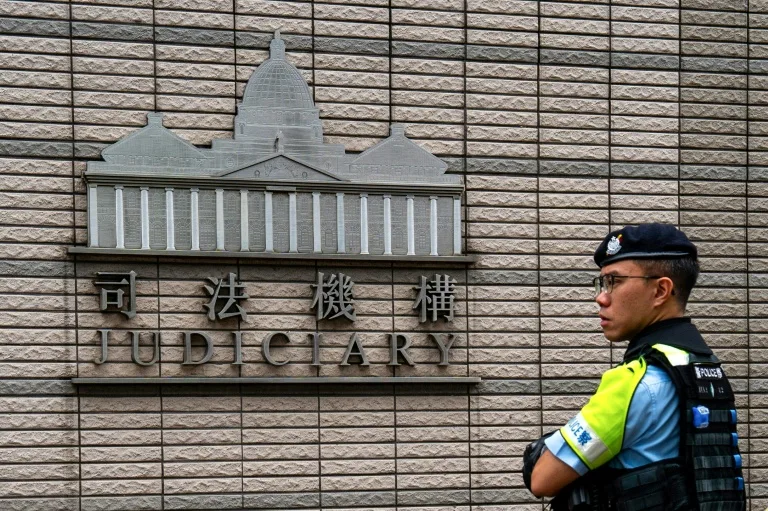
Hong Kong’s top appeals court has upheld the convictions and prison sentences of 12 prominent democracy campaigners jailed under the city’s national security law.
According to Daljoog News analysis, the ruling reinforces Beijing’s tightening grip on the semi-autonomous territory and signals that legal challenges to the 2020 security framework face steep odds.
The decision stems from the largest national security trial in the city’s history, a case that has reshaped Hong Kong’s political landscape since mass protests erupted in 2019.
What Happened?
On Monday, the High Court dismissed appeals filed by 12 of the 45 opposition figures convicted in 2024 for subversion.
The group had organized an unofficial primary election in 2020 aimed at boosting pro-democracy candidates’ chances in upcoming legislative polls. Authorities argued the strategy amounted to a coordinated attempt to paralyze the government by threatening to veto the city’s budget.
Among those whose appeals were rejected were veteran activist Leung Kwok-hung, widely known as “Long Hair,” and former journalist Gwyneth Ho.
Chief Judge Jeremy Poon ruled that the convictions and sentences should stand. The 12 appellants were part of a broader group of 45 individuals sentenced to prison terms ranging from four years and two months to 10 years, depending on their roles.
The charges were brought under the sweeping Hong Kong national security law imposed by Beijing in June 2020.
Prosecutors argued that the primary election was not a normal political exercise but a calculated plan to create a constitutional crisis by blocking government budgets unless demands such as universal suffrage were met.
The court also upheld the acquittal of lawyer Lawrence Lau, rejecting prosecutors’ attempt to overturn his earlier not-guilty verdict.
Why This Matters
The ruling marks another milestone in the transformation of Hong Kong’s political system.
Before 2020, opposition lawmakers routinely used procedural tools, including budget threats, to pressure the executive branch. Defence lawyers argued during appeals that vetoing a budget was a lawful mechanism under Hong Kong’s Basic Law, the city’s mini-constitution.
However, the courts sided with prosecutors, who maintained that the coordinated nature of the plan crossed into subversion under the new security framework.
The case carries broader implications for civil liberties in the territory. International observers have repeatedly expressed concern that the national security law has curtailed freedoms once protected under the “one country, two systems” principle.
With some defendants already serving nearly five years behind bars, the human cost of the crackdown continues to reverberate across Hong Kong’s civic sphere.
What Analysts or Officials Are Saying
Government prosecutors have consistently argued that the unofficial primary was not simply a political exercise but a deliberate attempt to destabilize governance.
During appeal hearings last year, defence counsel contended that lawmakers must retain the right to use budgetary powers as a form of oversight. They argued that elected representatives should not face criminal liability for how they vote in the legislature.
The court rejected that interpretation, reinforcing a narrower reading of permissible political conduct under the security law.
Legal experts note that the judgment aligns with a pattern seen in earlier national security cases, where courts have prioritized state stability over expansive interpretations of legislative autonomy.
Meanwhile, some defendants who did not appeal have already completed their sentences. As of last month, 18 individuals have been released after serving their terms.
Daljoog News Analysis
The appeals ruling confirms what many observers have anticipated: Hong Kong’s judiciary is unlikely to dilute the reach of the national security law.
While courts maintain procedural rigor, the interpretive direction has remained consistent. Political coordination aimed at challenging executive authority now carries significant legal risk.
The case also illustrates how institutional boundaries have shifted. Tools once considered part of normal legislative strategy—such as leveraging budget approvals—are now framed through a national security lens.
Beijing’s 2020 intervention fundamentally altered the city’s political equation. The law was introduced after months of intense protests in 2019, some of which turned violent. Since then, authorities have argued that stability and order require stronger guardrails.
Critics counter that the legal changes have narrowed the space for opposition politics to near extinction.
The outcome of this appeal cements the precedent that collective political action, even within electoral processes, can be treated as subversive if authorities deem its intent confrontational.
That reality reshapes how future candidates, activists, and civic groups will calculate political risk in Hong Kong.
What Happens Next
With the appeals dismissed, the 12 activists will continue serving their sentences unless further legal avenues are pursued.
Attention may now shift to whether any defendants seek leave to appeal to Hong Kong’s highest court, though such applications face high thresholds.
International reaction is also likely, particularly from governments that have criticized the security law since its enactment.
Domestically, the ruling reinforces the legal environment ahead of future elections. Political participation in Hong Kong now operates within boundaries more tightly defined than at any point since the city’s 1997 handover.
As the legal landscape continues to evolve, Daljoog News will monitor how this precedent influences governance, civil society, and Hong Kong’s global standing.