

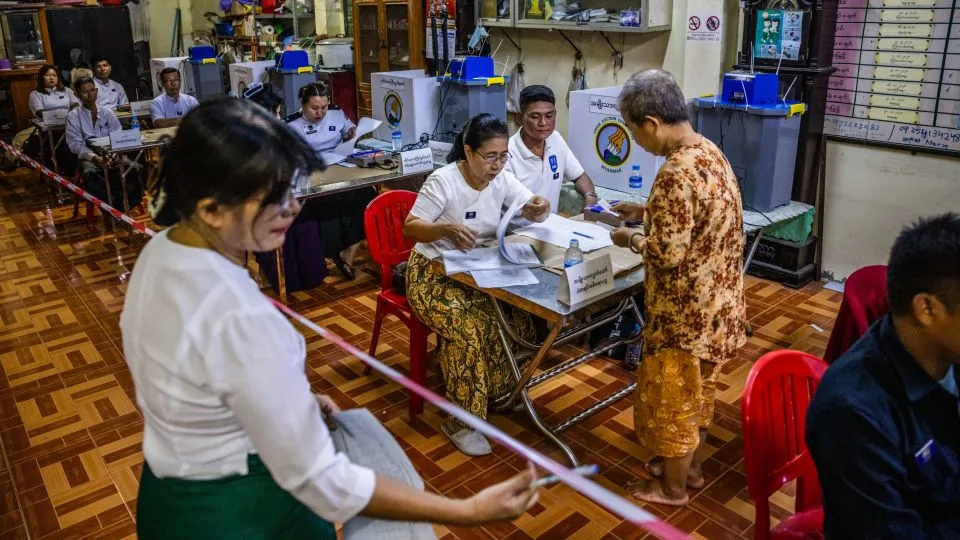
Myanmar’s military election began on Sunday, marking a contentious vote nearly five years after generals seized power from an elected government. The coup sparked a civil war that continues to devastate the country.
Aung San Suu Kyi, Myanmar’s most popular politician, remains imprisoned, while her party has been dissolved. The ballot is dominated by parties seen as aligned with the military. Hundreds have been arrested under a new law that criminalizes criticism, disruption, or obstruction of the vote.
Large regions of the country will see no voting at all, as the military battles ethnic rebels and pro-democracy fighters across borderlands and central plains.
Last year, these opposition groups inflicted several defeats on junta forces, raising hopes of ending decades of military dominance. However, this year, the military has regained territory with reinforcements from tens of thousands of new conscripts and Chinese-supplied weapons. Analysts say this regained control allowed the junta to organize the election, aiming to show the world a functioning parliament where a quarter of seats are reserved for the military.
In Yangon, Myanmar’s commercial hub, national flags lined major streets, and state media broadcast extensive coverage of the vote. The military’s top leader, Sen. Gen. Min Aung Hlaing, urged voters to choose candidates “who can cooperate sincerely with the Tatmadaw,” the Burmese word for the armed forces.
The atmosphere differs sharply from earlier elections when Myanmar experimented with democracy. Suu Kyi, who won the Nobel Peace Prize, is serving a 27-year sentence after convictions widely seen as politically motivated. Her nonviolent resistance, once the heart of Myanmar’s democracy movement, has all but disappeared amid civil war.
UN investigators and human rights groups report widespread abuses by the military against civilians and combatants. Humanitarian conditions have worsened, with aid blocked and health facilities targeted. The military’s tactics include bombing villages, mass arrests, forced conscription, and attacks on opponents. The junta denies atrocities, claiming it targets “terrorists.”
Critics argue that free and fair elections are impossible under these conditions. Arrests, torture, and the criminalization of political opposition have left voters with little choice. United Nations officials describe the vote as a sham designed to maintain military power.
The junta defends the election as part of a disciplined, multiparty democracy, saying international approval is not required.
The coup in February 2021 triggered a brutal crackdown after Suu Kyi’s National League for Democracy (NLD) won elections deemed free and fair by international observers. Young protesters fled to rebel-held border areas, forming the People’s Defense Forces to oppose military rule. Over five years, fighting has displaced more than three million people and devastated Myanmar’s economy. The country has become a major producer of methamphetamine and illicit opium, and criminal networks flourish in areas controlled by armed groups.
The military has allies in Russia and China, both of which have supported the elections. Western nations, including the United States and Japan, reject the junta’s legitimacy, while neighboring Thailand and India urge dialogue. China has brokered the return of key rebel-held areas, including gemstone-rich regions, to junta control.
Voting will take place in three stages, with the second and third rounds scheduled for January 11 and 25. Observers warn that rising violence, intimidation, and restricted freedoms undermine the integrity of the election. Analysts say any new administration is unlikely to challenge the military’s central control.
Many citizens see little point in voting. Su, an accountant in Yangon, said earlier elections allowed genuine choice, while this year, electronic ballots accept only junta-approved parties. Ko Win, who voted in previous elections, expressed cautious hope but declined to elaborate.
In conflict zones, residents are even more skeptical. Maw, a teacher in Kayah state, called the vote “unfair” and “a sham election,” reflecting widespread distrust among those living under the shadow of war.