

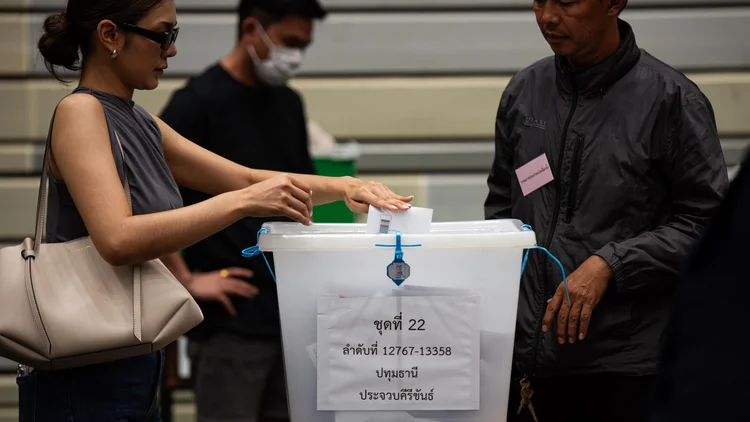
Thailand held a general election on Sunday, with voters choosing between popular reformists and conservative forces amid continued political uncertainty.
According to Daljoog News analysis, the vote comes after two years of rapid leadership changes, reflecting deep divisions in the country’s political system and ongoing influence from unelected institutions.
The incoming government will face pressing challenges, including slow economic recovery, ongoing border disputes, and the persistent threat of organized cyber scams affecting the region.
What Happened?
Voters in Thailand went to the polls to select representatives, while no party is expected to win an outright majority. Coalition negotiations are expected to follow the results expected late Sunday.
The progressive People’s Party, successor to the Move Forward Party that dominated the last election but was later dissolved, led opinion polls. Party leader Natthaphong Ruengpanyawut expressed confidence after casting his vote in Bangkok, pledging a government that benefits all citizens, not just elites.
Meanwhile, the conservative Bhumjaithai party, led by incumbent Prime Minister Anutin Charnvirakul, is polling second. Analysts predict it could retain power through a coalition with the third-ranked Pheu Thai party, the political vehicle associated with former Prime Minister Thaksin Shinawatra.
Thailand has seen rapid political turnover. After the 2023 election, Thaksin’s daughter Paetongtarn Shinawatra was removed from office by the constitutional court, paving the way for Anutin’s premiership—marking the third prime minister in just two years.
Why This Matters
Thailand’s politics are heavily influenced by institutions not directly elected by the public. The military and judiciary have repeatedly intervened, dissolving parties and ousting leaders.
Political scientist Napon Jatusripitak notes that elected leaders can be undermined by unelected actors, creating instability in a country with limited democratic experience.
Border security and defense remain major concerns. Recent clashes with Cambodia have heightened public anxiety, and voters are seeking leadership capable of protecting sovereignty. At the same time, the economy faces headwinds, with tourism still recovering from the Covid-19 pandemic and local scams threatening investor confidence.
What Analysts or Officials Are Saying
Thitinan Pongsudhirak, a political scientist, warned that forces beyond the political arena often determine outcomes in Thailand. Legal challenges and party dissolutions have repeatedly overridden popular vote results.
Observers also note that Move Forward’s dissolution was based on its proposed reforms to Thailand’s royal insult law, a highly sensitive issue in the country. This topic has not been central to the People’s Party campaign this time, suggesting a more cautious approach.
Pheu Thai’s influence has waned following Thaksin’s imprisonment and Paetongtarn’s removal. Polls place the party at just 16 percent, far below its historical support levels, while Bhumjaithai leverages national defense and public safety as key electoral issues.
Daljoog News Analysis
Thailand’s election reflects the country’s ongoing struggle to balance democratic aspirations with entrenched institutional control. Reformist parties promise progressive policies such as ending conscription and reducing military influence, while conservatives emphasize stability and defense.
Populist handouts remain a feature of the campaign. Pheu Thai, for instance, has pledged daily cash prizes to stimulate the economy, while all major parties continue to propose policies appealing to voters’ short-term needs.
The election also includes a referendum on whether citizens support constitutional reform in principle, although no specific measures are presented, highlighting the continuing debate over governance structures.
What Happens Next
No single party is expected to secure a majority, meaning coalition negotiations will play a decisive role in forming the next government. Analysts predict Bhumjaithai could maintain influence through alliances despite public support for reformists.
The results will shape Thailand’s political trajectory, testing whether reformist voices can gain power in a system where the military and judiciary retain significant influence.