

Violence swept across western Mexico after security forces killed cartel leader Nemesio Rubén Oseguera Cervantes, widely known as “El Mencho,” during a federal military operation in Jalisco state.
According to Daljoog News analysis, the operation marks one of the most consequential blows to organized crime in Mexico in years, but the immediate aftermath shows how quickly cartel networks can destabilize entire regions.
The death of the 59-year-old leader of the Jalisco New Generation Cartel, or CJNG, triggered hours of coordinated retaliation, including burning vehicles, roadblocks and airport disruptions across multiple states.
What Happened?
Mexico’s Ministry of Defense confirmed that troops launched an operation in the town of Tapalpa, Jalisco, where Oseguera Cervantes was located.
Officials said soldiers came under fire during the raid. Four individuals were killed at the scene. Three others, including Oseguera Cervantes, were wounded and later died while being transported to Mexico City. Two suspects were arrested. Authorities also seized armored vehicles, rocket launchers and additional weapons.
Three members of Mexico’s armed forces sustained injuries and received medical treatment.
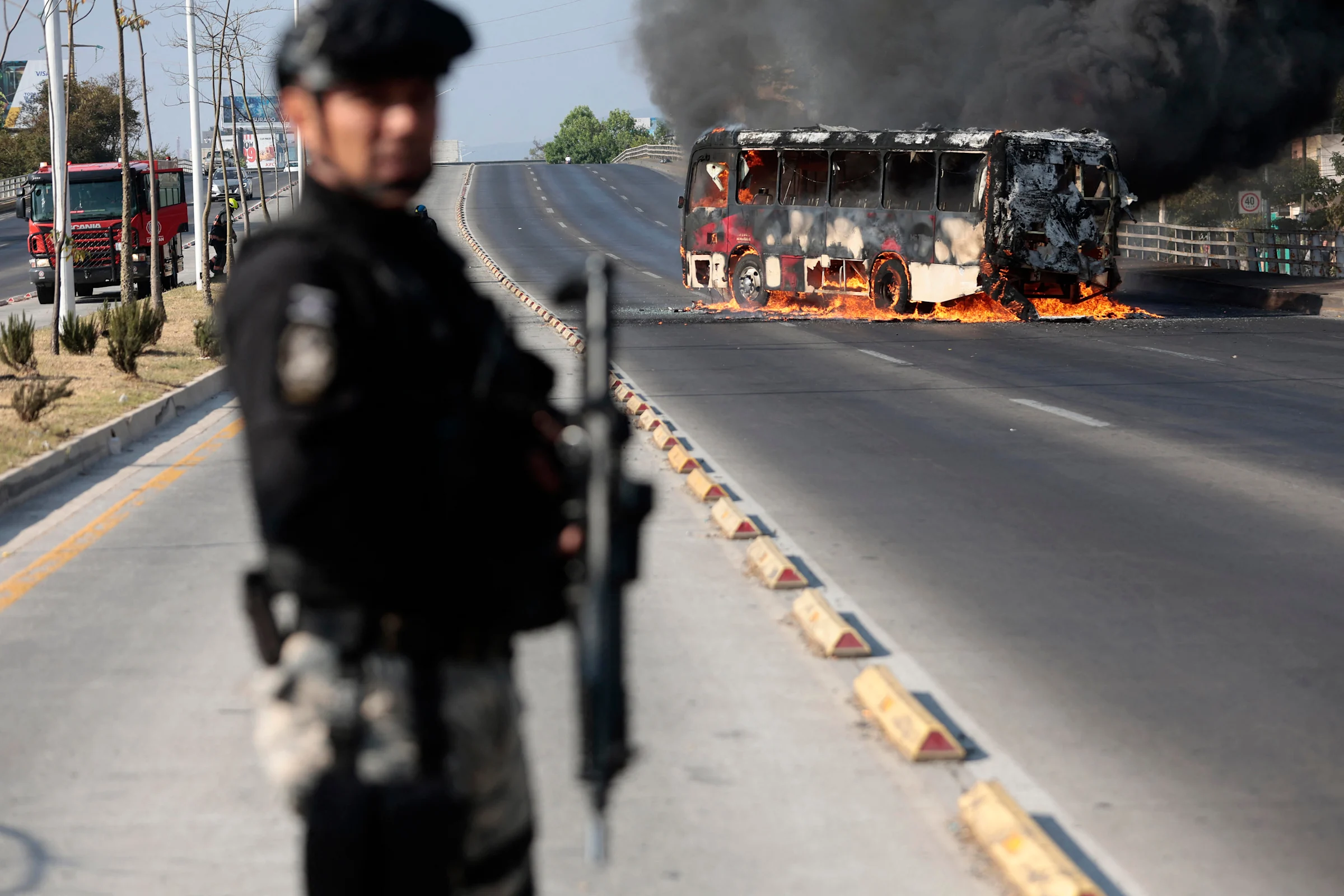
The killing of El Mencho, long considered one of the most powerful drug traffickers in the world, immediately sparked violent unrest. In Jalisco and neighboring states, criminal groups set vehicles ablaze and blocked major highways.
In Guadalajara, Mexico’s second-largest city, burning trucks shut down key roads. Similar scenes unfolded in Puerto Vallarta, where smoke rose above parts of the city, and panic spread near the airport.
Reynosa, near the U.S. border in Tamaulipas, also experienced disruptions. Roads leading to international bridges were reportedly blocked, complicating cross-border movement.
Jalisco Governor Pablo Lemus Navarro activated a “code red,” suspending public transportation and urging residents to remain indoors.
President Claudia Sheinbaum Pardo acknowledged the unrest but stated that most of the country remained calm.
Why This Matters
El Mencho’s death represents a historic moment in Mexico’s long struggle against cartel violence.
CJNG has grown into one of the most aggressive and sophisticated criminal organizations in the Western Hemisphere. The U.S. Drug Enforcement Administration has repeatedly ranked it alongside the Sinaloa Cartel in influence and reach.
The group dominates fentanyl trafficking routes into the United States and operates in all 50 U.S. states, according to U.S. authorities.
El Mencho had been indicted multiple times in U.S. federal court, and the U.S. State Department had offered a reward of up to $15 million for information leading to his capture.
The Trump administration formally designated CJNG as a foreign terrorist organization in 2025, citing its role not only in narcotics trafficking but also in extortion, migrant smuggling and arms trade.
His removal disrupts leadership at the top of a cartel known for military-style tactics, including drone-launched explosives and direct attacks on helicopters.
Yet the scale of retaliation following his death highlights CJNG’s capacity for coordinated violence, even without its central figure.
What Analysts or Officials Are Saying
U.S. Deputy Secretary of State Christopher Landau described the operation as a major victory against organized crime.
A U.S. defense official confirmed that American forces provided intelligence support through joint task force coordination but emphasized that the mission itself was carried out by Mexican forces.
Former DEA international operations chief Mike Vigil characterized the strike as one of the most significant actions in the history of drug enforcement, placing El Mencho in the same league as Joaquín “El Chapo” Guzmán and Ismael “El Mayo” Zambada.
Airlines reacted quickly to the instability. Air Canada temporarily suspended operations at Puerto Vallarta Airport. Delta Air Lines, Southwest Airlines and Alaska Airlines canceled flights or issued travel waivers. U.S. authorities issued security alerts advising Americans in affected states to shelter in place.
The U.S. State Department urged citizens in Jalisco, Tamaulipas, Michoacán, Guerrero and Nuevo León to remain indoors until further notice.
Daljoog News Analysis
The killing of El Mencho delivers a symbolic and operational blow to one of Mexico’s most feared cartels. But history suggests that leadership decapitation alone rarely ends organized crime networks.
Cartels often operate through layered command structures. Removing a top figure can trigger internal power struggles or retaliatory violence as factions seek to demonstrate strength.
CJNG’s swift response — blocking roads across several states and targeting transport infrastructure — appears designed to signal resilience.
Mexico’s security forces now face a critical window. Maintaining pressure could weaken the group’s cohesion. Allowing violence to spiral may reinforce perceptions that the cartel retains territorial control.
There is also a cross-border dimension. The United States has deepened intelligence coordination with Mexico, particularly on fentanyl trafficking. This operation underscores growing bilateral security cooperation.
However, sustained impact will depend on whether authorities can dismantle financial networks, arrest regional commanders and disrupt supply chains beyond a single headline operation.
What Happens Next
Authorities are likely to intensify operations against CJNG leadership in the coming days to prevent regrouping.
Security conditions in Jalisco and surrounding states remain fragile. Travelers should monitor official advisories closely.
Investigators will also assess succession dynamics within the cartel. A power vacuum could lead to either fragmentation or consolidation under a new leader.
For now, the death of El Mencho marks a turning point — but not the end — in Mexico’s battle against organized crime. Daljoog News will continue tracking developments as the security landscape evolves.