

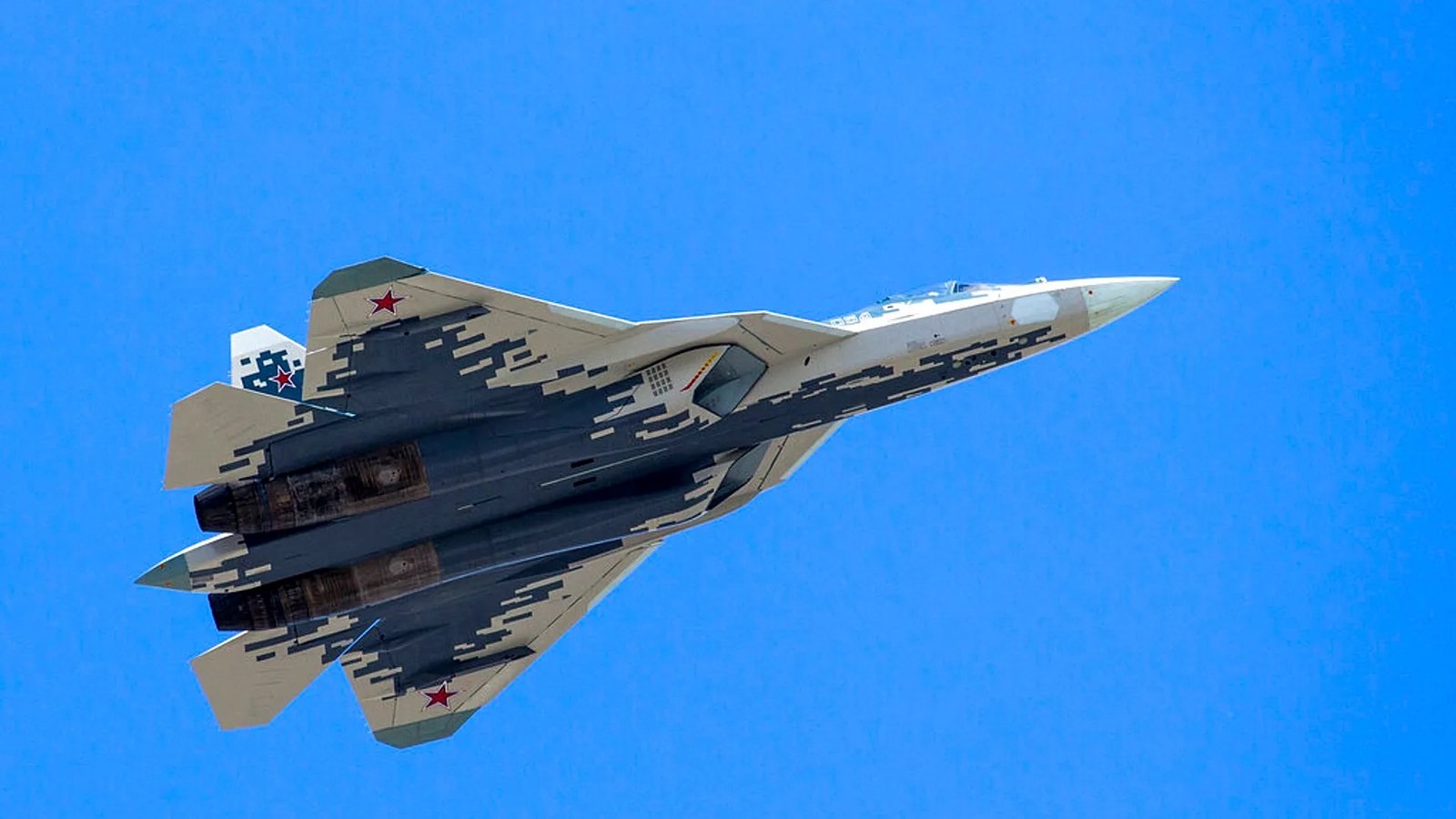
Russia has announced that it signed an export agreement for its fifth-generation Su-57 fighter jet with a Middle Eastern country, but it did not disclose the buyer’s name. The secrecy has fueled speculation that Iran could be the intended recipient.
According to Daljoog News analysis, if Tehran acquires the Su-57, it would mark a major shift in regional airpower dynamics. Such a deal would signal deepening military cooperation between Moscow and Tehran at a time of rising geopolitical tension.
The report comes as Russia and Iran expand defense ties, including drone cooperation during the Ukraine war and discussions over advanced aircraft transfers.
What Happened?
Russian officials indicated that a contract has been signed to export the Sukhoi Su-57 to a country in the Middle East. Moscow has not publicly identified the partner state.
Military analysts quickly pointed to Iran as a possible buyer. Tehran has long sought to modernize its aging air force, which still relies heavily on aircraft acquired before the 1979 revolution.
In recent years, defense cooperation between Russia and Iran has intensified. Tehran supplied Shahed drones to Moscow during the Ukraine conflict. In return, Russia has explored options for advanced aviation support and fighter aircraft transfers.
The Su-57 represents Russia’s most advanced stealth combat platform. It features advanced radar systems, electronic warfare capabilities, and air-to-air and deep-strike mission profiles designed to compete with Western fifth-generation jets.
Why This Matters
Iran’s air force faces significant modernization gaps. Decades of sanctions have limited access to cutting-edge Western platforms. If Iran secures the Su-57, it would gain stealth capability for the first time.
Stealth technology reduces radar detection and enhances survivability in contested airspace. This could alter military calculations for Israel, Gulf states, and U.S. forces stationed in the region.
Currently, Israel operates the F-35 Lightning II, making it the only Middle Eastern country with active fifth-generation stealth fighters. An Iranian Su-57 fleet would challenge that exclusivity.
The shift would not only affect Israel. The United States maintains air bases and naval forces throughout the Gulf. A modernized Iranian fleet equipped with long-range air-to-air missiles and advanced sensors could complicate operational planning.
What Analysts or Officials Are Saying
Russian defense commentators describe the Su-57 as a game-changing platform capable of high-speed maneuvering, electronic warfare dominance, and advanced radar tracking. They argue that export interest reflects growing confidence in the aircraft’s maturity.
Iranian officials have not confirmed any finalized agreement but have repeatedly emphasized the need to upgrade national defense capabilities. Tehran frames such acquisitions as defensive and sovereign decisions.
Western analysts urge caution in assessing the immediate impact. They note that acquiring fifth-generation jets involves training, logistics, maintenance infrastructure, and integration with existing systems. These processes take years.
Regional security observers also warn that a confirmed deal could trigger countermeasures. Gulf states may accelerate procurement of advanced missile defense or additional F-35 units.
Daljoog News Analysis
The possibility of Iran obtaining the Su-57 signals more than a hardware upgrade. It reflects a strategic alignment between Moscow and Tehran that extends beyond battlefield cooperation.
For Russia, exporting its flagship fighter strengthens political ties and challenges Western influence in the Middle East. For Iran, the acquisition would symbolize technological advancement after decades of isolation.
However, stealth capability alone does not instantly rebalance airpower. Operational readiness, pilot training, and networked defense systems determine effectiveness. Without full integration, even advanced aircraft remain limited assets.
Still, perception shapes deterrence. The mere announcement of a potential transfer forces regional militaries to reassess threat models. In a region already tense over missile programs and nuclear negotiations, advanced fighter deployments add another layer of complexity.
What Happens Next
Attention will now focus on confirmation. Moscow may reveal the buyer once production and delivery timelines solidify. Tehran’s official acknowledgment would further clarify the situation.
If Iran proceeds with procurement, training programs, and infrastructure upgrades will follow. Delivery schedules could span several years.
Regional rivals are likely to respond by strengthening air defense systems and deepening security partnerships with Washington.