

SpaceX has officially merged with Elon Musk’s AI startup xAI, consolidating two of the billionaire entrepreneur’s most ambitious ventures. The deal aims to combine space exploration, artificial intelligence, and advanced communications under a single corporate umbrella.
According to Daljoog News analysis, the merger signals Musk’s strategy to extend AI beyond Earth’s energy and infrastructure limitations, potentially creating the world’s first large-scale space-based AI ecosystem.
The announcement comes ahead of SpaceX’s planned initial public offering, which could now take on a new dimension with xAI’s AI technologies integrated into Musk’s space ambitions.
What Happened?
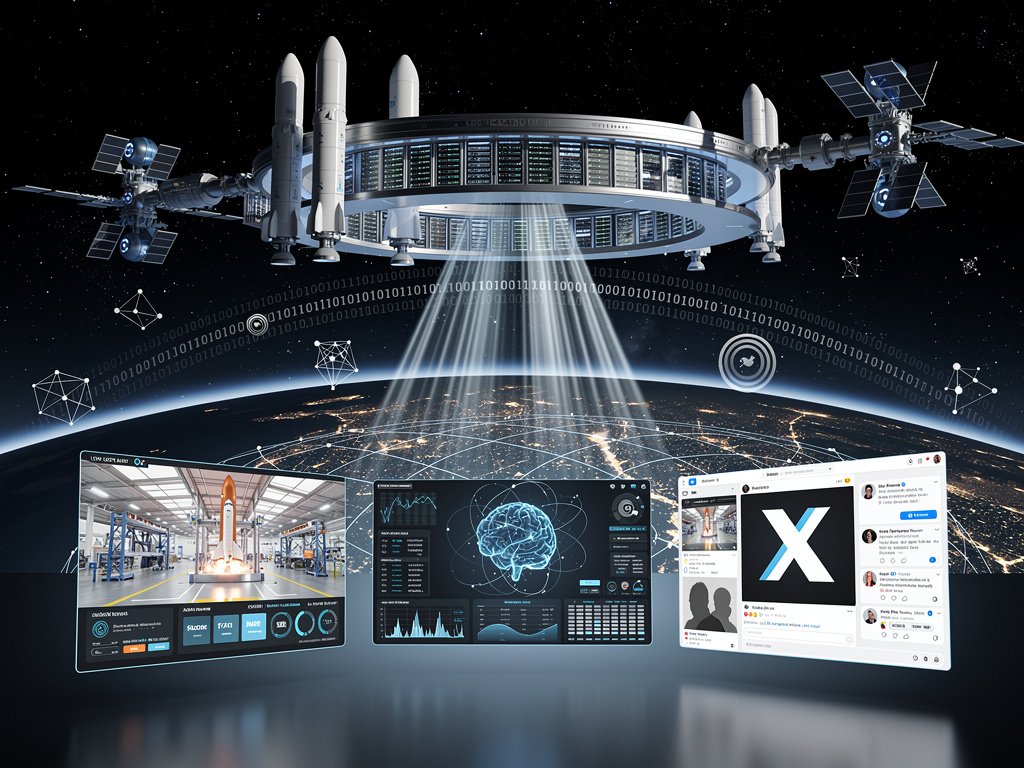
SpaceX announced the merger in a statement describing the union as “the most ambitious, vertically-integrated innovation engine on (and off) Earth.” The deal brings xAI under SpaceX’s umbrella, consolidating efforts in rockets, space-based internet, AI, and real-time communication technologies.
Elon Musk framed the merger as part of a broader vision to develop a “sentient sun to understand the Universe and extend the light of consciousness to the stars,” highlighting the company’s focus on long-term space-based intelligence. Bloomberg first reported the merger earlier on Monday.
Musk also emphasized the limitations of terrestrial AI, noting that data centers on Earth require massive energy and cooling, making space-based AI a logical path for scaling advanced systems. “Global electricity demand for AI simply cannot be met with terrestrial solutions,” Musk said.
Why This Matters
The merger could reshape the AI and space technology sectors simultaneously. By moving AI infrastructure into space, SpaceX may overcome terrestrial constraints on power and cooling, enabling larger, faster, and potentially more capable AI systems.
Daljoog News analysis indicates this could also redefine the business model for SpaceX’s upcoming IPO, originally expected to value the company at $1.5 trillion with the potential to raise $50 billion. xAI’s integration may increase the valuation or shift investor expectations toward combined AI-space capabilities.
Additionally, collaboration between engineers from Tesla, SpaceX, and xAI—including a recent $2 billion Tesla investment in xAI—suggests a multi-pronged approach that leverages talent and technology across Musk’s ventures.
What Analysts or Officials Are Saying
Musk highlighted that space-based AI would be necessary to scale intelligence in ways Earth-bound data centers cannot. Experts note that combining AI with satellite networks could allow for faster, global-scale computing with lower latency than traditional systems.
Industry analysts suggest Tesla’s involvement could bridge automotive AI and SpaceX’s orbital networks, creating synergies in data collection, neural networks, and AI processing. The Wall Street consensus is that Musk’s vision is bold but fraught with technical and regulatory challenges.
The merger also demonstrates Musk’s preference for vertical integration, bringing hardware, software, and data streams into a single ecosystem. This approach mirrors SpaceX’s launch operations and Tesla’s manufacturing model, where in-house control maximizes efficiency and innovation.
Daljoog News Analysis
Daljoog News interprets the merger as Musk laying the foundation for a new class of AI—one unconstrained by terrestrial limitations. Space-based AI could eventually serve multiple sectors, including Earth observation, telecommunications, autonomous systems, and even interplanetary exploration.
This move reinforces Musk’s pattern of combining visionary rhetoric with tangible corporate consolidation. While skeptics question the feasibility of orbital AI centers, the merger positions SpaceX-xAI as a unique contender in both the space and AI arenas, potentially leapfrogging competitors who rely solely on terrestrial data centers.
What Happens Next
SpaceX’s IPO plans remain in focus, though valuation and timing may be reassessed to account for xAI’s technologies. Investors will watch for regulatory approvals, technical milestones, and integration strategies between SpaceX and xAI.
In parallel, Musk’s teams at SpaceX, Tesla, and xAI are likely to accelerate collaboration on satellite networks, AI training in orbit, and infrastructure capable of supporting advanced space-based computing. The next few months could determine whether Musk’s vision of a space-based intelligence hub becomes a practical reality—or remains an ambitious concept.