
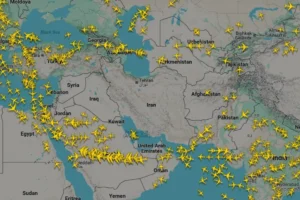

Major airports across the Middle East, including Dubai, Doha, and Abu Dhabi, were forced to shut on Saturday after U.S. and Israeli airstrikes on Iran triggered retaliatory missile and drone attacks by Tehran. The closures caused one of the most severe disruptions to global aviation in years.
According to Daljoog News analysis, the impact of these shutdowns extends far beyond the Gulf, as Dubai and Doha serve as key hubs connecting Europe and Asia. Millions of passengers and thousands of flights worldwide are now facing delays, cancellations, and rerouting.
The military escalation, which included strikes targeting Iran’s strategic sites and the killing of Supreme Leader Ayatollah Ali Khamenei, has created unprecedented uncertainty in regional airspace. Airlines and governments are scrambling to adapt to rapidly changing security conditions.
What Happened?
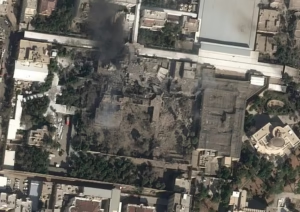
Dubai International Airport, which handles more than 1,000 daily flights, sustained damage during overnight Iranian missile attacks targeting sites across Gulf countries. Abu Dhabi and Kuwait’s international airports were also affected, prompting authorities to close airspace for safety reasons.
European and Middle Eastern airlines responded quickly, canceling flights to and from affected countries. Preliminary data from Cirium showed that roughly 50% of flights to Qatar and Israel, and 28% to Kuwait, were canceled on Saturday, with an overall 24% of Middle East-bound flights disrupted.
Passengers reported being stranded across Europe and the Middle East. At Charles de Gaulle Airport in Paris, travelers bound for Thailand via Doha had flights canceled, while students on a college trip to Dubai found themselves stuck without clear plans to return home.
Why This Matters
The Gulf region functions as a major east-west air corridor. Dubai and Doha alone funnel millions of connecting passengers each year. Any prolonged disruption in these hubs affects not only travelers but also cargo logistics, fuel planning, and airline schedules worldwide.
The closure of airspace adds operational risk. Airlines must reroute flights around conflict zones over Iraq, Iran, Kuwait, and Israel, lengthening travel times, increasing fuel costs, and raising the danger of accidental missile or drone incidents.
Aviation analysts warn that the ripple effects will be felt for days, potentially weeks, as airlines attempt to reschedule flights and restore service to disrupted routes.
What Analysts or Officials Are Saying
UK aviation analyst John Strickland described the scale of the disruption as “enormous,” noting that hundreds of thousands of passengers are stranded without certainty about travel. He added that major Gulf carriers like Emirates and Qatar Airways are not just passenger operators but also key global cargo airlines, amplifying the impact of any shutdown.
Eric Schouten, head of aviation security advisory Dyami, said airspace could remain closed “for quite some time,” underscoring the difficulty in resuming normal operations amid ongoing military strikes.
The European Union’s aviation regulator, EASA, recommended that airlines avoid airspace affected by the military intervention, further limiting options for rerouting flights.
Daljoog News Analysis
The disruptions highlight how regional conflicts can immediately affect global transportation networks. Middle Eastern airports act as hubs for international trade, tourism, and travel between Europe and Asia, so closures have cascading effects across the aviation ecosystem.
The combination of missile threats, damaged infrastructure, and precautionary airspace closures creates unprecedented operational strain for airlines. Even if airspace reopens quickly, backlog and logistical complications will likely persist.
Passengers face uncertainty not only over travel dates but also over safety. Hotels near major hubs are seeing surges in demand as stranded travelers seek accommodations, while airlines race to coordinate crew and aircraft for rerouted flights.
For cargo logistics, delays may affect global supply chains. Emirates and Qatar Airways, both major freight operators, transport critical goods that now face extended delivery times due to airspace restrictions.
What Happens Next
Airports in Dubai, Abu Dhabi, Doha, and Kuwait will remain closed until authorities can confirm the skies are safe. Airlines are closely monitoring developments and adjusting flight schedules dynamically.
Passengers are advised to check with carriers before traveling, while governments and aviation regulators continue to coordinate on safety, rerouting, and potential extended cancellations.
The Gulf’s airspace may remain highly sensitive in the coming days if Iran and allied forces continue missile or drone operations. Airlines worldwide must remain flexible, and travelers should prepare for ongoing disruptions.