

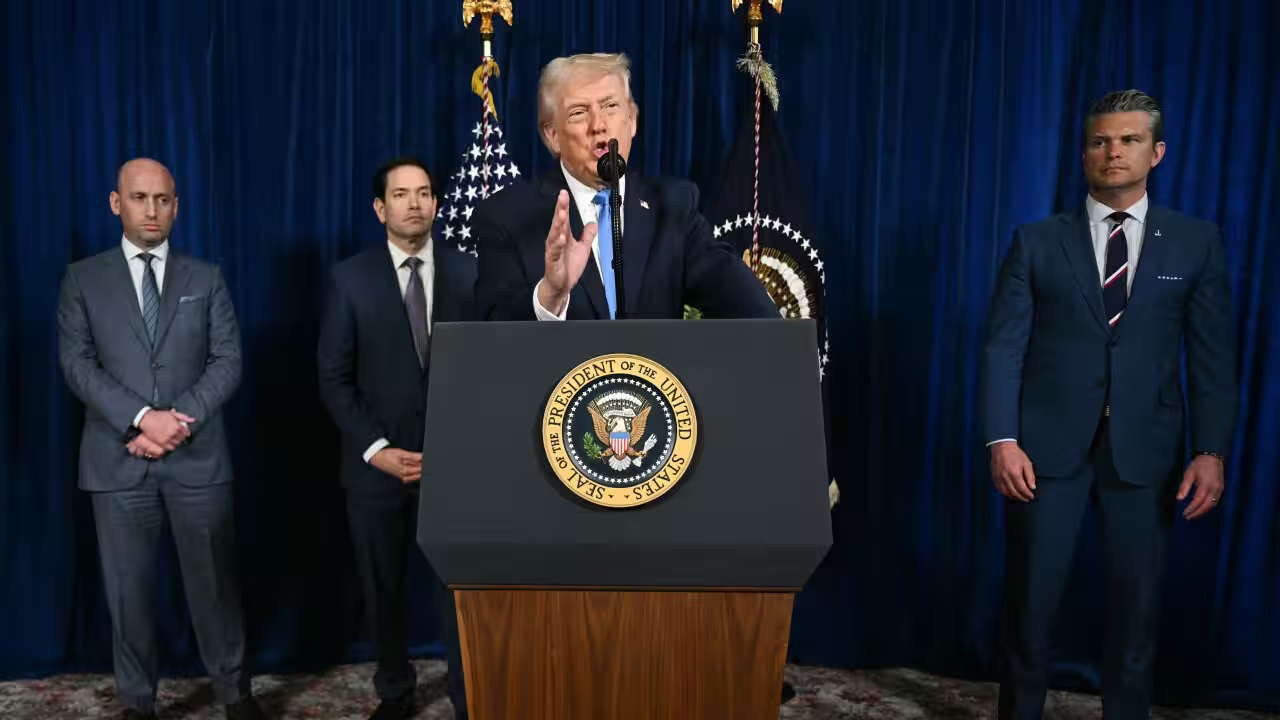
U.S. President Donald Trump has declared that the United States will oversee Venezuela until a safe transfer of power is ensured. Trump claimed that detained Venezuelan President Nicolás Maduro and his wife would be sent to New York.
The announcement came amid escalating tensions in Venezuela, where Caracas and other regions reportedly faced explosions and attacks over the weekend. Trump’s statement confirmed U.S. involvement in controlling the country’s administration temporarily.
The U.S. attacks reportedly targeted both military and civilian installations, raising alarms across the nation. In response, Venezuela declared a state of emergency. Defense Minister Vladimir Padrino vowed to resist foreign forces, emphasizing that Venezuela would not surrender its sovereignty. “Our nation has become the target of the most criminal military aggression by the U.S. government,” Padrino said. “We will defend our sacred land from any foreign invasion.”
Opposition leaders in Venezuela reacted to Trump’s announcement. Maria Carana Machado, a leading opposition figure, urged Edmundo Gonzalez to assume the role of interim president to stabilize the country. The political situation remains volatile, with competing claims over authority amid the U.S. intervention.
Several nations have condemned the U.S. operation. Russia, Iran, and Cuba joined other countries in criticizing what they called a violation of international law. Global leaders expressed concern over the escalating military actions and their potential impact on civilian lives.
The attacks reportedly involved multiple explosions in the capital city of Caracas, and other Venezuelan states were also affected. Authorities say both military and civilian targets were struck, though details remain limited. The U.S. claimed the operations were necessary to secure Maduro and his wife while establishing temporary governance.
Trump emphasized that the U.S. would control Venezuela only until power could be safely transferred. The president’s statements have sparked outrage in Caracas, where the government rejected any notion of yielding authority to foreign forces. Officials in Venezuela maintain that Maduro remains the legitimate president, and they vowed to resist any external interference.
The unfolding crisis highlights growing tensions in U.S.-Venezuela relations. Analysts warn that the military intervention could escalate into a broader conflict if diplomatic efforts fail. Meanwhile, the international community continues to monitor developments closely.
Humanitarian concerns are also rising. Civilians are reportedly caught in the crossfire of explosions and attacks. The state of emergency allows Venezuelan authorities to mobilize resources for security and public safety. Padrino assured citizens that the military would protect national sovereignty and civilian life.
Opposition leader Machado has appealed for unity among Venezuelans to prevent further chaos. She called on Edmundo Gonzalez to lead the country temporarily, aiming to restore order amid the political vacuum caused by the U.S. action. The opposition stresses a peaceful transition of power and avoidance of civilian casualties.
While Trump’s administration insists the operations target Maduro and his immediate circle, global criticism underscores concerns about legality and sovereignty. Countries, including Russia and Cuba, labeled the action as an unlawful intervention. International organizations are reportedly evaluating the situation for potential diplomatic and legal responses.
The situation remains tense, with uncertainty over how long U.S. forces may remain in control and what measures will follow. Observers say the crisis could have lasting effects on regional stability and international relations. Venezuelans are left navigating an environment of military action, political division, and humanitarian concern.
As events unfold, both U.S. and Venezuelan authorities continue to exchange statements, highlighting conflicting narratives over the legitimacy of the intervention. The world watches closely as Caracas confronts what officials describe as an unprecedented military threat, while the U.S. maintains it is acting to ensure a secure transfer of power.