


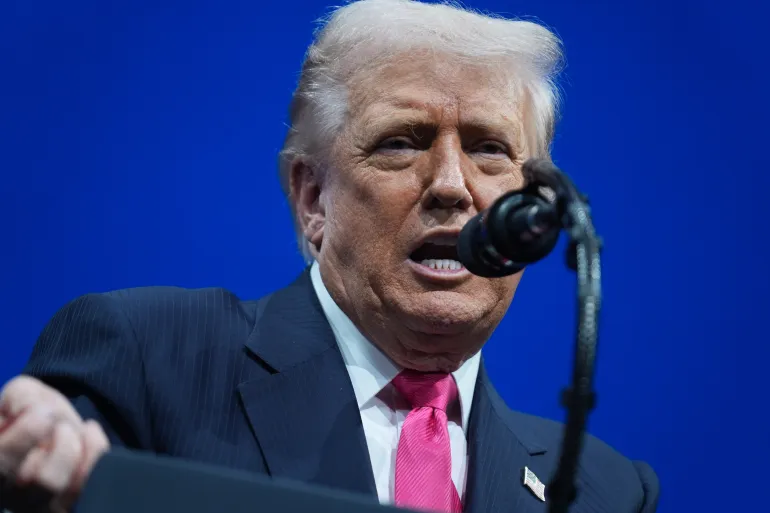
United States President Donald Trump announced a permanent halt on immigration from “all Third World Countries” late Thursday, marking a major escalation in his immigration policies. The move follows a deadly attack in Washington, D.C., where two National Guard members were shot, one fatally, by an Afghan national.
Trump posted on Truth Social that migration from Third World countries will be paused to allow the U.S. immigration system to “fully recover” and end what he described as “millions of Biden illegal admissions.” He did not define which countries are considered Third World, but the term generally refers to economically developing nations.
The president added that any immigrant deemed “not a net asset to the United States, or incapable of loving our Country” would face removal. Federal benefits and subsidies for noncitizens will end, and he plans to denaturalize migrants who “undermine domestic tranquillity” while deporting those seen as security risks or incompatible with Western values.
Earlier in 2025, Trump introduced visa bans for citizens of 12 countries and restrictions for seven more. The latest announcement intensifies these measures, aiming to re-examine all green cards for immigrants from countries on the previous travel ban list.
US Citizenship and Immigration Services (USCIS) confirmed an immediate suspension of immigration requests involving Afghan nationals. USCIS Director Joseph Edlow added that, under the president’s orders, a rigorous review of green cards from all countries of concern is underway. He said protecting the country and American citizens remains a top priority.
The list of affected countries includes those previously targeted under Trump’s June travel ban. Full bans apply to Afghanistan, Chad, the Democratic Republic of the Congo, Equatorial Guinea, Eritrea, Haiti, Iran, Libya, Myanmar, Somalia, Sudan, and Yemen. Partial restrictions cover Burundi, Cuba, Laos, Sierra Leone, Togo, Turkmenistan, and Venezuela.
Experts say the term “permanent pause” has no legal definition under U.S. law, meaning the restriction could last indefinitely but is not irreversible. The U.S. Immigration and Nationality Act allows the president to suspend immigrant entry temporarily or indefinitely, though such actions can be challenged in court.
Observers note that the administration’s vague language may intimidate migrant communities and serve as a political signal rather than a fully enforceable law. The measures are expected to disproportionately impact poorer countries, while wealthier or strategically important nations may be spared.
For immigrants already in the U.S., the effects remain uncertain. Pending applications could face delays, longer security screenings, and added scrutiny. Family reunification programs may also be interrupted, as spouses, children, and parents living abroad could be barred from entry until the pause is lifted.
The administration is also reviewing existing green cards. While U.S. immigration law allows revocation in cases of serious criminal activity or security risks, due process must be followed. Experts emphasize that arbitrary cancellation without legal procedure is not permitted.
Trump’s broader immigration agenda this year has included freezing refugee admissions, lowering the annual refugee cap to 7,500, and reviewing the status of over 230,000 refugees admitted under the previous administration. The administration has also raised fees for skilled worker visas and cut foreign aid for refugees in host countries.
Humanitarian observers warn that these policies could worsen global refugee crises. Critics argue that such measures dehumanize migrants and refugees, portraying them as threats rather than people seeking safety and opportunity. They caution that similar restrictive approaches in Europe have failed and often face legal challenges.
The permanent pause on immigration from Third World countries represents a significant shift in U.S. policy. Its practical implementation, the impact on current residents, and potential legal challenges will shape the nation’s immigration landscape in the months ahead.