


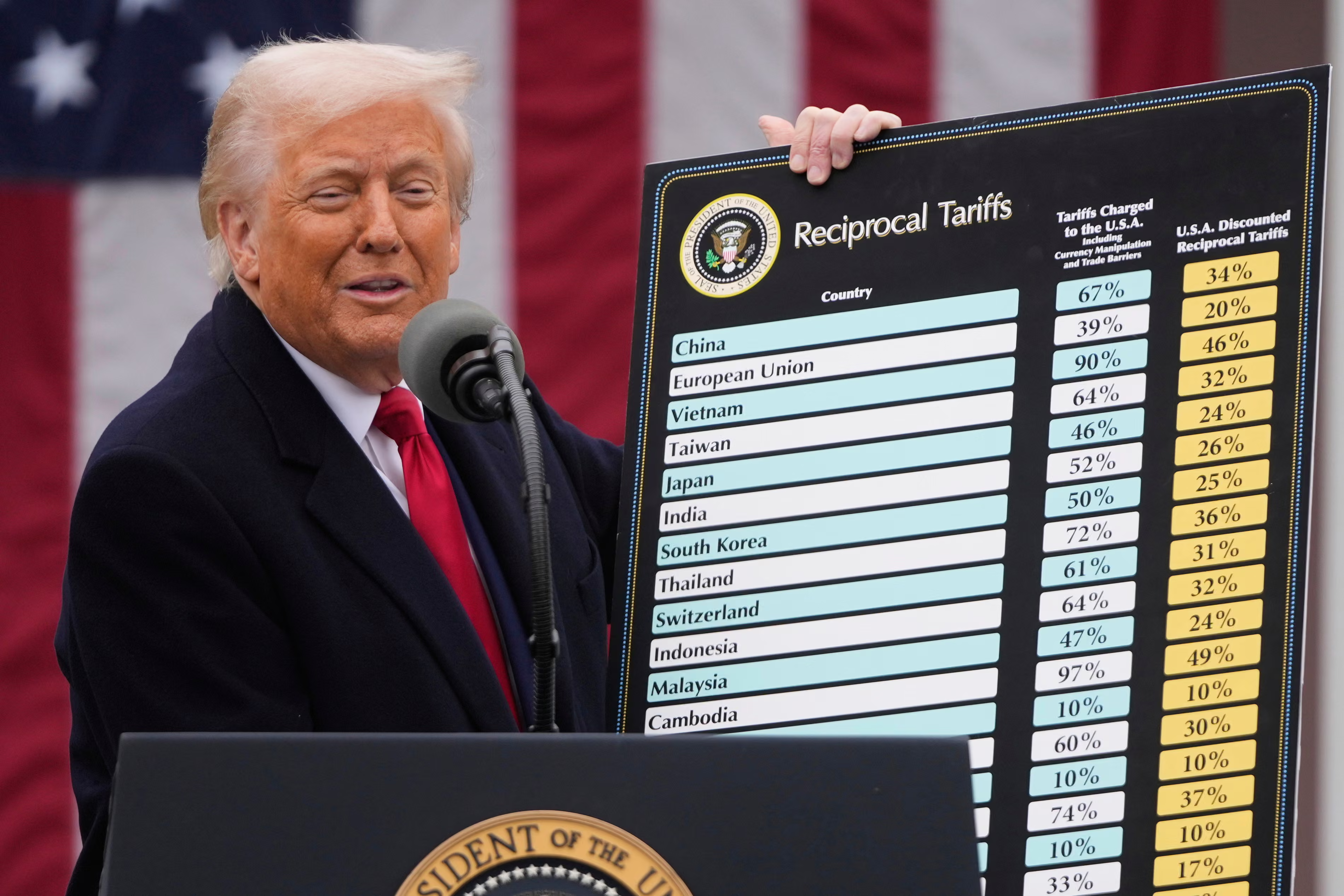
The US Supreme Court began hearing arguments over President Donald Trump’s sweeping tariffs, a legal challenge that could shape the limits of presidential power. The case focuses on whether Trump can impose tariffs on almost every US trading partner using emergency powers.
Trump cited the International Emergency Economic Powers Act (IEEPA), a 1977 law, in executive orders issued this year. IEEPA allows the president to regulate international transactions during a national emergency. However, critics argue that the law does not authorize tariffs, a power constitutionally reserved for Congress.
Lower courts have ruled against Trump’s tariffs, prompting appeals and setting up a crucial test for his administration. The Supreme Court, which has a right-wing supermajority appointed in part during Trump’s presidency, will rule by the end of its term in July 2026.
If the court rejects Trump’s use of IEEPA, the administration would need to revise its strategy for enforcing tariffs, which have strained global trade ties. If the court sides with Trump, it would strengthen his authority and support his claims that tariffs can boost the US economy, generate government revenue, and revitalize industry.
Trump has emphasized the importance of the case, calling it “one of the most important in the History of the Country” and claiming that a ruling against him could leave the US “defenseless.” He suggested that winning would make the country “the Richest, Most Secure anywhere in the World, BY FAR,” while losing could reduce it to “almost Third World status.”
Some senior administration officials have indicated that alternate authorities exist to continue imposing tariffs if the court rules against the current approach. Treasury Secretary Scott Bessent, attending the hearings, said the administration has “lots of other authorities” to maintain trade restrictions.
The tariffs have already affected US households significantly. According to the non-partisan Tax Foundation, the measures will increase the average US household’s taxes by $1,200 in 2025 and $1,600 in 2026. A coalition of 12 states — including New York, California, and Illinois — along with small businesses, filed lawsuits challenging the tariffs. Other cases, such as Learning Resources, Inc v Trump and Trump v VOS Selections, were consolidated for Supreme Court review.
Opponents argue that no single individual should have the power to impose taxes with global economic consequences. Jeffrey Schwab, senior counsel at the Liberty Justice Center, said the Constitution grants Congress the authority to set tax rates, including tariffs. The US Chamber of Commerce has also filed briefs urging Congress to reclaim its role, citing the burden on families, small businesses, and manufacturers from higher costs.
Recently, the US Senate voted 51 to 47 to nullify Trump’s reciprocal tariffs, with bipartisan support from four Republicans. However, the House of Representatives is unlikely to follow suit due to procedural rules that block resolutions challenging the tariffs from reaching the floor.
As the Supreme Court examines the case, the ruling will determine whether the president can continue to use emergency powers to shape trade policy, setting an important precedent for the balance of power between Congress and the executive branch.