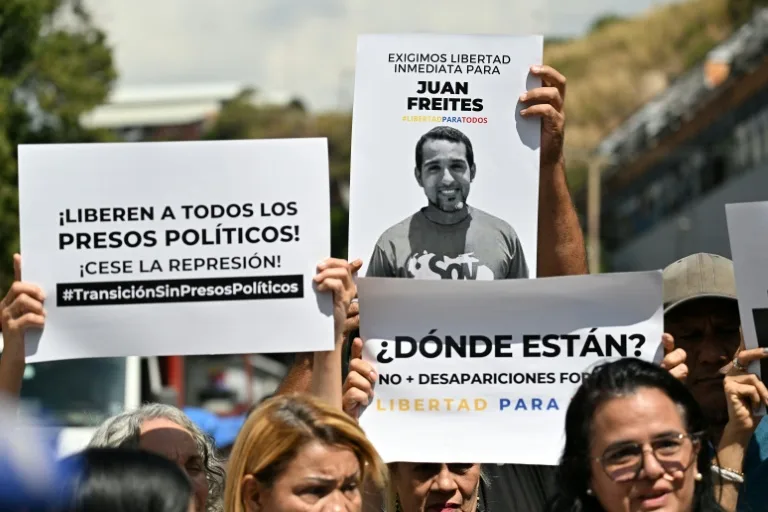
Venezuela’s interim government says it has released more than 600 prisoners, but rights groups and families of those still detained say the pace of freedom has been slow and far from enough. Interim President Delcy Rodríguez announced the number this week, but her claim has sparked fresh frustration among relatives demanding the release of all political prisoners.
Rodríguez said on Friday that 626 people have been freed since December as part of an ongoing effort to release detainees held under the previous government. She also said she plans to ask the United Nations High Commissioner for Human Rights to verify the released list to add transparency to the process.
The announcement came after the United States backed Rodríguez as interim leader following a January 3 operation that ousted socialist leader Nicolás Maduro. Washington welcomed the release figures, but there has been a mismatch between official claims and independent counts, raising questions about how many political prisoners have actually walked free.
Human rights organization Foro Penal, which tracks political prisoners in Venezuela, has confirmed the release of only 154 political prisoners since January 8. The group says that hundreds of others remain behind bars, and it disputes the government’s higher figures.
Rights groups estimate that more than 700 people are still detained for political reasons. Many of those held are critics of the Maduro government, civil society activists, journalists, and opposition figures.
The discrepancy has fueled anger and anxiety among families waiting for loved ones to be freed. Outside El Helicoide, an intelligence service facility in central Caracas that many human rights groups say is used as a torture center, relatives have gathered frequently as they await news of more releases.
Adriana Abreu, whose husband Guillermo Lopez was detained two years ago for his opposition activity, expressed deep frustration. She said her husband has missed key moments in their family’s life, including time with their young son, as she continues to hope for his release.
The government’s release of detainees has unfolded slowly, with small numbers being freed over weeks rather than large groups walking out at once. This approach has disappointed many families who had expected faster action after the change in leadership.
“The releases have taken place in dribs and drabs,” a description used in reports covering the situation, capturing the frustration felt by those who hoped for a clearer and quicker path to freedom.
Rodríguez’s supporters argue that releasing prisoners is a sign of progress and political openness, even if the process is gradual. They also point to diplomatic steps, including cooperation with the United States and potential oil sector reforms, as part of broader change efforts.
However, many families and activists say that slow releases are insufficient and do not match the scale of political imprisonment in the country. They continue to call for all political prisoners to be freed without delay.
The ongoing debate highlights deep divisions in Venezuela’s political landscape and sharp differences over how to address issues tied to political detention, justice, and national reconciliation.
As international attention remains on Venezuela’s transition and human rights situation, families of the detained say they will continue to press for the freedom of all prisoners.