


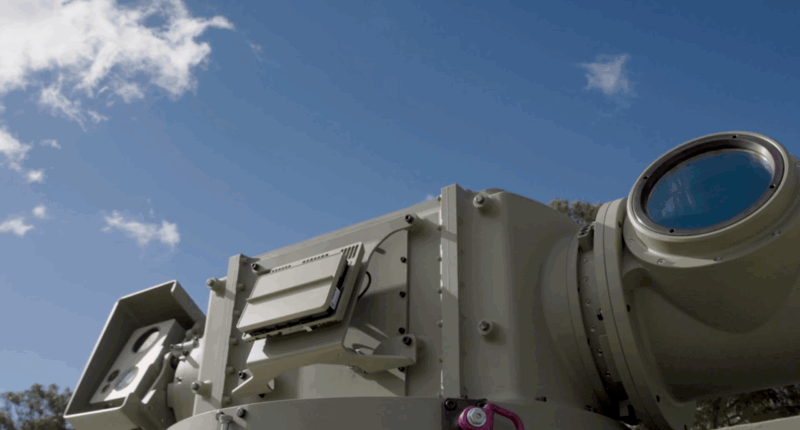
Australia has drawn global attention with a new laser weapon called Apollo. The system can destroy between 20 and 30 drones every minute. Experts say it may change how countries defend against drone attacks. The weapon works silently and does not use missiles or rockets. Its low cost and high speed make it a strong alternative to traditional air defense systems.
The Australia laser weapon Apollo is designed to target small and medium-sized drones. It uses a powerful laser beam instead of explosives. The laser heats the drone’s internal structure until it melts. The drone then loses control and crashes to the ground. The entire process happens within seconds and without loud noise or visible explosions.
One of the biggest advantages of Apollo is its cost. Each laser shot costs between one and ten euros. This is far cheaper than missiles, which can cost thousands or even millions per launch. Military analysts say this makes the system ideal for defending against large drone swarms, where using missiles would be too expensive and slow.
The weapon was developed by an Australian defense technology company. The company says Apollo is more effective than guns or rockets when facing drone attacks. Traditional systems struggle when many drones arrive at once. Apollo can engage targets continuously as long as power is available. This allows forces to respond quickly to fast-moving threats.
Interest in the Australia laser weapon Apollo has grown quickly. Many countries are now looking for alternatives to missile-based systems. Rising global tensions and supply concerns have pushed governments to explore new defense options. Some European nations are especially interested in systems that do not depend on foreign missile supplies.
Officials say Apollo does not use parts from the United States. This makes it attractive to countries that want greater independence in defense procurement. Analysts note that recent geopolitical shifts have made weapon supply chains more sensitive. As a result, demand for non-missile defense systems has increased across Europe, Asia, and the Middle East.
The Netherlands has already purchased a 100-kilowatt version of the Apollo system. The weapon is now part of its air defense planning. Germany is also moving forward, with a factory under development to support production and future deployment. Talks are ongoing with about ten other European countries regarding possible orders.
Experts say drone warfare is changing modern battlefields. Drones are cheap, easy to launch, and hard to stop in large numbers. Missile systems were not designed to handle dozens of small drones at once. Laser weapons like Apollo offer a solution by combining speed, accuracy, and low operating cost.
Laser systems also reduce risks to civilians. There are no falling missile fragments or large explosions. This makes them useful for protecting cities, bases, and critical infrastructure. The silent nature of the weapon also reduces panic during attacks.
Despite its advantages, experts caution that laser weapons depend on stable power sources and clear weather. Heavy rain, fog, or dust can reduce effectiveness. Still, many believe the benefits outweigh the limits, especially for close-range defense.
Military analysts say laser weapons will not replace missiles entirely. Instead, they will work alongside them. Missiles may still be used for large or distant targets. Lasers like Apollo are expected to handle drones and short-range threats.
As drone technology spreads, demand for fast and affordable defense systems continues to rise. The Australia laser weapon Apollo is now seen as a major step in that direction. Its success could shape the future of air defense and reduce reliance on costly missile systems.