
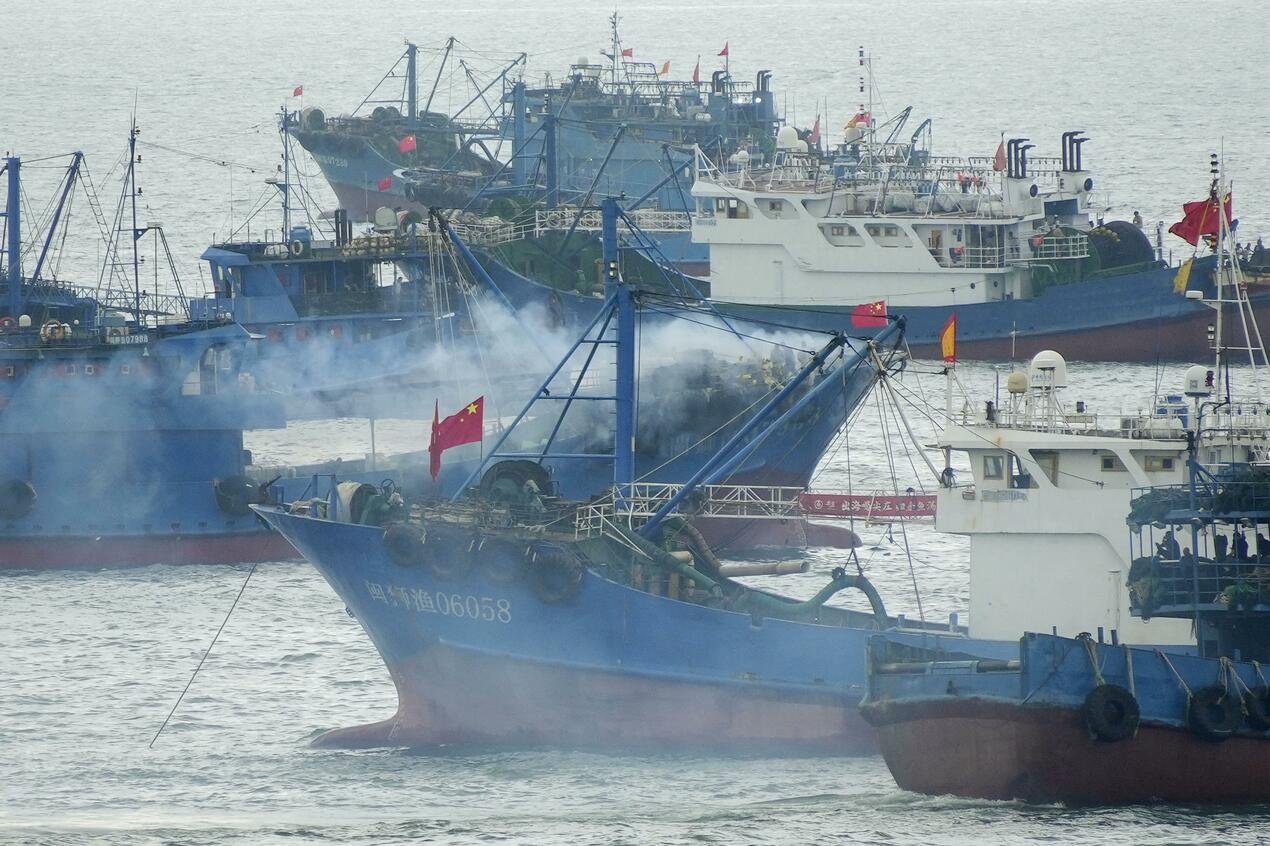
Satellite images have revealed an unusual gathering of nearly 2,000 Chinese vessels in waters close to Taiwan, raising concerns among defense analysts and regional observers. The boats appear to be clustered in large formations across a wide stretch of ocean, yet show no clear signs of normal fishing activity.
According to Daljoog News analysis, the unusual maritime formation likely reflects a coordinated pressure tactic rather than routine economic activity. Experts believe the vessels may belong to China’s expanding maritime militia network, a loosely organized fleet that can support strategic objectives without direct military confrontation.
The images come at a sensitive moment in East Asia, where tensions over Taiwan’s security and regional influence continue to shape geopolitical calculations. The unusual deployment highlights how maritime activity is increasingly being used as a tool of strategic signaling in contested waters.
What Happened?
Recent satellite imagery has captured an extraordinary maritime scene unfolding near Taiwan. Thousands of vessels—estimated at roughly 2,000—were seen clustered in an “L-shaped” formation across waters not far from the island.
The boats were spread across an area estimated to cover roughly 400 kilometers, yet remained unusually close to each other. Observers noted that the vessels were not actively fishing, which immediately raised questions about their true purpose.
Jason Wang, chief executive of a satellite imaging company known as Ingenia Space, indicated that such a dense grouping of fishing boats is highly unusual. Fishing vessels typically operate at greater distances from one another to maximize catch opportunities and avoid overlapping nets.
Security analysts examining the images also noted the organized structure of the formation. The arrangement suggests coordination rather than coincidence, strengthening speculation that the vessels were positioned for strategic signaling rather than commercial fishing.
Australian maritime specialist Jennifer Parker also highlighted the anomaly, explaining that fishing fleets rarely gather in such tight formations. In normal operations, boats scatter widely to cover larger fishing grounds.
These observations have fueled growing concern that the vessels are linked to China’s maritime militia system.
Why This Matters
The presence of thousands of Chinese vessels near Taiwan carries broader strategic implications for the region.
China has long used maritime forces—including fishing fleets, coast guard ships, and naval vessels—to assert influence across contested waters. In recent years, analysts have increasingly focused on the role of civilian-looking vessels that operate under government coordination.
These vessels can serve several functions simultaneously.
They can monitor foreign naval movements, gather intelligence, transport supplies, and create logistical support for larger military operations. In some cases, they also act as a physical presence designed to overwhelm or intimidate rival maritime forces.
The tactic falls within what security experts describe as “gray zone” operations.
Rather than engaging in direct conflict, gray zone strategies rely on pressure, ambiguity, and persistent presence to shift the strategic balance without triggering full-scale war.
For Taiwan, such deployments add another layer of complexity to an already sensitive security environment. The island’s government closely monitors Chinese activity in surrounding waters, as Beijing considers Taiwan part of its territory.
The United States and several regional allies have also warned that maritime pressure campaigns could gradually reshape control of the region’s sea lanes.
What Analysts or Officials Are Saying
International security experts say the deployment appears consistent with China’s broader maritime strategy in East Asia.
According to analysts who study Chinese naval modernization, the country has the world’s largest navy but still faces logistical challenges in large-scale amphibious operations. Specialized landing ships are limited compared to the scale of a potential military campaign across the Taiwan Strait.
To compensate, Beijing has increasingly integrated civilian vessels into its strategic planning.
Cargo ships, ferries, and fishing boats can potentially serve as transport platforms in a crisis scenario. These vessels can move personnel, equipment, or supplies while blending into normal maritime traffic.
Defense specialists say such ships may also support surveillance missions, track foreign vessels, and relay information to Chinese naval forces.
In many cases, the ships appear to operate under instructions from government or military authorities while retaining the outward appearance of civilian fishing fleets.
This dual-use structure complicates international responses, as confronting civilian-looking vessels risks escalation and legal complications.
Several analysts argue that the large formation near Taiwan represents a visible demonstration of this maritime militia model.
Daljoog News Analysis
The unusual concentration of vessels near Taiwan reflects a broader shift in how power is projected at sea.
Traditional naval deployments rely on warships, aircraft carriers, and submarines. China’s approach increasingly mixes military strength with civilian fleets, creating layers of pressure that are difficult to counter.
This strategy provides Beijing with several advantages.
First, it allows China to expand its maritime footprint without immediately escalating tensions to open conflict. Second, it blurs the line between civilian activity and state-directed operations, complicating legal and diplomatic responses from other countries.
However, the tactic also increases the risk of miscalculation.
Large numbers of vessels operating in contested waters raise the chances of accidents, confrontations, or unintended escalation between rival forces.
If regional actors interpret these movements as preparation for a larger operation, the result could be a rapid increase in military readiness across East Asia.
From a strategic perspective, the satellite images highlight how maritime competition is evolving beyond traditional naval power. Influence in contested waters is now shaped not only by warships but also by coordinated civilian fleets.
For policymakers in Taipei, Washington, and allied capitals, the challenge will be determining how to respond to gray zone pressure without escalating tensions unnecessarily.
What Happens Next
Beijing has not officially commented on the purpose of the vessels seen in the satellite images.
In the absence of a formal explanation, analysts expect regional governments to intensify monitoring of maritime activity around Taiwan. Satellite surveillance, coast guard patrols, and intelligence sharing between allies will likely increase in the coming weeks.
Taiwan’s defense authorities are also expected to review the movements carefully to determine whether the vessels remain in position or disperse.
If the formations persist or expand, the incident could become another focal point in the ongoing strategic rivalry between China and Western allies in the Indo-Pacific.
Observers will also watch for any parallel military exercises or naval deployments that could signal broader operational planning.