
The debate over a possible China–Taiwan conflict is intensifying across global strategic circles, as Beijing continues expanding its military capabilities while maintaining its long-standing claim over the self-governed island. Recent analyses suggest that the situation is less about immediate invasion plans and more about sustained pressure and long-term positioning.
According to Daljojo News analysis, the evolving dynamics in the Taiwan Strait reflect a calculated geopolitical strategy rather than a fixed timeline for conflict. The focus, experts argue, is on building the capacity to act decisively if political conditions become favorable.
The growing tension comes at a time when U.S.–China competition is already shaping global security, trade routes, and technology supply chains, making Taiwan one of the most sensitive flashpoints in international relations.
What Happened?
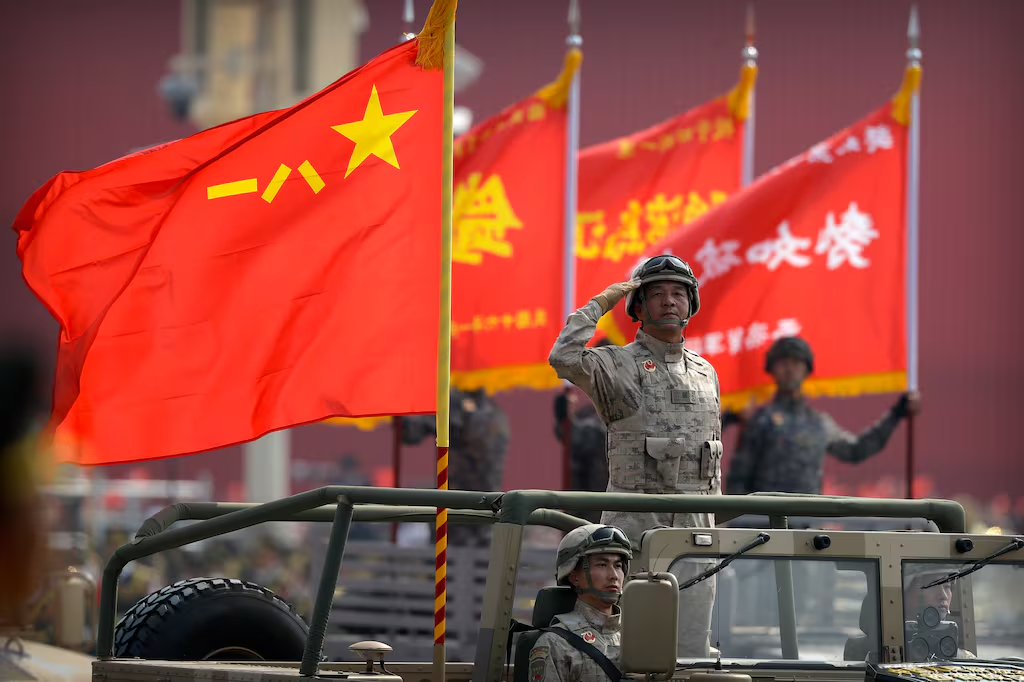
International attention has shifted once again toward the Taiwan Strait as China continues to expand and modernize its military forces, particularly its naval and air capabilities. Over the past decade, Beijing has significantly increased its readiness for operations involving island-based scenarios, according to multiple defense assessments.
China has never formally recognized Taiwan as a separate state, maintaining instead that it remains part of its sovereign territory since the end of the Chinese Civil War in 1949. This position remains central to Beijing’s national strategy and political identity, framing Taiwan as a core issue of territorial integrity.
U.S. intelligence assessments suggest that China is not preparing for an immediate invasion, but is steadily improving its ability to conduct such an operation if required. Analysts often refer to this period as a potential “capability window,” with some estimating heightened readiness could emerge around the late 2020s, though no fixed timeline exists.
Meanwhile, reports highlight that China is actively engaging in what experts describe as “gray zone” activities. These include frequent airspace incursions, cyber operations, and information campaigns aimed at increasing pressure without triggering full-scale conflict.
Why This Matters
The Taiwan Strait is one of the most strategically important regions in the world, not only because of military positioning but also due to its role in global trade and technology supply chains. Any disruption in the area would have immediate international consequences.
Taiwan is a critical hub for semiconductor manufacturing, producing a large share of the world’s advanced chips. A conflict in the region could severely disrupt global electronics production, affecting industries from smartphones to artificial intelligence systems.
At the same time, growing military cooperation between Taiwan and its partners, including the United States and Japan, is raising the potential cost of any escalation. Increased defense support and regional coordination are seen as key deterrents against direct military action.
However, this deterrence dynamic also contributes to long-term tension. As both sides strengthen their positions, the risk of miscalculation increases, particularly in a region where military activity is already frequent and closely monitored.
What Analysts or Officials Are Saying
Defense analysts describe China’s strategy as a combination of capability building and psychological pressure rather than immediate war planning. The emphasis, they argue, is on creating conditions where Taiwan becomes politically or economically vulnerable over time.
Some experts point to internal political divisions in Taiwan, including debates over defense spending and modernization priorities, as factors that Beijing may perceive as strategic opportunities. However, they also caution against overestimating internal instability as a trigger for conflict.
Western intelligence assessments generally agree that while China is not currently preparing for a near-term invasion, its long-term trajectory continues to reduce the gap between capability and operational readiness.
Officials in allied countries emphasize that deterrence remains the primary tool for maintaining stability. Strengthening defense cooperation and maintaining a credible response capability are seen as essential to preventing escalation.
Daljojo News Analysis
The Taiwan issue has entered a phase where uncertainty itself has become a strategic instrument. Neither side appears ready for direct conflict, yet both continue to invest heavily in preparations that assume the possibility of one.
China’s approach reflects a broader pattern of modern hybrid strategy, where military readiness is combined with cyber activity, economic influence, and sustained pressure tactics. This reduces the need for immediate confrontation while keeping strategic options open.
For Taiwan and its partners, the challenge lies in balancing deterrence with stability. Over-militarization could heighten tensions, while under-preparation could invite risk. This delicate balance defines the current status quo in the region.
What makes the situation particularly sensitive is the absence of a clear timeline. Without a defined trigger point, escalation risks emerge from misjudgment, accidental encounters, or rapid political shifts rather than planned decisions.
In this sense, the Taiwan Strait is not a conventional battlefield today, but a long-term pressure zone where strategic patience and miscalculation exist side by side.
What Happens Next
In the coming years, attention will remain focused on military developments, diplomatic engagement, and regional defense coordination. Any significant shift in China’s operational posture will be closely monitored by the United States and its allies.
Taiwan is expected to continue strengthening its defensive capabilities, particularly in asymmetric warfare systems such as drones, cyber defense, and mobile missile platforms. These investments aim to increase resilience against potential blockade or coercion scenarios.
Diplomatic efforts are likely to continue alongside military preparation, although trust between major actors remains limited. Communication channels will play a key role in preventing accidental escalation.